
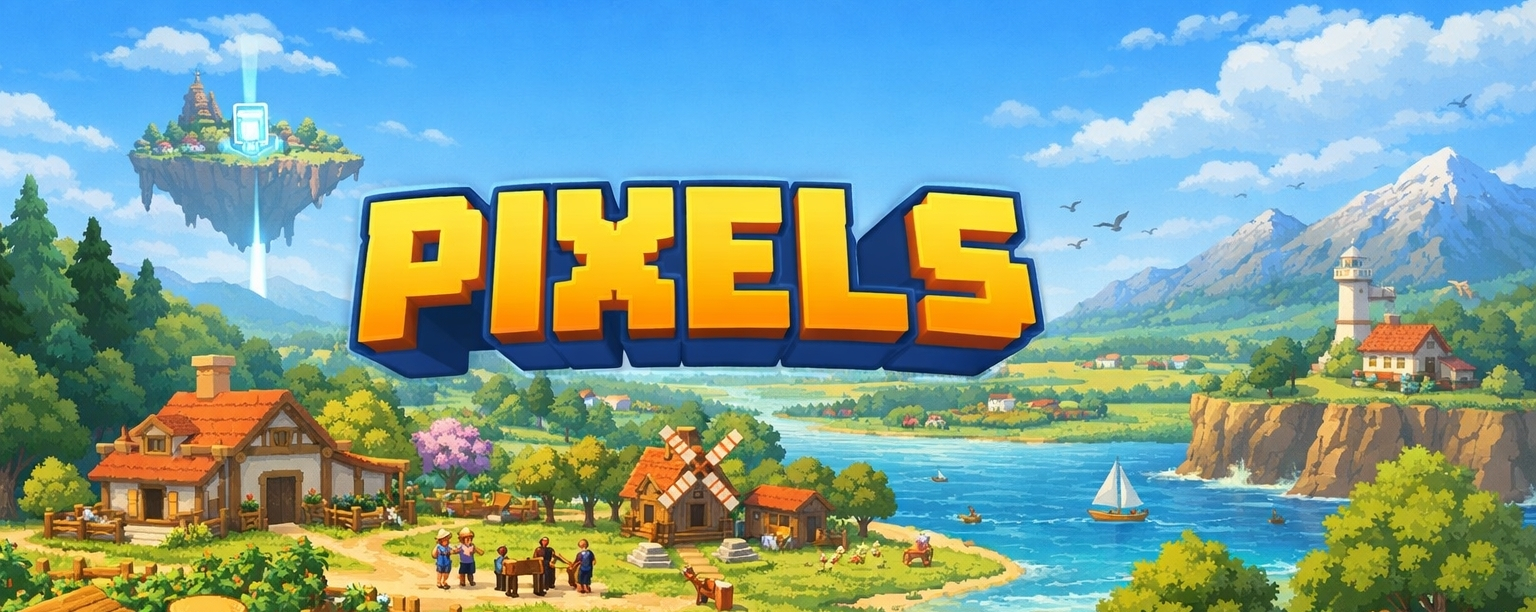
When I first came across Pixels, I noticed how naturally it presents itself compared to many other Web3 projects. It does not begin with complexity or technical pressure. Instead, it introduces a simple and familiar world where players can farm, explore, and interact at their own pace. I started thinking about how rare this approach is in a space that often prioritizes systems over experience.
Pixels is built on the Ronin Network, and it focuses on creating a social, open-world environment where players gradually discover deeper layers of ownership and participation. At the surface, it feels like a casual game. But if it becomes clear over time, that simplicity is carefully designed. They are trying to make the entry point as comfortable as possible, especially for users who may not fully understand blockchain.
I wondered why this matters so much. Many Web3 games rely heavily on token incentives to attract users. While that can work in the short term, it often leads to unstable ecosystems. Pixels seems to take a different path. It focuses on engagement first, assuming that if players genuinely enjoy the experience, they will stay longer and contribute more meaningfully. We are seeing a shift here toward a more grounded and realistic model of user behavior.
The gameplay itself revolves around farming, crafting, and exploration. Players begin with limited resources and slowly expand their capabilities through consistent interaction with the game world. I’m noticing that progression feels steady and intentional. There is no sense of urgency or forced optimization. Instead, the experience encourages routine and familiarity, which can be more sustainable over time.
They’re also integrating social interaction in a subtle but important way. Players can visit each other, trade resources, and share parts of the world. It becomes clear that Pixels is not just about individual progress but about shared presence. This creates a layer of connection that many blockchain-based games have struggled to achieve.
As I spent more time understanding the system, I started thinking about how ownership is introduced. In Pixels, assets such as land and items can exist on-chain, but the game does not immediately require users to engage with those mechanics. If it becomes necessary, players can explore that layer gradually. This approach reduces friction and allows users to learn by doing rather than being overwhelmed at the start.
The PIXEL token plays a role in supporting the ecosystem, but it does not dominate the experience. It is used for transactions, progression elements, and certain interactions within the game. However, We’re seeing a design where the token remains in the background rather than controlling the entire system. This balance is important because it helps prevent the game from becoming overly dependent on financial incentives.
I wondered whether this balance can hold over time. Token economies are difficult to manage, especially as user behavior changes. If it becomes too focused on extraction, the system could lose its stability. But if managed carefully, it may support a more sustainable cycle of participation and reward.
The choice of the Ronin Network also reflects a practical understanding of user needs. Transactions are faster and more affordable, which directly improves the gameplay experience. I’m seeing how this reduces friction and allows players to focus on the game rather than the underlying infrastructure. It becomes clear that technical decisions are closely tied to user retention.
When evaluating progress, I found it more useful to look beyond surface-level metrics. Token price or short-term attention does not always reflect real growth. Instead, factors such as active users, retention, and the depth of interaction provide a clearer picture. We are seeing steady engagement, which suggests that players are finding value in simply being part of the world.
At the same time, there are realistic challenges that cannot be ignored. I started thinking about how the project will maintain balance between different types of users. Some players may focus on enjoyment, while others may approach the game with a profit-driven mindset. If one side becomes too dominant, it could shift the overall experience.
There is also the challenge of long-term economic stability. Even with careful design, maintaining a healthy token ecosystem requires continuous adjustment. They’re operating in a space where external factors, including market conditions, can influence user behavior in unpredictable ways.
Competition is another factor. Many projects are exploring similar ideas, and differentiation will depend on consistent execution rather than early success. Pixels will need to continue refining its systems without losing the simplicity that defines it.
Looking ahead, I wondered how this world might evolve. It seems likely that Pixels will expand its social systems, deepen player interaction, and gradually move toward a more player-influenced environment. If it becomes a space where users actively shape the world, the value of participation could grow naturally rather than being externally driven.
We’re seeing early signs of this direction, but it remains a gradual process. The key will be maintaining alignment between short-term updates and long-term vision. Sudden shifts could disrupt the balance that currently exists.
In the end, Pixels feels less like a traditional Web3 product and more like an evolving environment. I’m finding that this distinction matters. It suggests a focus on continuity rather than rapid expansion. They are trying to understand how people engage over time, not just how to attract them initially.
It becomes clear that the project’s strength lies in its restraint. By avoiding unnecessary complexity and focusing on real user behavior, it creates space for organic growth. If it becomes successful in maintaining this balance, it may quietly establish itself as a meaningful example of sustainable Web3 gaming.
The future of Pixels does not appear to depend on sudden breakthroughs or dramatic shifts. Instead, it seems to rely on consistency, thoughtful design, and a clear understanding of its players. And in a rapidly changing space, that steady approach may prove to be its most valuable quality.