
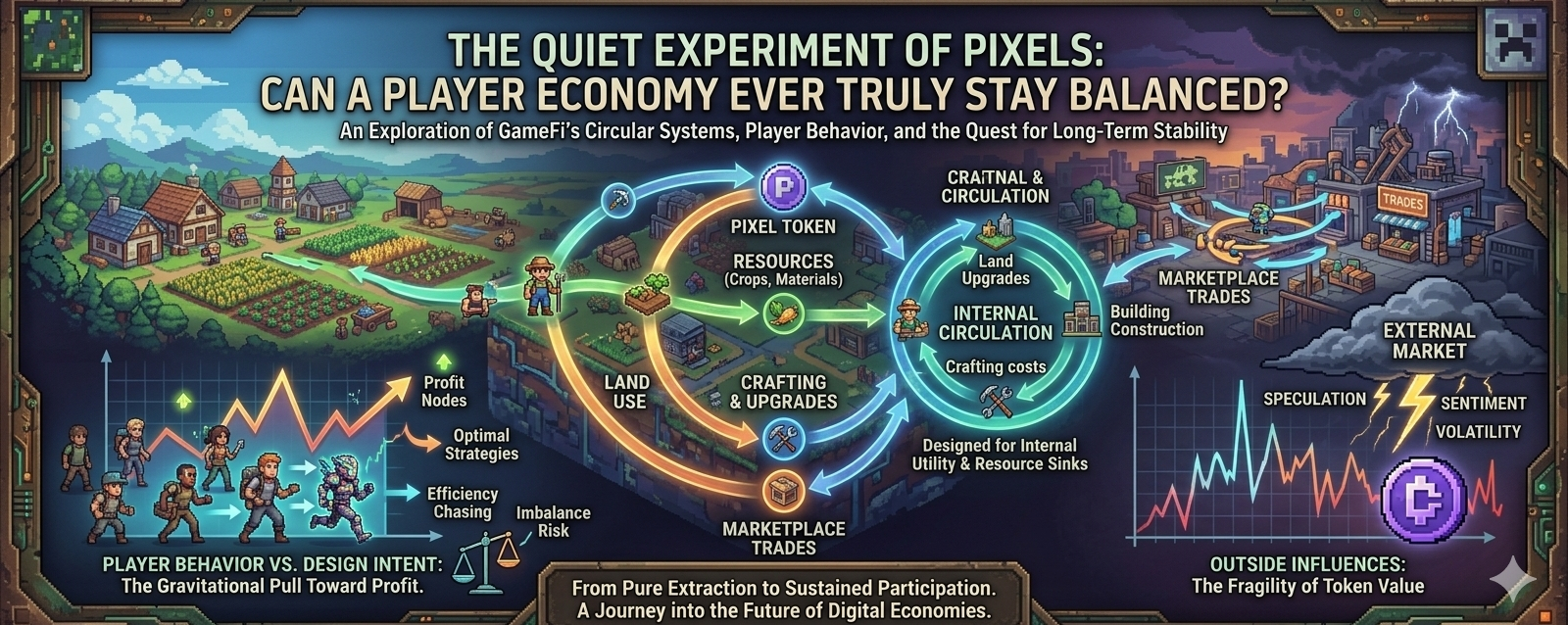
@Pixels I keep finding myself drifting back to the same question after spending time with Pixels, and it’s not a loud, obvious doubt—it’s more like a slow, persistent itch in the back of my mind. Is this actually something different, or just a more polished version of the same play-to-earn cycles we’ve already watched rise and fall? On the surface, it doesn’t try too hard to convince you otherwise. You farm, you grind, you earn—it looks familiar enough. But the longer I sit inside it, the more it feels like there’s a subtle shift happening under the hood, something that’s less about extracting value and more about circulating it. It’s not just about earning tokens; it’s about producing resources, using them, trading them, and feeding them back into the same system. That loop feels intentional, almost like the game is trying to sustain itself without constantly leaning on new players to keep things alive.
What really makes me pause is how the economy leans on internal activity instead of pure emissions. The presence of land usage, crafting systems, upgrades, and marketplace interactions doesn’t just add gameplay depth—it creates friction, demand, and reasons for value to move rather than just accumulate. It feels like the system is designed to recycle what players generate, constantly pulling it back in instead of letting it spill out unchecked. Compared to the usual GameFi structures where everything depends on fresh liquidity entering from the outside, this approach feels quieter, more measured, almost like it’s trying to outlast the typical boom-and-bust cycle. But even with that, I can’t shake the underlying tension. Because if the rewards being produced still outweigh what the system can realistically absorb, then the imbalance doesn’t vanish—it just builds more slowly, hidden beneath the surface until it eventually shows.
And then there’s the part that no design can fully control: player behavior. Systems can suggest balance, but players rarely follow suggestions—they chase efficiency. Given enough time, people will always find the most profitable loop and lean into it hard. What begins as a diverse economy, with different roles feeding into each other, can gradually compress into a narrow set of optimal strategies. When that happens at scale, balance becomes fragile. Add in players with more resources or better optimization, and suddenly the gap widens even further. The system might encourage variety, but incentives often pull in the opposite direction. And outside of all this, the token itself still lives in a broader market, meaning its value isn’t just shaped by the game—it’s influenced by speculation, sentiment, and forces completely beyond the design.
The more I sit with it, the more Pixels feels less like a solution and more like an experiment—one that’s aware of the flaws in GameFi and is trying to navigate around them rather than pretend they don’t exist. It shifts the focus from pure extraction to participation, from short-term gain to something that at least attempts continuity. And that alone makes it stand out. But the core question never really disappears, it just becomes more nuanced over time. Not whether the system is thoughtfully designed—it clearly is—but whether any player-driven economy can remain stable when every participant is naturally inclined to push it toward imbalance in search of profit.