

I’ll be honest, I’ve gotten pretty numb to Web3 games. I’ve watched too many of them follow the same script. Early hype, easy rewards, everyone feels smart for a minute… then things slowly fall apart. Not always in a dramatic crash, sometimes it’s quieter than that. Players just stop caring. Liquidity fades. The “game” turns into a chore, then into nothing. So when I look at Pixels, I’m not coming in excited. I’m coming in tired… but still a bit curious.
At first glance, Pixels doesn’t look like something complicated. It’s a farming game. You plant crops, gather resources, explore land, maybe build something over time. It feels soft, almost nostalgic. Like something you’d play casually without thinking too hard. That simplicity is intentional, I think. It lowers the barrier. It makes it easier for people to just show up and start doing something without reading a long guide or worrying about wallets every five minutes.
But yeah… that’s just the surface layer. Underneath, it’s still a token-driven system. And that changes everything.
What I’ve learned the hard way is that game mechanics are rarely the thing that breaks. It’s the economy. Always the economy. You can have a fun loop, decent progression, even a strong community—but if the reward system gets out of balance, everything else starts to feel pointless. It’s like a city where the roads technically work, but traffic is so bad nobody wants to drive anymore.
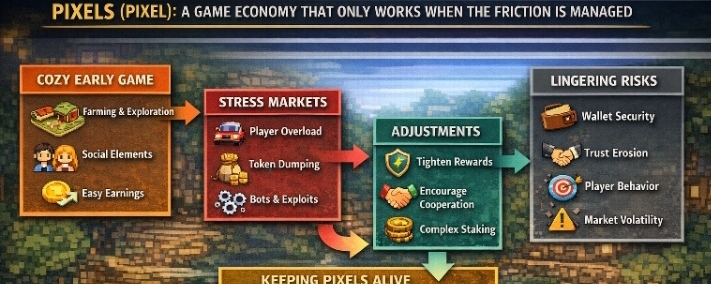
Pixels seems to understand that risk. You can tell by how it’s evolving. Earlier, it relied heavily on a soft currency called $BERRY, and from what I’ve seen, that didn’t hold up well. A 2% daily inflation rate sounds manageable until you actually run it in a live environment. Then it turns into a flood. Too much supply, not enough sinks, and suddenly what players earn doesn’t feel meaningful anymore. I’ve seen that exact pattern before, and it never ends well.
So now they’re shifting toward $PIXEL as the core token. That move isn’t just cosmetic. It’s an attempt to tighten control over how value moves through the system. Less inflation, more intentional rewards, more structure around how players earn and spend. In theory, that should make the economy more stable. In practice… it depends on behavior. It always depends on behavior.
Because here’s the thing people underestimate: players don’t behave like designers expect. They optimize. Fast. If there’s a way to extract more value with less effort, someone will find it. Then everyone copies it. And suddenly your “balanced” system is under pressure from thousands of players doing the exact same thing.
Pixels tries to counter that by shifting rewards toward more meaningful activity. Not just mindless farming, but cooperation, contribution, maybe even strategy. That sounds good. It probably is good. But it also introduces friction. And friction is tricky. Too little, and people exploit the system. Too much, and people just stop playing.
I keep thinking of it like plumbing. If water flows too freely, you get leaks and pressure drops. If you restrict it too much, nothing moves. The system needs just enough resistance to stay stable without blocking flow entirely. That’s not easy to tune, especially when the number of players keeps changing.
Then there’s staking. This is where things start to feel less like a game and more like a financial layer wrapped around a game. You can stake $PIXEL in different ways—on-chain, in-game, through land ownership. Each path has its own logic, its own rewards, its own expectations. On paper, this creates depth. It gives players options.
But from where I’m standing, it also adds cognitive load.
Now players aren’t just thinking about crops or resources. They’re thinking about where to allocate tokens, how long to lock them, whether rewards are worth the risk. Some people enjoy that. Others don’t. And when things get stressful—like when prices move or rewards shift—those decisions start to feel heavier. Less like gameplay, more like managing exposure.
That’s usually where cracks start forming. Not instantly, but gradually. A few players get confused. A few feel like the system isn’t paying fairly. A few exit early. And if enough of that happens at once, momentum slows down.
The Ronin network helps smooth some of the rough edges, I’ll give it that. Transactions are cheaper, faster, less annoying overall. You don’t feel like you’re fighting the infrastructure just to play. That matters more than people think. Friction at the technical level can kill a game before the economy even has a chance to fail.
Still, infrastructure is just the road. It doesn’t decide where people drive.
What really decides that is trust. And trust in these systems is fragile. It builds slowly, then disappears fast. Pixels tries to maintain it through rules—no botting, no exploiting, no cheating. Fair enough. But enforcement isn’t automatic. It requires constant oversight. And that introduces another layer of dependency: players have to believe the system is being watched and adjusted fairly.
Then there’s the wallet side of things. This is where reality hits a bit harder. If something goes wrong—if you sign a bad transaction or your wallet gets compromised—that’s it. No refunds. No recovery. I get why that’s the case. It’s how blockchain works. But it also means the system inherits all the risks of self-custody, whether players fully understand them or not.
And that matters because most players aren’t security experts. They’re just trying to play a game.
So what you end up with is a mix of systems that all need to hold together at the same time. Game design, token economy, infrastructure, security, moderation. If one of them weakens under pressure, it doesn’t stay isolated. It spreads. Like a small crack in a bridge that eventually affects the whole structure.
I don’t think Pixels is ignoring these risks. If anything, it feels like it’s been shaped by them. The move away from inflation-heavy tokens, the push toward more controlled rewards, the layered staking system… these aren’t random choices. They’re responses to things that have already gone wrong in similar projects.
But responses aren’t guarantees.
There are still things it can’t control. It can’t force players to value long-term participation over short-term gains. It can’t prevent coordinated farming if incentives allow it. It can’t ensure that new players keep arriving at the pace needed to sustain the economy. And it definitely can’t eliminate the natural volatility that comes with any token-based system.
So yeah, I’m watching it with cautious interest. Not excitement, not skepticism for the sake of it—just… attention. I’ve seen enough to know how quickly things can shift when pressure builds.
Right now, Pixels feels like a system trying to stay ahead of its own weaknesses. And honestly, that might be the most realistic approach I’ve seen in this space. Not perfect. Not safe. But at least aware of where things tend to break.
And in this space, that awareness counts for more than promises ever did.
