
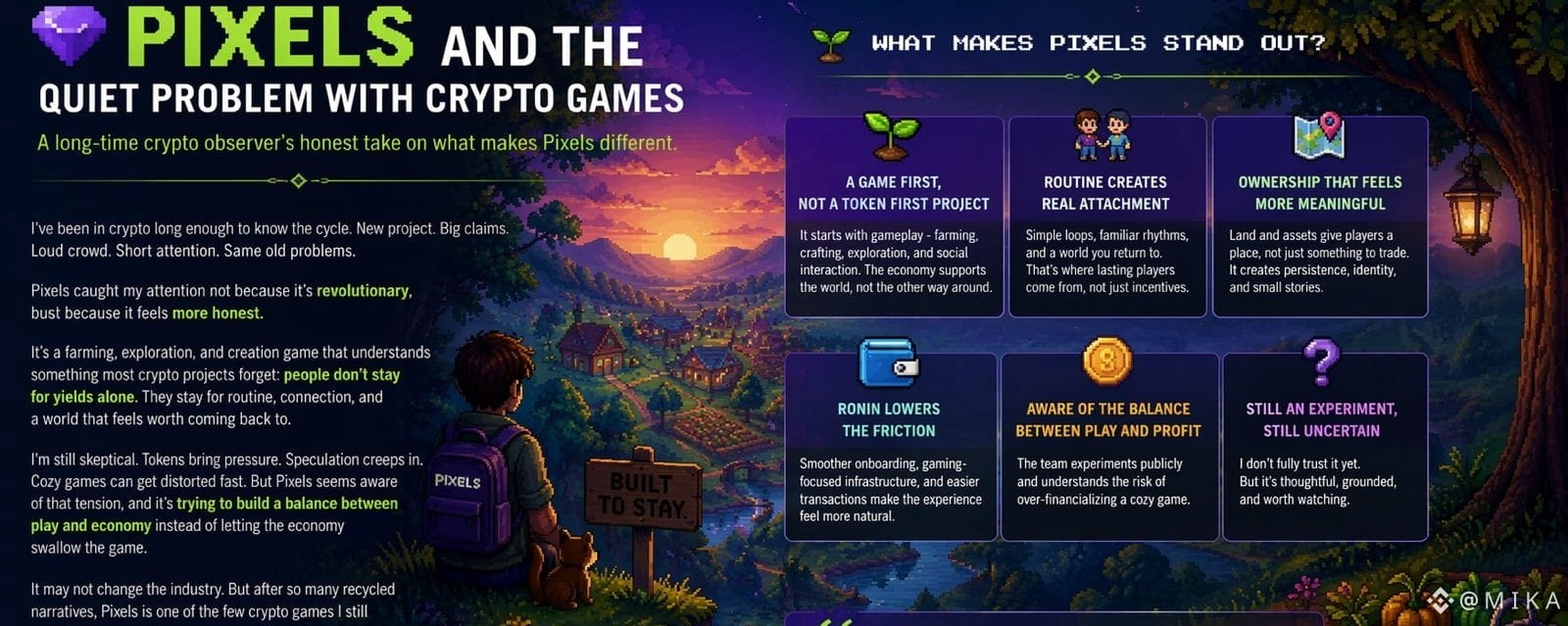
I’ve been around crypto long enough to know when something is just wearing a new mask.
The language changes every cycle, but the rhythm usually doesn’t. A new project shows up, people call it a breakthrough, the token gets treated like proof of innovation, and for a while everyone acts like the old problems have somehow disappeared. Then time passes, incentives weaken, attention moves, and the whole thing starts looking a lot more ordinary than it did in the beginning.
That’s probably why I’ve become slower to react. I don’t get excited that easily anymore. I’ve seen too many projects confuse noise for traction and too many communities mistake motion for meaning. So when I say Pixels caught my attention, I don’t mean I think it’s the future. I just mean it made me pause, which already puts it ahead of most things in this market.
Because most crypto games still feel backwards to me.
They usually start with the economy. That’s the first mistake. You can feel it almost immediately. The token comes first, the reward loop gets mapped out, the marketplace gets positioned as a major feature, and somewhere after all that, somebody remembers the thing is also supposed to be a game. It ends up feeling less like a world and more like a financial model trying to imitate play.
I’ve seen this before so many times that I almost expect it now.
Pixels doesn’t fully escape that pattern, but it doesn’t feel as trapped inside it either. That’s the part I keep coming back to. Underneath all the usual crypto layers, it’s still a farming game. A social one. Slow in the way farming games are supposed to be slow. Repetitive in a way that doesn’t feel accidental. You plant, gather, build, wander, upgrade, come back, do it again. There’s something almost humble about that loop, and crypto usually doesn’t know what to do with humble.
This space likes things that sound huge. It likes disruption, scale, dominance, transformation. It likes the feeling that everything is about to change forever. But most people don’t live like that. Most people are drawn to smaller rhythms. Familiar loops. Places they can return to without needing to explain why. That’s what I keep noticing when I look at Pixels. It seems to understand, maybe better than most Web3 games, that not every successful product has to feel like a revolution.
Sometimes people just want a place.
That sounds simple, but crypto has a strange habit of making simple things unnatural. It takes basic human behavior and runs it through a financial filter until it starts looking distorted. A game becomes an economy. A community becomes a funnel. Time becomes yield. Curiosity becomes speculation. At some point you stop asking whether something is enjoyable and start asking whether it is efficient, and that shift quietly ruins more products than most teams ever admit.
That’s the tension I feel with Pixels too.
Because on one hand, I can see why it stands out. It’s lighter. Softer. Less obsessed with looking intense. It’s built around farming, land, crafting, social interaction, and routine. That’s already a very different emotional starting point from a lot of older crypto games that wanted everything to feel like conquest, scarcity, and status. Pixels feels more domestic than heroic, and honestly, that might be one of the smartest things about it.
But on the other hand, it still lives inside crypto. Which means it still has to deal with the same old gravity.
Once a token enters the picture, the atmosphere changes. It always does. It doesn’t matter how cozy the game looks or how friendly the world feels. The second real value gets attached to the loop, people begin behaving differently. Some will play because they enjoy it. Some will grind because they think it pays. Some will speculate on the token. Some will treat the whole thing like an economic surface rather than a living game. And when those groups mix together, the tone of the entire product can shift without warning.
That’s the part I don’t fully trust.
I’ve watched too many projects start with good intentions and then slowly bend toward whatever the market rewards in the short term. A game says it wants sustainability, but the community wants upside. The team says it wants balance, but users keep chasing optimization. Before long, every feature gets discussed in terms of sinks, emissions, retention, yield pressure, and token support. The language of play gets buried under the language of maintenance.
When that happens, a game can still look alive from the outside. It can still have users, volume, and activity. But something underneath it changes. The world stops feeling inhabited and starts feeling processed.
That’s why casual games are actually harder to protect than people think. Their appeal is fragile. The mood matters. The softness matters. The illusion of ease matters. If too much financial pressure enters the system, the whole thing starts to feel mechanical. Farming becomes labor. Routine becomes obligation. Social interaction becomes strategy. Even a peaceful game can start to feel extractive once enough people enter it with calculators in their heads.
And crypto is full of calculators.
Still, I think Pixels is worth taking seriously because it doesn’t seem built by people who completely misunderstand that risk. I’m not saying they’ve solved it. I’m not saying the model is clean. I’m just saying the project feels more aware of the problem than a lot of what came before it.
The move to Ronin is part of that for me. Not because chain migration alone means much, but because it signals what the team thinks matters. And after years of watching crypto builders romanticize bad user experience, I’ve become more appreciative of projects that choose practicality over ideology. Ronin makes sense for a game like this. Lower friction, a gaming-focused environment, easier onboarding, better alignment with people who already understand digital game economies. That doesn’t make the project safe, but it makes it more believable.
Believable matters more to me than ambitious.
I think that’s another reason Pixels stays in my mind. It doesn’t feel like it’s trying to convince me that it will replace gaming. It doesn’t need to sound historic every five minutes. There’s a certain restraint in that, or maybe just a quieter kind of confidence. And after watching years of exaggerated claims in this market, I trust quieter projects more than loud ones.
Not blindly. Never blindly.
But enough to keep watching.
There’s also something interesting about the kind of ownership Pixels leans into. In crypto, ownership has been sold for years like it’s a magic ingredient. Put assets on-chain, let people trade them, call it empowerment, and somehow that’s supposed to deepen the experience. But I’ve never thought ownership alone was enough. People do not automatically care more just because an item is tradable. In a lot of cases, tradability just introduces pressure. It makes people think about resale before they think about meaning.
With Pixels, land and assets seem to work a little better because they’re attached to a loop that at least tries to feel lived in. A place you return to. A space you arrange. Something persistent enough to leave a small mark on. That’s more compelling than the usual NFT logic where ownership exists mostly so people can say they own something. Here, the ownership at least has a relationship with routine, and that gives it more emotional weight.
But even there, I’m cautious.
Because ownership in crypto games can also create invisible class systems. The people with assets become the center of the economy. The people without them become support traffic, labor, or latecomers trying to catch up. Sometimes that structure creates healthy interaction. Sometimes it just recreates old hierarchies in a shinier form. Crypto is not very good at admitting when its “open economies” are actually just new ways of sorting people.
So I don’t look at Pixels and see a clean answer. I see a real experiment. A more thoughtful one than most, maybe, but still an experiment. And I think the honesty of that matters. It matters that the project seems to be testing something real instead of pretending the formula is already solved.
Because the truth is, crypto gaming still hasn’t solved its core problem.
The problem was never just onboarding. It was never just gas fees, wallet friction, or bad token design. Those things mattered, sure. But the deeper issue was always emotional. Crypto has spent years trying to engineer commitment through incentives, and it still doesn’t seem to fully understand that incentives are not the same thing as attachment.
People can farm a reward without loving the system that gives it to them. People can stay active without feeling connected. People can participate without believing. And the moment rewards thin out, all that borrowed loyalty disappears.
That’s why I keep coming back to a simple question whenever I look at a project like Pixels: if the money got quieter, would people still want to be there?
I don’t know the answer yet. Maybe not enough of them. Maybe the token layer is still too central. Maybe the market surrounding the game will eventually distort the game itself, the way it so often does. That risk is real. I wouldn’t dismiss it.
But I also can’t dismiss the fact that Pixels seems to understand something older and more durable than most crypto products do. It understands routine. It understands softness. It understands that people sometimes return not because something is explosive, but because it has become familiar.
And familiarity is underrated in this market.
Crypto is always chasing intensity. Bigger launches. Bigger narratives. Bigger numbers. Bigger promises. It rarely stops to ask whether a product has the kind of texture people can quietly live with. Pixels, for all its imperfections, at least seems interested in that question.
That’s enough for me to pay attention.
Not with hype. Not with certainty. Just with the kind of cautious interest that survives after years in this market. The kind that comes from seeing too many recycled ideas, too many forced narratives, too many projects trying to manufacture meaning instead of earning it.
Something about Pixels feels less forced than most.
Maybe that’s because it doesn’t seem desperate to impress. Maybe it’s because the world itself feels more grounded than the economy wrapped around it. Maybe it’s just because after so many years of watching crypto overcomplicate basic human behavior, a game built around planting crops and coming back tomorrow feels strangely honest.
I’m still skeptical. I probably always will be.
But I keep watching Pixels, and that alone says something.
In crypto, I’ve learned not to ignore the projects that make me quietly pay attention instead of loudly react.
Those are usually the only ones worth thinking about.