
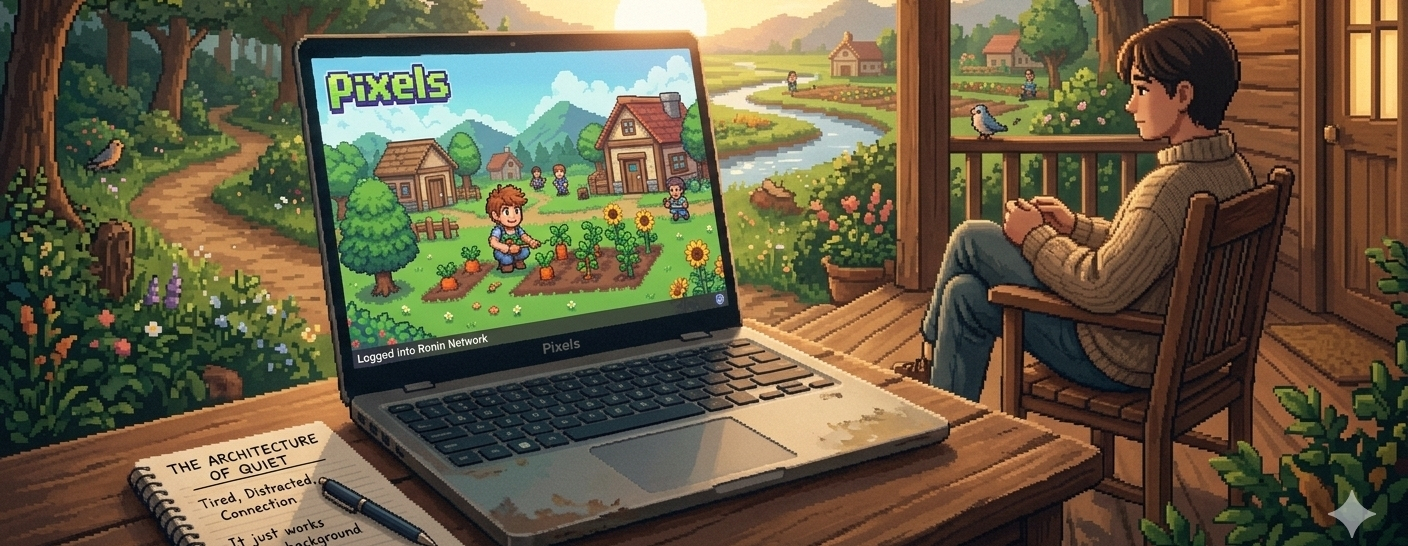

I caught myself doing that thing again today scrolling past a dozen crypto updates without actually reading any of them. It all starts to blur. Same tone, same promises, same exhausting feeling that every project is trying just a little too hard to sound revolutionary.
Then I paused on Pixels. Not because it looked like the "future of gaming," but because it didn’t.
That’s the strange part.
Lately, I’ve been thinking about how clinical Web3 feels. It’s built for people who are already inside the house. If you don’t understand wallets, gas fees or network latency, you’re already standing on the porch looking in. And even when you do understand it, there’s a persistent ghost of a question. Why would I come back to this tomorrow?
We don’t ask that enough. We talk about TPS (transactions per second) and data availability but we rarely talk about the "vibe" of staying.
When I first looked into Pixels, I was skeptical. A farming game on a blockchain? It sounded like another "play to earn" loop disguised as a chore. But the more I sat with it, the more I noticed the intentionality behind the simplicity. You farm, you explore, you hang out. There’s no immediate pressure to "optimize." It’s an environment you can just exist in for twenty minutes.
In a space that demands constant attention and high stakes decision making, that quietness is refreshing.
It runs on the Ronin Network, which has always felt more like a playground than a laboratory. The technical friction is tucked away in the basement where it belongs. You aren't constantly reminded that you're interacting with a distributed ledger, it just works in the background.
And that’s when it clicked for me. Maybe this is the direction the "Machine Economy" needs to take. Not louder. Not more complex. Just quieter and easier to live with.
There’s still a token and that’s where the internal debate starts. On one hand, having your time carry tangible weight is the promise of sovereign digital identity. What you build doesn't just evaporate when you log off.
On the other hand, we’ve all seen how quickly a token can ruin the mood. The moment a game feels like a job, the magic dies. Incentives are a double edged sword, they give you a reason to start, but they can become the only reason you stay.
I don’t think Pixels has "solved" the economy I’m not sure anyone has. But it feels aware of the human element in a way most "DeFi with graphics" projects aren't.
It made me stop and consider a hard truth:
Maybe people don’t actually want more powerful systems.
Maybe they just want something they can come back to without thinking too much.
If that’s true, then we’ve been building for potential instead of behavior. We’ve been assuming people will adapt to the tech, rather than building tech that meets people where they already are tired, distracted and looking for a bit of connection.
I’m not wearing rose colored glasses. Games lose momentum. Communities migrate. The moment the incentives shift, the crowd can drift away as fast as they arrived. That’s the gravity of this industry.
But for the first time in a long time, I didn’t walk away from a project thinking about the roadmap or the tokenomics. I just thought about how it felt to be there.
In a world of "moon talk" and "disruption," that feels like a small, but meaningful, win.