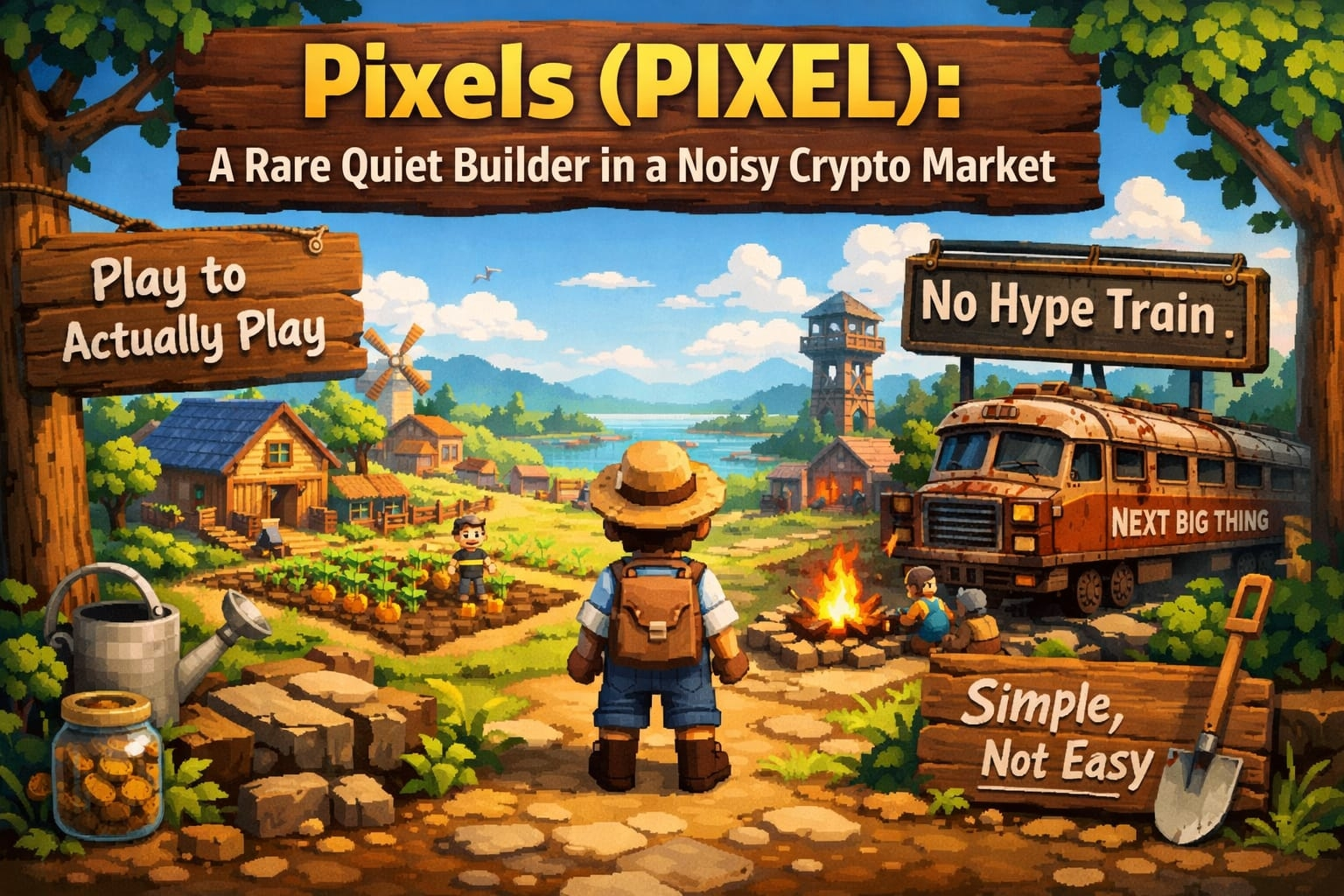
Crypto has a way of making everything feel louder than it really is.
Every week there’s a new token, a new trend, a new story people insist will change everything. A lot of it feels recycled. Same excitement, same language, same ending.
After a while, you stop paying attention to what sounds big and start noticing what feels a little more grounded.
That’s more or less where Pixels sits for me.
Pixels is a social, casual Web3 game built on Ronin. At first glance, it would be easy to dismiss it. Crypto gaming has burned through a lot of goodwill over the years, and for good reason. Too many projects treated games like financial products with cartoon skins on top.
That usually ends the same way.
People show up for the rewards, not because they actually enjoy being there. Then the numbers slow down, the incentives get weaker, and the whole thing starts to feel empty.
Pixels seems to be trying to avoid that, or at least push in a slightly different direction.
It’s built around a slower kind of experience — farming, exploring, collecting resources, building things over time. Nothing about that sounds especially new, and maybe that’s why it works. It doesn’t feel desperate to impress you.
It feels simple on purpose.
That matters more than people think.
A lot of Web3 games failed because they forgot one basic thing: if the game itself doesn’t feel good to come back to, ownership doesn’t really save it. Tokens don’t create loyalty. They create short-term behavior.
And short-term behavior disappears fast.
What Pixels seems to understand is that people need a reason to return that isn’t purely financial. A routine. A familiar loop. Something light enough to fit into daily life without feeling like work.
Of course, that’s also where the tension is.
Because crypto has this habit of turning everything into labor. The second rewards enter the picture, even a relaxed game can start to feel transactional. You stop asking whether something is fun and start asking whether it’s “worth it.”
That shift ruins a lot of things.
So the real question for Pixels isn’t whether it can get attention. It already has that. The better question is whether people still care when the earning side matters less and the playing side has to stand on its own.
That’s the part I still wonder about.
There’s also the social side, which is probably one of the more interesting parts of the project. Pixels isn’t just built around individual progression. A lot of its appeal seems to come from shared spaces, interaction, and this idea that the world feels alive because other people are in it too.
That sounds obvious, but it’s actually rare.
A lot of crypto projects talk about community, but what they really mean is audience. Those are not the same thing. A real community has habits, inside jokes, small relationships, a reason to stay even when nothing dramatic is happening.
You can’t really manufacture that.
You can make room for it, but you can’t force it.
Pixels seems to be trying to create that kind of environment, and I think that’s part of why it feels a bit different from the usual Web3 game pitch. It’s less about selling a grand vision and more about building something people might actually spend time in.
Ronin helps too, at least in a practical sense.
It gives Pixels a home inside an ecosystem that already understands gaming better than most crypto networks do. That doesn’t guarantee anything, but distribution matters. Familiar infrastructure matters. It’s easier to build habits when people aren’t fighting the onboarding process every step of the way.
Still, none of this means Pixels is guaranteed to work.
Crypto gaming has a long history of looking promising right until it doesn’t. And sometimes projects that seem thoughtful still end up pulled back into the same old cycle — more incentives, more extraction, more noise.
That risk is still here.
But Pixels does feel a little more restrained than most. A little less eager to sell itself as the future. A little more interested in just being a game people return to.
That may not sound dramatic, but honestly, that’s probably a good thing.
In this market, I’m less interested in projects that try to look important and more interested in ones that quietly build something people actually use.
Pixels might end up being one of those.
Or it might not.
But at the very least, it feels like a project worth paying attention to without needing to romanticize it. And in crypto, that alone goes a long way.