
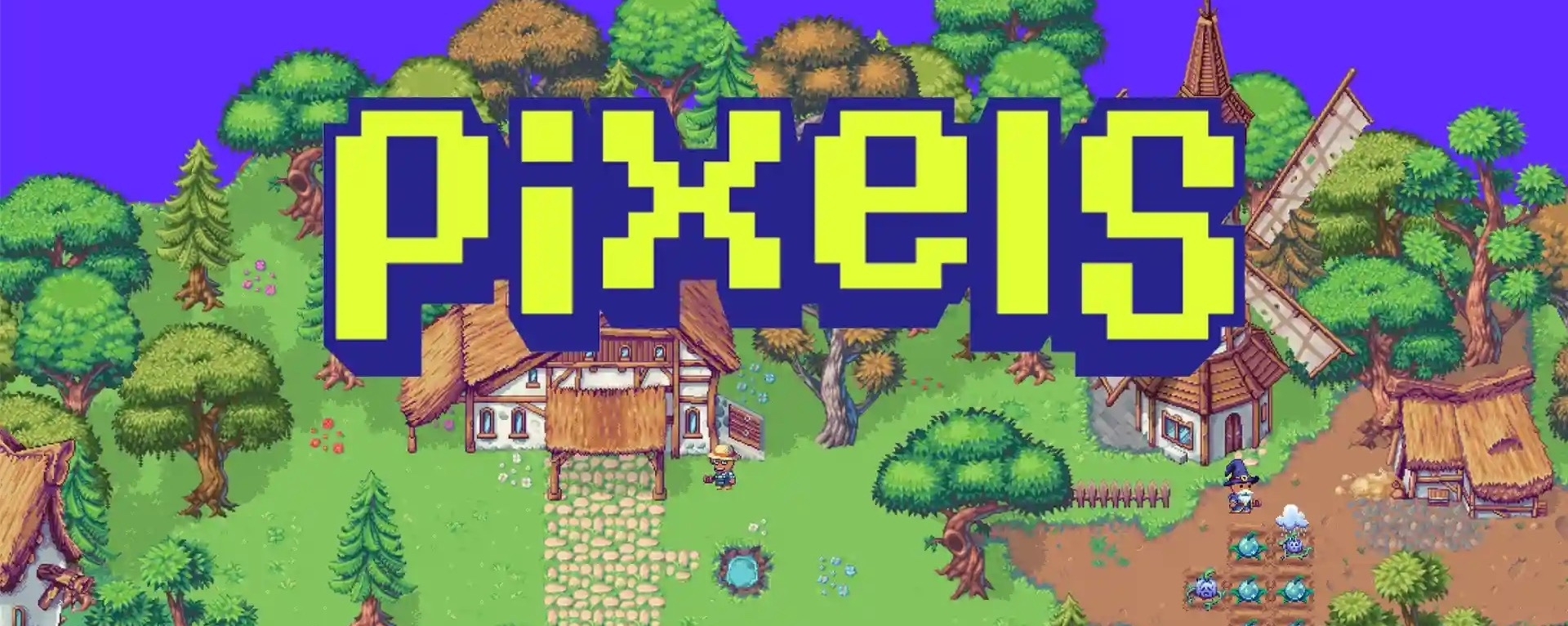
when I first looked at Pixels on Ronin, I go in with excitement. If anything, I expected another variation of the same formula just with better branding or smoother UX. I logged in mostly out of curiosity, not conviction.
At first, nothing about it felt groundbreaking.
You farm. You move around. You interact with a pretty simple environment. On paper, it doesn’t sound like much. And honestly, if you’re looking for instant depth or complexity, it might even feel underwhelming.
But the strange part is… I didn’t log off.
I kept playing. Not because I felt like I had to, or because I was chasing some reward, but because the experience itself was easy to stay in. It didn’t overwhelm me with systems. It didn’t push tokens in my face every five minutes. It just let me exist in the game for a bit.
And that’s where it started to feel different not in a loud, obvious way, but in how it quietly held my attention.
One thing that stood out early was the onboarding. Most Web3 games throw too much at you upfront wallet connections, token mechanics, NFT explanations, staking, crafting systems all layered on top of each other. It creates friction before you even understand why you should care.
Pixels doesn’t do that.
You can just play. No pressure. No immediate need to engage with the “Web3” part of it. The systems reveal themselves slowly, almost in the background. And because of that, you’re learning by doing, not by reading or figuring things out through trial and error.
That alone changes how you approach the game.
It starts to feel less like you’re entering an economy and more like you’re entering a world.
The gameplay loop itself is simple, but it’s not empty. Farming connects to crafting. Crafting connects to progression. Exploration ties into both. It’s not just repeating one action for the sake of earning it’s a set of small systems that feed into each other.
And that’s an important distinction.
In most “play-to-earn” setups, the loop is shallow by design. It’s meant to be optimized, not enjoyed. You figure out the most efficient path and repeat it until it stops being worth it.
Here, optimization doesn’t feel like the main goal at least not early on. You’re just moving through the game, unlocking things gradually, and finding your own rhythm.
The introduction of the Pixel token is another interesting piece.
It’s there, but it’s not aggressively pushed on you from the start. You become aware of it over time, and by the time it starts to matter, you already have some context for the game itself. That changes your relationship with it.
Instead of seeing the token as the reason you’re playing, it becomes something that complements what you’re already doing.
That subtle shift in psychology is important. It doesn’t eliminate the economic layer it just reframes it.
Ownership is another area where Pixels feels more grounded than most.
In a lot of Web3 games, owning assets feels disconnected from actual gameplay. You buy an NFT, and it either generates yield or sits there as a speculative item. The “ownership” is more financial than functional.
Here, it pixel feels a bit more tied to how you play.
Land, items, progression they’re not just abstract assets. They have a role in your day-to-day experience. They affect what you can do, how you interact with the world, and how you progress over time.
It’s not perfect, but it feels closer to what ownership in a game should actually mean.
The economy also doesn’t feel as rigid as what we’ve seen in previous GameFi cycles.
Instead of a fixed reward system where everyone is funneling into the same loop, there’s a sense that player behavior is shaping things in real time. Supply, demand, activity it all feels more organic, even if it’s still early.
That doesn’t mean it’s immune to the same problems. If anything, it’s probably still vulnerable to them. But at least the structure leaves room for adaptation.
Pixel , Ronin network plays a role here too, even if it’s not something you think about constantly.
Transactions are fast. Costs are low. You’re not constantly reminded that you’re interacting with a blockchain. And that’s exactly how it should be. The infrastructure fades into the background, which lets the game itself take the spotlight.
That’s something a lot of projects underestimate.
If the chain experience is clunky, it doesn’t matter how good the game is people won’t stick around long enough to see it.
What I also find interesting is the pace at which Pixels is evolving.
It’s not trying to dominate attention with hype cycles or overpromise on future features. Updates feel incremental. Systems seem to be introduced with some level of caution. It gives the impression that the team is observing how players behave before pushing things further.
That slower approach might not generate the same excitement as a big, flashy launch, but it could be more sustainable in the long run.
And that’s really what this comes down to.
Pixels doesn’t feel like a finished product or a guaranteed success. It still has gaps. It still relies on an economy that could shift in unpredictable ways. And like every Web3 game, it’s ultimately tied to user incentives in some form.
But it does feel like it’s trying to solve the right problems.
Instead of asking “how do we reward players more,” it seems to be asking “how do we make players want to stay, even without rewards?”
That’s a much harder question and a much more important one.
If there’s any real signal here, it’s not the token price or short-term activity spikes. It’s how people behave over time. Are they logging in because they want to, or because they feel like they should? Are they building, exploring, interacting or just extracting value?
Right now, it feels like a mix of both. Which is probably realistic.
It’s still early. It’s not perfect. And it’s definitely not immune to the same pressures that have broken other GameFi projects.
But for the first time in a while, I’ve spent time in a Web3 game where the experience didn’t immediately collapse into a spreadsheet.
And that alone is worth paying attention to pixel..