
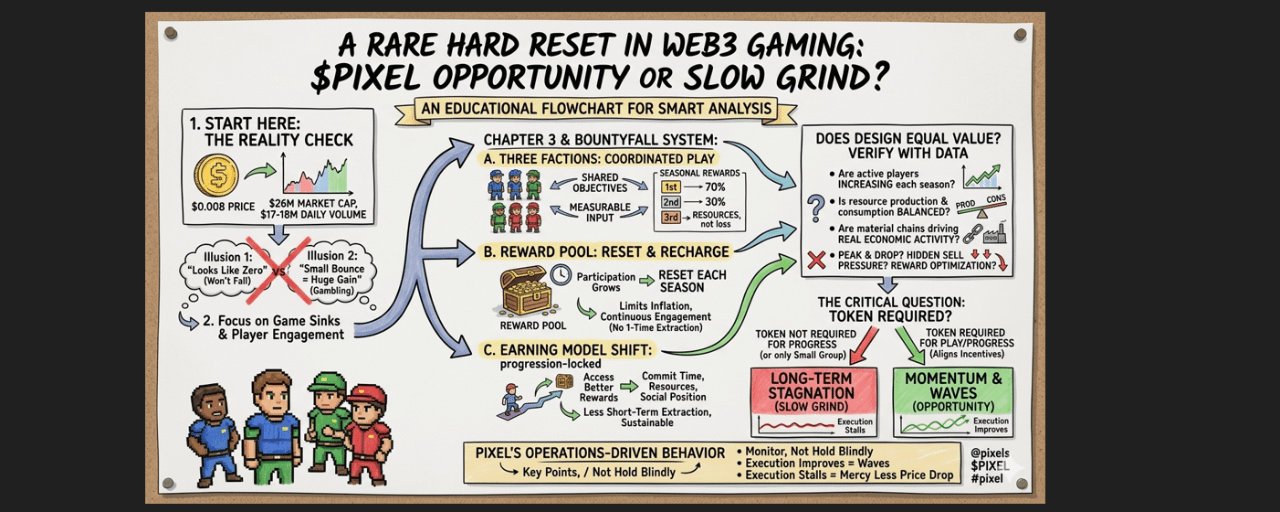

Let’s talk about @Pixels and PIXEL, but not in the usual “gaming sector pumps and everything follows” narrative. That shortcut thinking has cost people enough already. Before getting into anything abstract, let’s anchor this properly in reality.
At the time of writing, $PIXEL is trading around 0.008, with a market cap of roughly 26 million dollars and about 17 to 18 million in daily volume. It is not dead, clearly. But it is also far from where serious capital clusters. It sits in that awkward zone where there is activity, yet no strong conviction. That context matters, because without it, everything else becomes theory.
If you zoom out, the price history creates a very specific psychological trap. From a peak around 1.02 down to this range, and with an ATL near 0.0045, it sits in what I would call the “looks like zero, but has not actually zeroed” zone. This is where two illusions appear. One side believes it cannot fall much further, the other believes even a small bounce could mean outsized returns. I do not rely on either. I only look at two things. Does the game create real sinks, and does it push players to engage deeper instead of extracting and leaving.
That is where the real shift in Pixels begins to matter. With Chapter 3 and the Bountyfall system, the game is clearly moving away from isolated grinding into coordinated, seasonal competition. Players join one of three factions, contribute toward shared objectives, and receive rewards based on measurable input. The structure itself is where things get interesting. At the end of each season, rewards are distributed with a clear hierarchy. The top faction takes 70 percent of the reward pool, the second takes 30 percent, and the third does not simply lose, it receives starting resources for the next season. That last detail is not random. It prevents total elimination while still preserving competition.
At the same time, the reward pool grows with participation but resets every season. This is a deliberate design choice. It limits long-term inflation and prevents early participants from permanently dominating rewards. In simple terms, the system forces continuous engagement instead of allowing one-time extraction. If you go deeper, the earning model itself has changed. Higher-value output is no longer something you casually farm and sell. It is tied to progression layers, production systems, and coordinated play. To access better rewards, you need to commit time, resources, or even social positioning within the game. That makes the system less friendly to short-term extraction, but more aligned with sustainability.
It also brings up a more uncomfortable question. Does this actually translate into value for the token. Because this is where many Web3 games fail, even when the game itself improves. There are two common traps. The first is when the game becomes genuinely good, but the token is not actually required to play or progress. The second is when the token is required, but only for a small group of paying users or competitive players chasing leaderboards. Both scenarios can result in long-term price stagnation. And Pixels is not immune to either.
Now, to be fair, there are real signals worth acknowledging. The project openly highlights a player base of over 10 million users, and support from the Ronin ecosystem is consistent and visible. This is not just community hype. Infrastructure backing and ecosystem alignment matter far more than presentation slides in this sector. But this is exactly where a more difficult question appears. If a project claims millions of players, yet sits at a market cap of around 26 million dollars, the gap should not excite you immediately. You should ask whether that gap represents opportunity, or a structural problem. Because the market is already expressing a view through pricing.
And this is where most people stop too early. Good design does not guarantee effective outcomes. That has to be verified with data. There are a few things that actually matter here. Are active players increasing with each season, or peaking and dropping. Is the production and consumption of in-game resources balanced, or building hidden sell pressure. Are players engaging in material and production chains that drive real economic activity, or just optimizing reward extraction. If you ignore these and only watch price charts, you are not analyzing. You are gambling. That distinction matters more than anything else in this space.
Because right now, $PIXEL haves more like an operations-driven asset than a narrative-driven one. If execution improves, momentum comes in waves. If execution stalls, the price reflects it quickly and without mercy. This is not an asset you hold blindly. It is one you monitor.
If someone chooses to engage, the focus should stay practical. Whether price can stabilize within a meaningful range. Whether volume reflects real participation instead of short-lived spikes. Whether each new season forces spending and deeper engagement rather than passive accumulation.
At this level, the real risk is not entering at the wrong price. The real risk is realizing too late that the system does not actually require the token to function. And that is what turns a potential opportunity into a slow grind.