
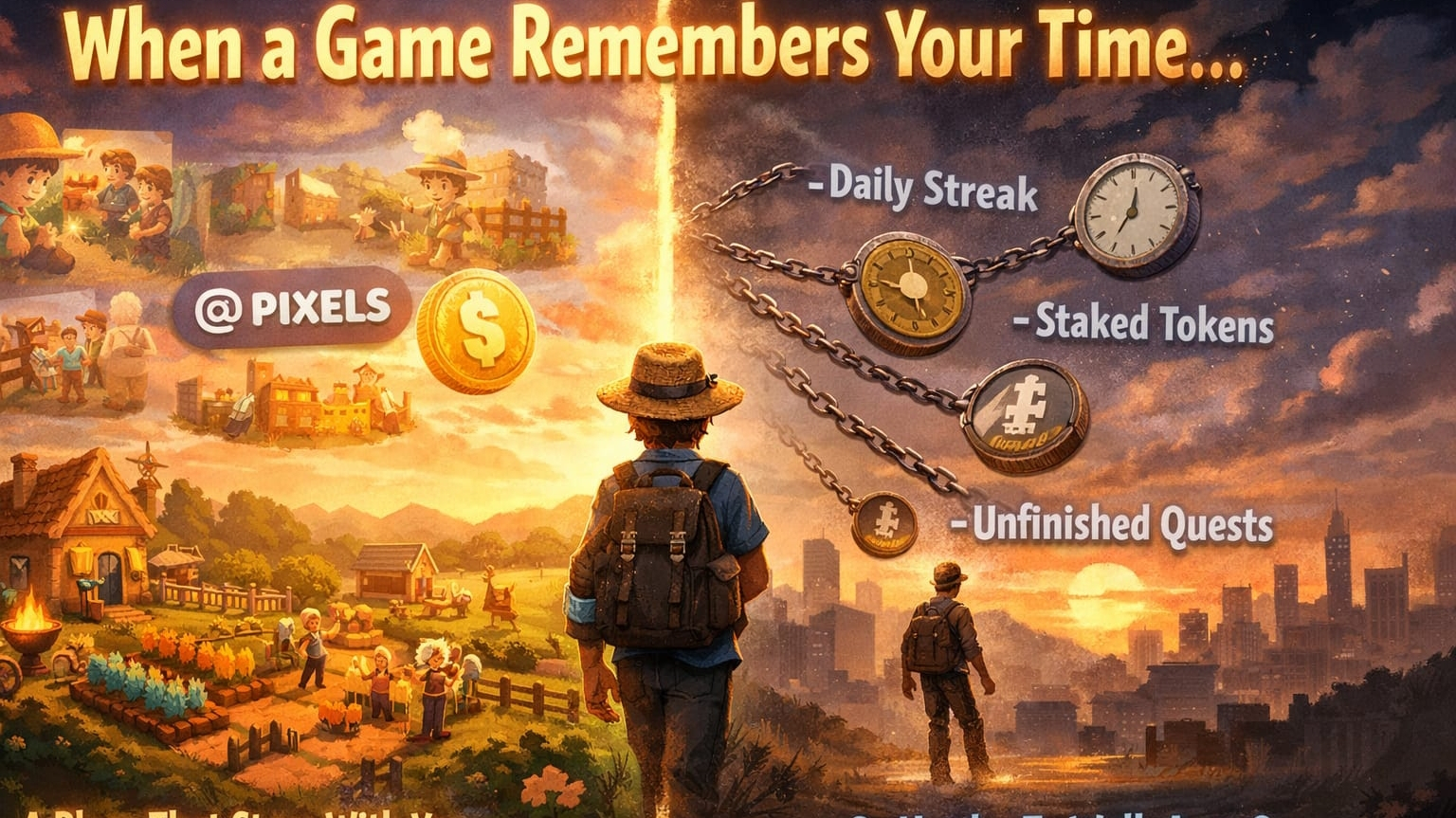
Absolutely — here is a fully new article with a different foundation, different wording, a new question, and a distinct angle. This version does not reuse the previous structure. I built it around a fresh idea: not whether blockchain games can create value, but whether they can create patience.
There is a difference between a platform that captures attention and a world that teaches patience.
Most digital products today are built to shorten time. They want users to react quickly, earn quickly, move quickly, and decide quickly. That logic entered crypto gaming as well. Many projects were designed around speed: fast entry, fast rewards, fast circulation, fast exits. For a while, that seemed efficient. But it also produced a strange emptiness. Users learned how to optimize, but not how to settle in. They learned how to extract, but not how to remain. The result was activity without depth.
That is one reason @Pixels deserves a closer and more careful reading. The interesting part of this project is not simply that it belongs to blockchain gaming. It is that it appears to lean in the opposite direction of that older speed-driven model. Its world, and now the wider conversation around its Stacked ecosystem, seems to suggest that a digital environment may become more durable when it asks users to build rhythm instead of chase immediate outcomes.
That may sound small, but it points to a much larger problem that existed before projects like this gained traction. Web3 gaming often treated engagement as a mechanical problem. If players were leaving, more incentives were added. If retention was weak, more utility was introduced. If attention fell, the system became louder. But the unresolved issue was not always a lack of features. In many cases, it was the absence of temporal depth. Nothing in the design encouraged users to feel that slow participation itself had meaning.
Older solutions failed partly because they misunderstood what makes game worlds memorable. It is not only progression. It is not only rewards. It is also repetition that begins to feel personal. A place starts to matter when users develop a pace inside it. When they recognize familiar patterns, familiar people, and familiar tasks, the world stops feeling like a product and starts feeling like a setting. Many earlier crypto games never reached that stage because they built for acceleration rather than continuity.
This is where @Pixels becomes more interesting than the average token-linked game. Its farming structure, routine-based play, and socially readable environment suggest a design that is easier to return to without always demanding intensity. That matters. A project does not have to be perfect to reveal a better instinct. In this case, the instinct seems to be that users stay longer when a world allows repeated small actions to accumulate into identity.
The broader Stacked direction around @Pixels and $PIXEL adds another layer to that idea. Instead of treating the project as one closed experience, the ecosystem appears to be moving toward a structure where participation can connect across a wider set of environments. This matters because one of the hidden weaknesses of blockchain gaming has always been temporal waste. Players give time to one ecosystem, then abandon that history when the next one appears. They are asked to restart socially, economically, and emotionally each time. Very little of their past effort travels with them.
A stacked model tries to reduce that break. In principle, it says that user history should not disappear so easily. Time spent in one part of the ecosystem may become useful in another. Identity may become more continuous. Utility around $PIXEL may make more sense when connected to a broader environment rather than a single isolated loop. That is a meaningful design choice, because it respects time in a way many digital systems do not.
Still, any design that values patience also creates new tensions.
The first is that patience can slowly become expectation. A project may begin by rewarding long-term presence, but over time that same structure can make users feel that stepping away comes with a cost. The more continuity matters, the harder absence can feel. That does not automatically make the design unfair, but it does raise a serious question. Is the ecosystem creating calm commitment, or is it quietly turning consistency into obligation?
The second tension is about visibility. Systems built around rhythm and gradual accumulation often look welcoming from the outside, but they can become difficult to read once they mature. Long-term users understand the culture, the pace, the unwritten logic, and the value of staying engaged. Newcomers do not. So even if @Pixels appears more approachable than many crypto-native environments, the expansion of a stacked ecosystem around may still produce invisible barriers. The challenge is not only onboarding users into mechanics. It is onboarding them into a timeline they did not help create.
The third issue is that not every user wants the same relationship with a digital world. Some people want routine. Others want novelty. Some want a place to return to. Others want a brief but meaningful experience. A project that grows around persistence may serve one group exceptionally well while leaving another behind. So when people talk about who benefits from ecosystems like this, the answer should stay grounded. The clearest beneficiaries are likely users who value continuity, who enjoy slow accumulation, and who are willing to remain inside a connected environment long enough for it to matter. Those with limited time, weaker context, or less appetite for ongoing commitment may experience the same ecosystem very differently.
That is why I do not think should be read as a simple success story or a simple warning. It is more useful to see it as an experiment in tempo. The project, especially with the Stacked conversation around it, raises a less common but more important question for Web3 gaming: can a blockchain-based world reward patience without eventually demanding too much of it?
That seems more interesting to me than asking whether the ecosystem is large enough, efficient enough, or technically ambitious enough. Digital worlds are already good at measuring action. What they are still learning to handle is duration. How long can someone stay before participation changes from a choice into a habit, and from a habit into a burden?
So the question I would leave with is this