
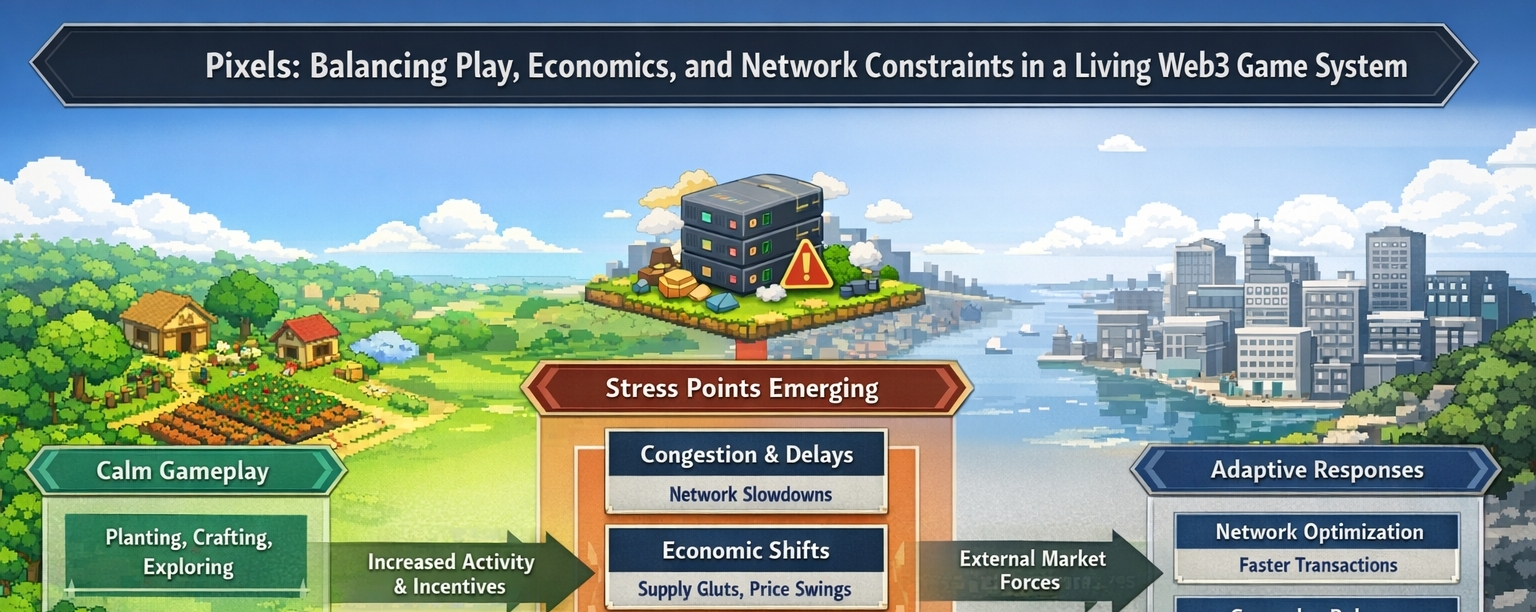
Pixels looks simple at first glance. You plant, you harvest, you wander around a soft-colored world that feels intentionally slow. I’ve seen a lot of systems like this, and they often feel stable when you only observe them at rest. But stability in calm conditions doesn’t tell you much. The real signal comes when more people show up, when rewards start to matter, and when small delays begin to stack on top of each other.
What’s interesting about Pixels is not the farming itself, but the fact that every action quietly ties into a shared system of ownership and value. That changes behavior, even if the game tries to stay casual. In a normal game, planting crops is just a loop. Here, it’s closer to participating in a small economy. And like any economy, it behaves differently when it’s busy.
I tend to think of it like a local market that slowly turns into a crowded trading hub. At the beginning, everyone moves freely. You can take your time, make small decisions, and nothing feels urgent. But once more players arrive and certain actions become more rewarding than others, patterns form. People start doing the same things for the same reasons. That’s where friction begins to build.
The network underneath Pixels, the Ronin infrastructure, is designed to keep things fast and cheap. And to be fair, that helps a lot in everyday use. You don’t feel every transaction the way you would on slower systems. But speed doesn’t remove pressure, it just delays where it shows up. When activity increases, the system still has to process everything, and small inefficiencies become visible.
I’ve watched this happen in different environments. At low usage, everything feels smooth because there’s room for error. At higher usage, timing starts to matter. A delay of a few seconds can change outcomes. A slightly faster action can give someone an advantage. Over time, that shifts how people play. They stop behaving like casual farmers and start acting more like participants in a race they didn’t initially sign up for.
In Pixels, this shows up in subtle ways. If certain crops or activities are more profitable, players naturally move toward them. That’s not a flaw, it’s just how incentives work. But when too many people follow the same path, the system starts to lean. Supply increases, value shifts, and what looked balanced before starts to feel uneven. It’s like traffic in a city where one shortcut becomes too popular. It works well until everyone uses it at once.
Trust is another piece that feels invisible until something goes wrong. Most of the time, players don’t think about the system recording their actions. They just expect things to work. And usually they do. But when there’s a delay, or when outcomes feel inconsistent, even briefly, people start to question what’s happening behind the scenes. Not in a dramatic way, but enough to change how they engage.
I think of this like water pressure in a building. When everything flows normally, you don’t notice the pipes. But if the pressure drops or spikes, suddenly you’re aware of the system. In Pixels, those “pipes” are transaction processing, updates, and how quickly the system reflects reality back to the player. When those processes lag, even slightly, the experience shifts from passive to reactive.
There’s also a quiet tension between different types of players. Some people are there because they enjoy the loop. Others are there because they see an opportunity to earn or gain something. Most sit somewhere in between, but the balance changes over time. When rewards increase, behavior sharpens. People optimize, repeat efficient actions, and sometimes stretch the system in ways it wasn’t fully designed for.
This doesn’t break the game, but it does change its tone. What starts as exploration can slowly turn into routine. What feels like play can start to resemble work, especially for those trying to maximize outcomes. And once that shift happens, expectations change. Players become less tolerant of delays, inconsistencies, or anything that disrupts their rhythm.
The design of Pixels tries to soften this by keeping the core experience familiar. Farming is predictable. Crafting makes sense. Exploration is open-ended. These choices help ground the system so it doesn’t feel purely transactional. But there’s a limit to how much design can control behavior once real incentives are involved.
External factors play a role too. The value of in-game assets doesn’t exist in isolation. It connects to a broader environment where sentiment changes quickly. If value rises, new players arrive with different goals. If it falls, some players leave, and activity drops. Both scenarios create their own kind of stress. Growth can overwhelm systems, while decline can hollow them out.
I’ve noticed that systems like Pixels don’t usually fail in obvious ways. They don’t collapse overnight. Instead, they shift. Small imbalances appear, get corrected, and then reappear somewhere else. It’s more like maintaining a busy road network than building a static structure. You’re always adjusting traffic, but you never fully eliminate congestion.
The reliance on a faster network like Ronin is a practical decision. It reduces friction where it’s easiest to reduce. But it doesn’t solve deeper coordination problems. If too many players act in the same way at the same time, or if incentives push behavior in narrow directions, the system still has to absorb that pressure somehow.
There are also things Pixels simply can’t control. It can’t stop players from organizing outside the game. It can’t prevent strategies that exploit patterns in the system, even if they follow the rules. It can’t fully stabilize value in an environment that’s influenced by forces far beyond its own design. These aren’t weaknesses, just boundaries.
What I find most realistic about Pixels is that it doesn’t try to hide these trade-offs entirely. It leans on simplicity where possible and accepts a certain level of unpredictability. That doesn’t make it immune to stress, but it does make it more adaptable than systems that promise too much control.
In quiet moments, the game feels exactly as intended. You move through it without thinking about infrastructure or incentives. But those layers are always there, just beneath the surface. And when conditions change, they come into view.
That’s where the real story of Pixels sits, not in how it behaves when everything is working, but in how it responds when things get slightly out of sync. Not broken, just strained. And in systems like this, that’s usually where the most honest behavior shows up.