

👇
The longer I stay around crypto, the less I trust migration announcements on first read.
Every project says the same things—better ecosystem, better support, better scalability, better alignment. The wording changes, but the structure never does. After a while, those lines stop sounding like explanations and start feeling like polished cover for something simpler underneath.
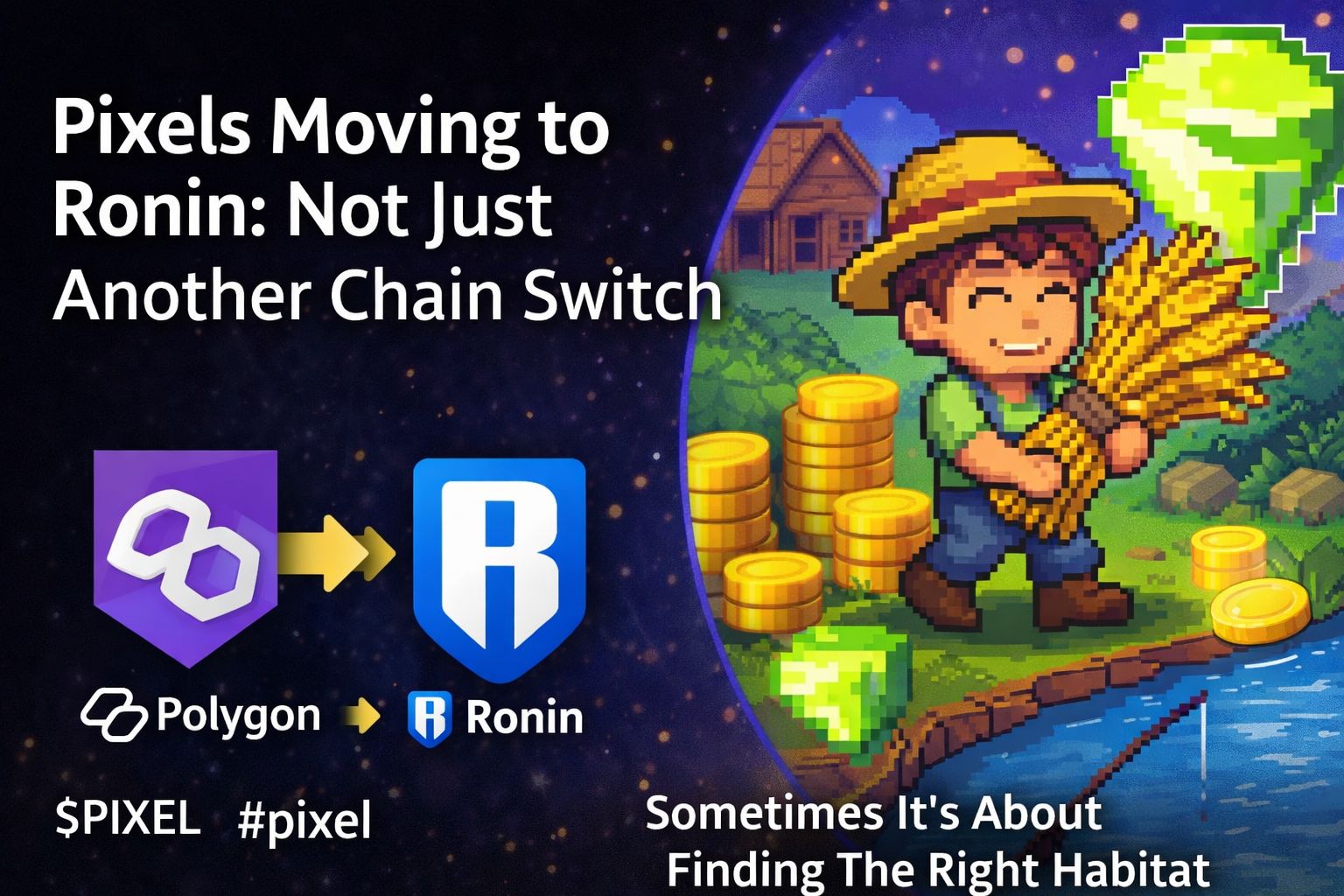
That’s why Pixels moving from Polygon to Ronin felt worth slowing down for.
At first glance, it looked like another routine chain switch—the kind crypto overhypes for a few days and then forgets. But the more I sat with it, the more it felt like this one actually meant something.
Not because Ronin is perfect.
Not because Polygon became bad.
And definitely not because switching chains magically creates success.
That’s still fantasy.
🌱 This Wasn’t About Switching Chains
What made this move different was something simpler.
Pixels wasn’t just looking for another blockchain.
It was looking for the right environment to grow in.
And that’s a huge difference.
Before the move, Pixels already had traction. It had users, activity, and momentum. This wasn’t a weak project trying to escape a quiet ecosystem. It was alive.
So when it moved, it didn’t feel like a rescue.
It felt like a project asking:
“If we want to become something bigger… where do we actually belong?”
🎯 The Real Advantage: The Right Audience
The answer was clear.
Ronin had the kind of users Pixels needed.
Not just crypto users.
Not just wallet holders.
But people already familiar with Web3 gaming.
That distinction matters more than it sounds.
Because:
The average crypto user isn’t a gamer
The average gamer doesn’t want crypto friction
Web3 gaming sits in that awkward middle.
So when a project finds a network where users already understand:
Wallet setup
In-game ownership
Marketplaces
Token loops
That’s not a small edge.
That’s the edge.
⚖️ Polygon vs Ronin (The Real Difference)
Polygon is broad.
It offers:
Scale
Integrations
Flexibility
Visibility
But for a game like Pixels, that breadth creates noise.
Gaming becomes just one category among many:
DeFi
NFTs
Brands
Experiments
Your project exists—but doesn’t feel central.
Ronin is the opposite.
It’s narrow by design.
Gaming isn’t a side category.
It’s the main language.
And that changes everything.
🧠 Why Sky Mavis Actually Matters
This wasn’t just about chains.
It was about who’s behind them.
Sky Mavis had already lived through massive Web3 gaming growth with Axie Infinity.
They’ve seen:
User explosions
Economic stress
Speculation cycles
System breakdowns
That experience isn’t clean.
But it’s real.
And in crypto, real experience > perfect theory.
⚙️ The Full Stack Advantage
Ronin didn’t just offer a chain.
It offered a full ecosystem:
Wallet layer
Marketplace
Token infrastructure
Gaming-first distribution
That matters more than people admit.
Most Web3 games don’t fail because of one missing feature.
They fail because the overall experience feels dead.
Ronin gave Pixels a better chance of feeling alive.
📈 After the Move: Growth… With Reality
After migrating, Pixels grew fast.
That part is important.
Because without growth, this would just be another overanalyzed crypto story.
But growth doesn’t equal perfection.
Let’s be honest:
Wallets ≠ real players
Activity ≠ retention
Incentives ≠ genuine engagement
And yes—bots, farming, and extraction showed up.
They always do.
That’s not a bug.
That’s Web3.
🪷 The Real Takeaway
This isn’t a fairytale.
Pixels didn’t become perfect after moving.
But it did gain:
A stronger audience
A better environment
More cultural relevance
A network where it actually mattered
And that’s enough to call it a win.
Not a clean win.
Not a permanent win.
But a real one.
🔥 Final Thought
Crypto loves to frame migrations as technical upgrades.
But this wasn’t about better tech.
It was about better fit.
Pixels didn’t choose Ronin because it was “better.”
It chose it because it was more aligned with what the game needed to become.
Polygon offered range.
Ronin offered focus.
At that stage—
Focus was worth more.
