
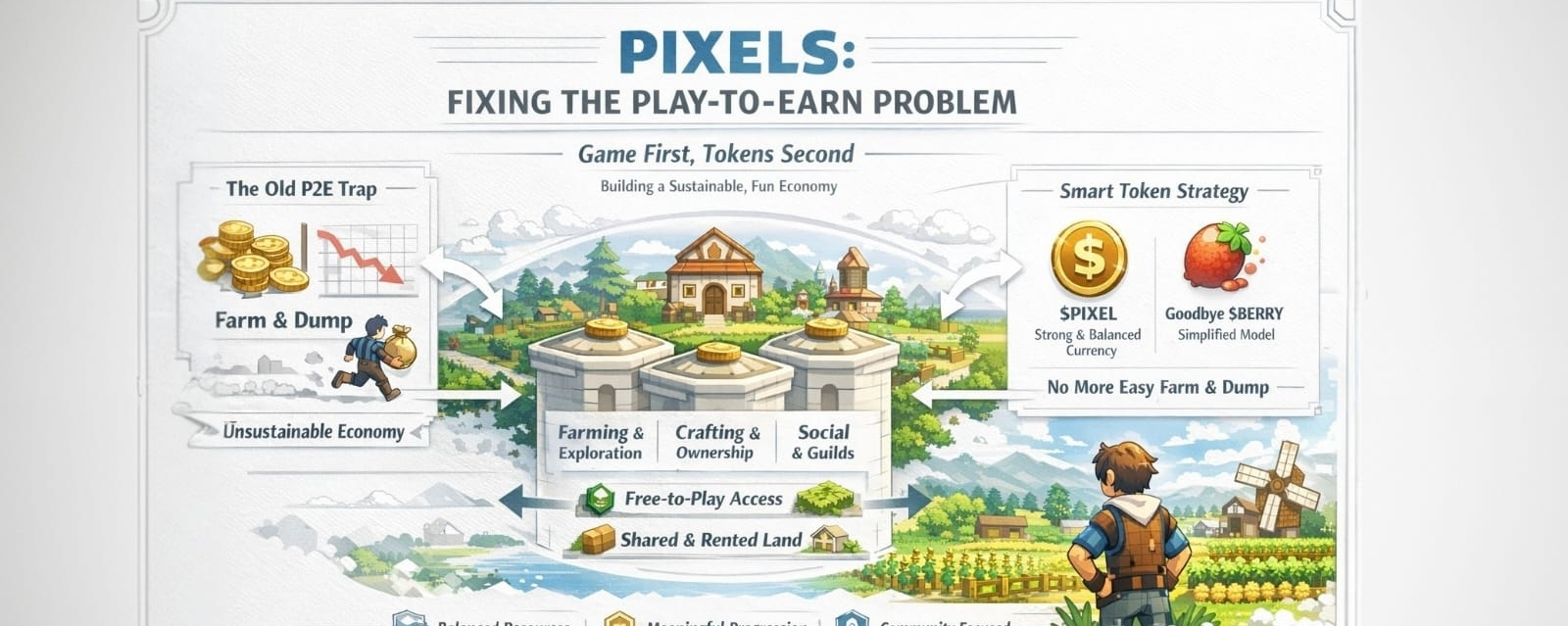
I have seen this story play out enough times in crypto gaming to recognize the pattern quickly. A game launches, the rewards look exciting, the token becomes the main attraction, and then the economy slowly starts working against itself. That was the core weakness of the old play-to-earn model, and it is the exact problem Pixels seems to be targeting. Reuters described how early P2E games ran into financial pressure once the hype faded, and that is the background lesson behind most of the newer Web3 game designs.
What makes Pixels worth paying attention to is that it does not try to hide that lesson. Its own whitepaper says the project is focused on building a game economy that lasts, not just one that looks good when rewards are flowing fast. The game is built around farming, exploration, creation, ownership, and social play, which already tells you the team wants the experience itself to matter, not just the payout.
That is a big difference from the old P2E mindset. In many earlier games, the first question players asked was not whether the world was fun, but whether the rewards were still worth chasing. Once that happens, the game starts feeling like a job with a price chart attached to it. Pixels is clearly trying to move away from that kind of behavior. Its FAQ says Chapter 2 is designed to protect the economy, simplify the system, and reduce the pressure that comes from having too many moving pieces in the token model. It also says the game is free-to-play and playable on mobile or browser, which lowers the barrier to entry and makes the experience feel more like a real game than a financial gate.
The token side shows the same thinking. Pixels originally used $BERRY as the main in-game currency and $PIXEL as the premium currency. The docs describe $BERRY as the softer, easier-to-earn currency for day-to-day gameplay, while $PIXEL was meant for higher-value actions like premium items, upgrades, land minting, and other optional uses. That separation made sense on paper, but the team later updated its approach because too much easy-to-earn value can create the same problem old P2E games had: people farm, sell, and leave. The newer FAQ says Pixels is phasing out $BERRY, moving toward a cleaner currency structure, and focusing more strongly on $PIXEL.
That is the part that feels most human to me. It looks like a team that actually listened to how players behave instead of just how a whitepaper sounds. A game economy is not saved by slogans. It is saved by sinks, limits, pacing, and reasons to stay. Pixels’ docs talk about adjusting resource generation, replenishment times, input costs, and store prices so supply does not run away from demand. That is basically the game design version of keeping a room from filling with smoke.
The other thing Pixels does differently is lower the pressure to own everything on day one. Its model includes free-to-play access, shared land, rented land, and owned land, so a new player can enter without immediately being forced into the most expensive layer of the ecosystem. That matters because old P2E often made ownership feel mandatory before anyone even knew whether the game was worth staying for. Pixels is trying to make ownership meaningful, but not compulsory.
There is also a social layer here that matters more than people sometimes admit. Pixels talks about guilds, player trading, reputation, and cooperative progression. That may sound simple, but it is exactly the kind of structure that keeps a game alive after the first wave of token hunters moves on. A good in-game economy needs a reason for players to depend on each other. It needs friction, trust, and repeated interaction. Otherwise it becomes a one-way machine that only prints and drains.
The traction suggests the idea is working better than a lot of people expected. Pixels’ own FAQ says the game passed 180K daily active users in 2023 after moving to Ronin. Ronin later said Pixels held more than 1 million monthly active users since mid-March 2024, peaked around 1.7 million MAU in June, and saw players spend over 5.3 million $PIXEL in a recent 30-day period. That is not just noise. It shows the game found enough real engagement to keep people inside the ecosystem.
So when I look at Pixels, I do not see a project trying to bring back the old play-to-earn dream. I see a project trying to repair the damage that dream caused. The old model made the token the product. Pixels is trying to make the game the product and the token the support layer. That is a much healthier direction, and honestly, it is the only direction I trust after watching so many reward-first games collapse under their own weight.