
I’ve been noticing how differently I look at projects now compared to before. There was a time when I would feel that early excitement almost instantly—the visuals, the idea, the momentum building around it. But after watching that cycle repeat itself too many times, something in me slowed down. I don’t react the same way anymore. I just observe, quietly, and wait for things to reveal themselves over time.
Pixels is one of those projects I haven’t rushed to judge. It doesn’t demand attention in an aggressive way, and maybe that’s why it lingers in my thoughts a little longer than most. There’s something understated about it. An open world that doesn’t feel like it’s trying too hard to impress, and a pace that feels almost out of sync with the usual urgency of crypto. At first, I wasn’t sure if that was a strength or just a lack of direction. I’m still not sure.
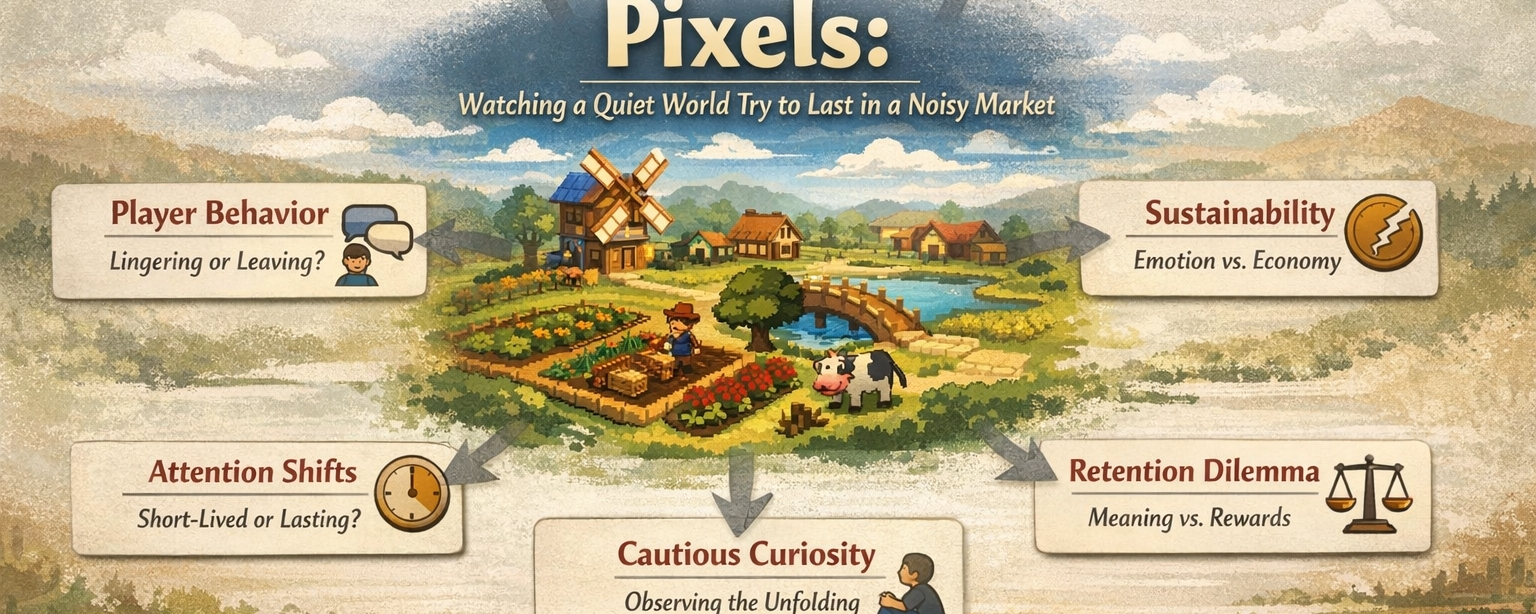
What I keep coming back to is the feeling of the space itself. Not the mechanics, not the token, but the atmosphere. The way people exist inside it. Some stay longer than expected. Some move slowly, without that constant pressure to maximize or extract. It’s subtle, but it stands out because it’s rare. Most Web3 environments feel temporary, like everyone is just passing through on their way to something else. Here, at least for now, it feels like a few people are actually pausing.
But I can’t ignore what I’ve seen happen before. Early calm can be misleading. A soft beginning doesn’t always grow into something lasting. Sometimes it just fades quietly, without ever fully forming into anything solid. Attention moves on, incentives shift, and the same space that once felt alive starts to feel empty. I don’t think Pixels is immune to that. No project really is.
There’s also a question that stays in the back of my mind—whether this kind of experience can hold people when there’s less to gain. Right now, curiosity plays a role. So does the idea of ownership, even if it’s still forming. But over time, those things get tested. When rewards stabilize or slow down, what remains? Do people stay because they want to, or because they feel like they should? That difference matters more than most teams realize.
I find myself paying attention to smaller signals now. Not announcements or promises, but behavior. Do people return without being reminded? Do they talk about their time there in a way that feels personal, not transactional? These things are harder to measure, but they tell a more honest story. Pixels shows glimpses of that kind of connection, but it’s still fragile. It could grow into something meaningful, or it could dissolve as soon as the conditions change.
There’s a quiet tension running through it. Between building something people care about and building something that sustains itself financially. Between creating a space that feels genuine and one that leans too heavily on incentives. I don’t think that tension has been resolved, and maybe it never fully is. But how it’s handled over time will define what this becomes.
I don’t feel certain about it, and I don’t think I need to. What I feel instead is a kind of cautious curiosity. Enough to keep watching, but not enough to fully believe. And maybe that’s the most honest place to be.
So I let it unfold at its own pace. I check in, I step back, I notice what changes. Because in a market that moves this fast, the only things that really matter tend to show themselves slowly—and sometimes, only after most people have already stopped paying attention.