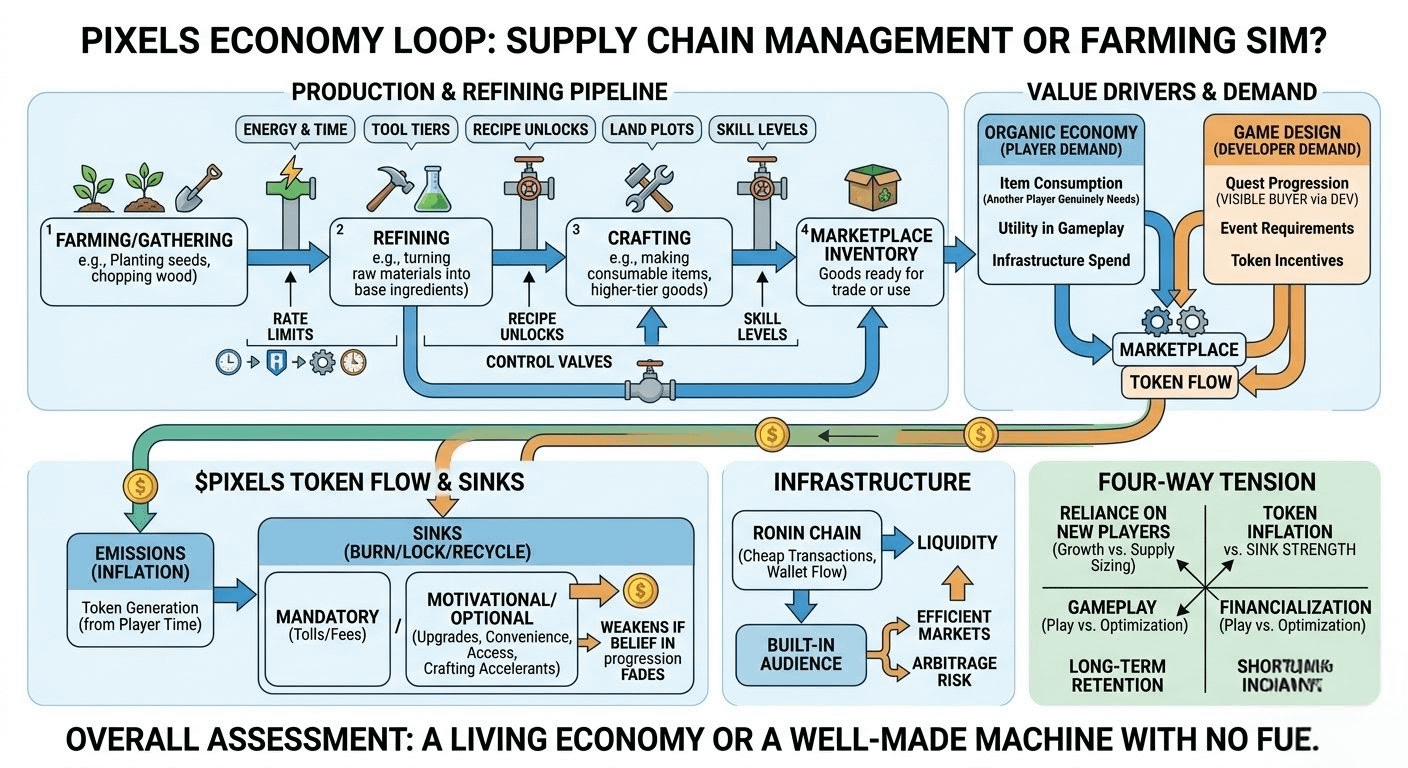
most people talk about pixels like it’s just a cute farm sim where you earn $pixels for doing chores. plant stuff, harvest, craft, sell, repeat. that’s the surface narrative and it’s not wrong, but it misses the real thing i keep noticing: the game is basically a set of throttles and conversion steps designed to turn player time into tradeable outputs, without letting the outputs spiral out of control.
resource generation is where the system shows its hands. the loop is familiar: farming/gathering → refining → crafting → either use items for quests/progression or sell them. but it’s not a free-form sandbox; it’s gated in a bunch of small ways that function like rate limits. energy/time, recipe unlocks, tool tiers, maybe land/plot constraints… it all shapes how quickly raw materials become market inventory.
one in-game loop i keep staring at: grow a basic crop → harvest → process into an ingredient → craft a higher-tier consumable → sell it because someone needs it for a quest chain. on paper, that’s “player economy.” in practice, it’s super sensitive to how many players are doing the same thing and how often the game refreshes demand. if demand is mostly quest-driven, then the dev team is kind of the invisible buyer, just wearing a mask. honestly, i’m not sure if that’s bad (traditional games do it constantly), but it does mean the economy can look healthy because the content schedule says so.
token flow is the part that feels hardest to trust. $pixels emissions make the loop feel rewarding and measurable, but emissions are also just inflation with better branding. so i’m trying to map sinks in a more cynical way: what permanently removes $pixels from circulation (burns, hard fees, irreversible spends), what temporarily locks it, and what just recycles it between players.
and here’s the part i’m thinking about: a lot of sinks in these systems are “motivational,” not mandatory. upgrades, convenience, access, crafting accelerants—players spend when they believe the next step matters. the second that belief weakens (token flat, market saturated, progression feels capped), optional sinks turn off. then you’re left with a token that keeps getting emitted and fewer reasons to spend it, which usually ends with sell pressure and a creeping “why am i doing this” vibe.
infrastructure-wise, ronin is doing a ton of work for pixels, even if players barely notice. cheap transactions and smoother wallet flows mean the game can support frequent trading and asset movement without every action feeling like a fee decision. that matters because pixels’ economy wants a lot of small trades, not a few giant ones. ronin also brings a built-in audience that already understands game nfts and marketplace behavior, which is great for liquidity but also makes the economy more “efficient” in the scary way: profitable loops get found fast, copied fast, and drained fast. if there’s an imbalance between emission rewards and crafting costs, ronin-native players will arbitrage it like it’s their job.
zooming out: is the loop sustainable? i keep coming back to whether players are generating value or extracting it. if the primary value is “i made an item another player genuinely needs and will consume,” that’s closer to a real economy. if the primary value is “i completed the actions that trigger token rewards,” then items are just intermediate steps in an emissions pipeline. the system can still function either way, but the second one tends to depend on continuous user growth (new entrants absorbing supply, buying starter assets, keeping markets liquid). when growth slows, you find out if the economy has real consumption or just circulation.
the tension i see is basically four-way:
- reliance on new players to keep demand ahead of supply
- token inflation vs sink strength (and whether sinks are fun or just tolls)
- gameplay vs financialization (does optimization replace play?)
- long-term retention vs short-term incentives (do people stay when the “earn” narrative cools off?)
i don’t have a clean conclusion, which is annoying but probably honest. pixels feels competently designed, but competence can still produce a short-term loop that looks stable until the macro mood shifts.
watching:
- do sinks remain active when $pixels price/attention drops, or do players stop spending?
- marketplace depth for crafted goods (are listings clearing without constant events?)
- retention after reward-heavy periods (who keeps farming when it’s not “worth it”?)
- how frequently they tweak emissions/gates (normal balancing vs constant patching leaks)
if user growth plateaued tomorrow and token speculation went quiet, would pixels still feel like a living economy… or would it feel like a well-made machine with no fuel?