
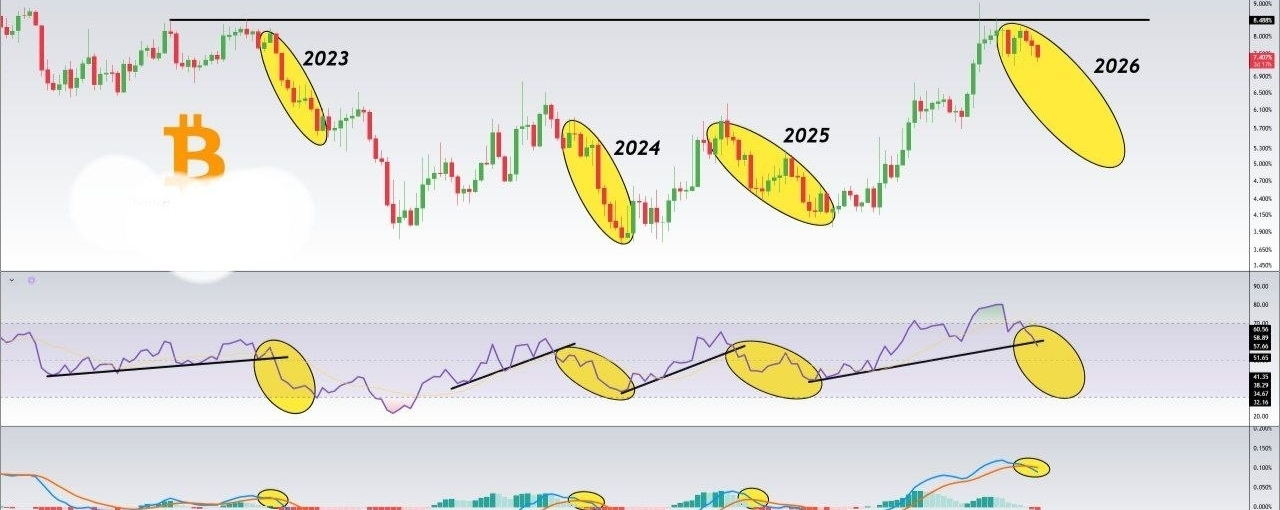

Look at the structure in your chart. Every year follows the same rhythm, but never in a way that feels obvious while you’re inside it. Price pushes up, people get louder, timelines fill with conviction—and then something subtle shifts. Not price. Not yet. Just momentum.
That’s where most get caught.
The Pattern Nobody Respects in Real Time
2023 had it.
2024 repeated it.
2025 didn’t even try to hide it.
And now 2026 is starting to lean the same way.
Strong move up. Then a tight cluster of candles near the highs. Not a sharp rejection—just hesitation. That slow bleed of confidence.
It’s not dramatic. That’s the problem.
Because people are trained to react to crashes, not to silence.
Momentum Speaks First — Price Follows Later
The RSI section tells a quiet story.
On the surface, it looks healthy—higher lows, holding structure, no obvious breakdown. But zoom in mentally and you’ll notice something off: each push upward carries less force than the last.
Price climbs. RSI shrugs.
That gap matters.
It’s the difference between a market that’s being chased and one that’s being maintained. And maintained markets don’t last long without fresh fuel.
MACD: Where the Exit Door Opens Early
MACD doesn’t scream. It drifts.
The histogram peaks, then slowly compresses. Lines get closer. Eventually, they cross—but by then, the move already feels “weird.”
That’s the stage we’re brushing against now.
Not a breakdown. Not yet.
Just… friction.
And friction is where trends go to stall.
The Illusion of Strength
Here’s where people usually get it wrong:
They see price holding near highs and assume strength.
But holding isn’t the same as pushing.
Strong markets expand. They don’t sit still and ask for validation. When price starts hovering instead of moving, it often means buyers are no longer in control—they’re just not gone yet.
That’s a very different situation.
Altcoins Don’t Lead — They Borrow Energy
Every alt rally, no matter how unique it looks, is borrowing momentum from somewhere else.
Usually Bitcoin. Sometimes macro liquidity. Occasionally a narrative wave that pulls attention for a few weeks.
But altcoins rarely generate sustained moves on their own.
So when Bitcoin starts trending hard—or worse, gets unstable—alts lose their footing fast. Not instantly. But inevitably.
That’s why these topping structures feel slow.
They are.
Narratives Come and Go. Behavior Doesn’t.
The names change every year:
AI. Gaming. DePIN. RWAs.
Different packaging. Same cycle.
Something catches attention → capital rotates in → price accelerates → late buyers arrive → early buyers quietly leave.
No announcement. No signal flare.
Just thinner moves. Slower reactions. Less follow-through.
Until one day, the chart looks heavy—and nobody can explain why.
Where This Leaves Us Now
This doesn’t look like a clean top.
But it doesn’t look like a fresh breakout either.
It looks like a market deciding whether it still has enough energy to continue—or whether it needs to reset.
And resets don’t always mean dumping.
Sometimes they mean weeks of sideways action that slowly drains interest.
Which, in its own way, is worse.
What Actually Matters Here
Not predictions. Not hope.
Just a few simple observations:
If momentum rebuilds, this structure continues
If momentum fades further, price eventually follows
If Bitcoin dominates, altcoins suffocate
If liquidity expands, everything gets another chance
Everything else is noise layered on top.
Final Thought
Altcoins rarely give you a clean ending.
They stretch the moment out. Make it feel like there’s still time. Like one more push is coming.
Sometimes it does.
Most times, it doesn’t.
And by the time that becomes clear…
the market has already moved on.