
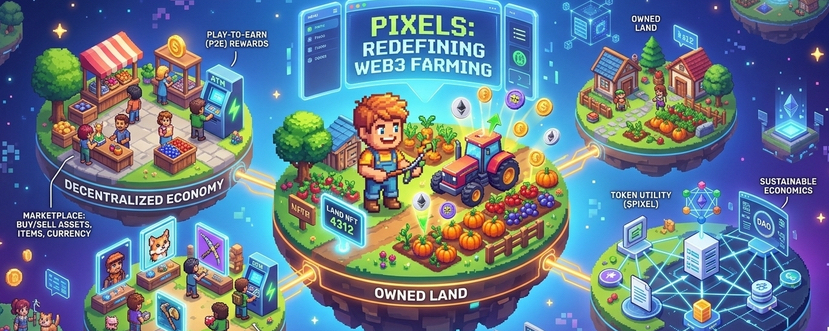
The evolution of Web3 gaming is entering a new phase, and @Pixels is one of the clearest examples of how a “stacked ecosystem” can create long-term value. Unlike traditional play-to-earn models, Pixels is not just a game—it’s a growing digital economy built around ownership, creativity, and social interaction.
At its core, $PIXEL powers everything. From NFT minting to guild participation and premium upgrades, the token acts as the backbone of the in-game economy and governance layer. This creates a circular system where players are not just users, but contributors to a living ecosystem.
What makes the Pixels stacked ecosystem interesting is how it expands beyond simple farming gameplay. With integrations like land ownership, crafting systems, and social guilds, players are effectively stacking multiple income streams and engagement layers. This “stacked” design increases retention and gives utility to every action within the game.
More importantly, Pixels leverages the Ronin network to enable fast and low-cost transactions, making Web3 gaming accessible to a wider audience. This is crucial because scalability has always been a bottleneck for blockchain games.
Looking forward, the success of @Pixels will depend on how well it continues to expand its ecosystem—whether through new gameplay loops, partnerships, or creator-driven content. If executed correctly, $PIXEL could become a benchmark for sustainable GameFi economies.
In my view, Pixels represents a shift from hype-driven tokenomics to utility-driven ecosystems. And that’s exactly what Web3 gaming needs right now.
