
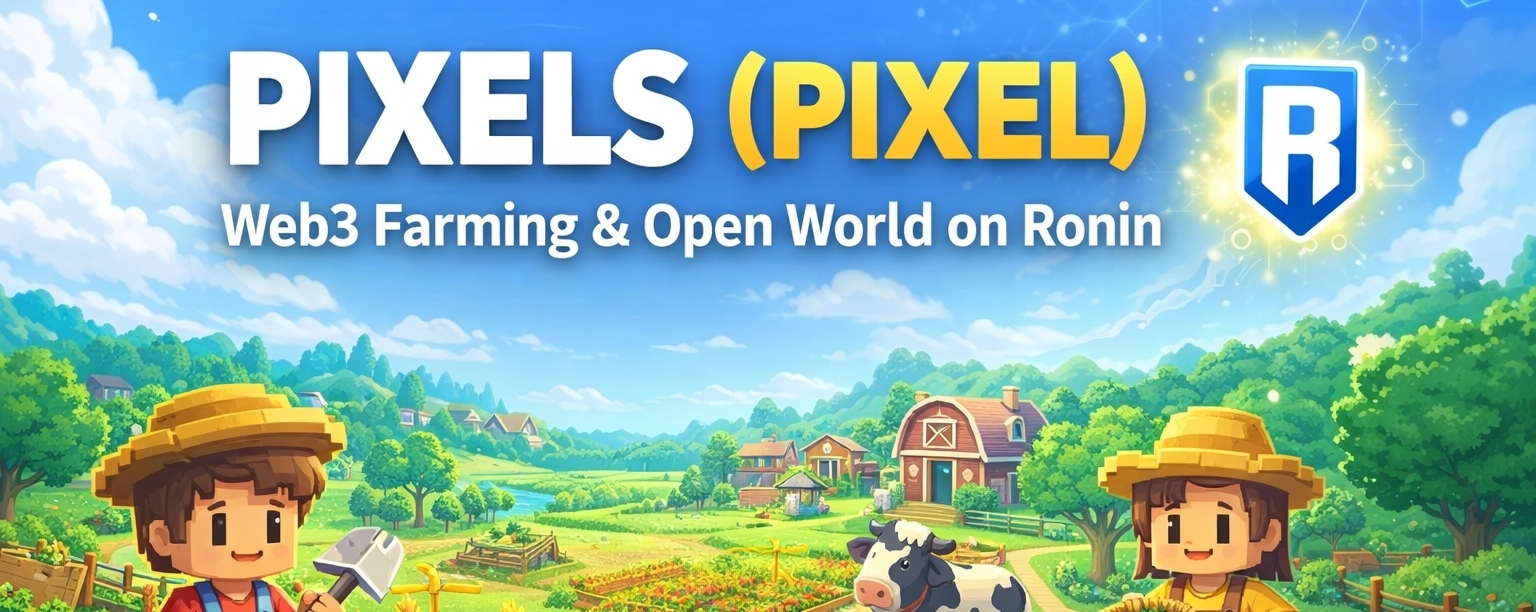
When I first came across PIXELS, I noticed something that felt different from many other Web3 projects. It did not begin with complex explanations, token mechanics, or pressure to understand blockchain systems. Instead, it introduced a calm and familiar world where players can farm, explore, and interact at their own pace. I started thinking about how intentional this approach is, especially in a space where many projects try to deliver everything at once. Here, the experience comes first, and the deeper layers appear gradually.
PIXELS is built on the Ronin Network, which is already known for supporting gaming-focused ecosystems. This decision reflects a clear direction. They’re not trying to experiment with unstable infrastructure. They are building on something that already works reliably. I’m seeing that this allows the team to focus more on gameplay and user experience rather than technical limitations. If it becomes difficult for users to interact with the system, the entire experience loses its purpose, and PIXELS seems designed to avoid that from the beginning.
At its core, PIXELS exists to solve a common challenge in Web3 gaming. Many blockchain-based games attract users through rewards but struggle to keep them engaged over time. I noticed that this often leads to short-term activity instead of long-term communities. PIXELS takes a different approach. It begins with simple and familiar gameplay elements like farming and exploration, allowing users to feel comfortable before encountering blockchain features. They’re trying to make ownership feel like a natural part of the experience, not the main reason to join.
The game world is open and flexible, allowing players to move freely, collect resources, and build their own routines. I noticed that there is no pressure to compete aggressively or optimize every action. This creates a relaxed environment that feels closer to traditional casual games. I wondered how this might influence user behavior over time. It becomes clear that when players are not under constant pressure, they are more likely to stay engaged and explore naturally. If it becomes too reward-driven, the experience can feel mechanical, and PIXELS seems careful to avoid that balance shifting too far.
As players spend more time in the game, they gradually discover its deeper systems. Ownership of land, resource management, and interactions with other players begin to connect with blockchain elements. I’m seeing that this gradual introduction reduces the barrier for new users. They are not required to understand everything at once. Instead, they learn through experience. We’re seeing a design where complexity is layered in a way that feels manageable rather than overwhelming.
The role of Ronin Network continues to support this experience in the background. Fast transactions and low costs help maintain smooth gameplay. I noticed that these technical advantages are not always visible, but they strongly influence how users feel. If actions become slow or expensive, users lose interest quickly. PIXELS avoids this issue by relying on infrastructure that is already optimized for gaming environments.
The design philosophy of PIXELS focuses on simplicity, consistency, and gradual progression. They are trying to create a system where users feel comfortable experimenting without pressure. I started thinking about whether this slower approach might limit rapid growth. However, it may also lead to stronger retention over time. When players are not driven only by rewards, they are more likely to form habits and return regularly. I’m seeing that this supports a more stable ecosystem.
Measuring progress in PIXELS also appears to follow a different logic. Instead of focusing only on token price or sudden spikes in activity, the project seems to value user engagement and community interaction. It becomes clear that long-term success depends on how users actually behave within the game. They’re focusing on building consistency rather than chasing attention.
At the same time, there are realistic challenges. I noticed that balancing gameplay and economic systems can become more difficult as the project grows. If financial incentives become too strong, they may change how users interact with the game. There is also the challenge of scaling while maintaining simplicity. Even with strong infrastructure, growth introduces new complexities that must be managed carefully.
Another important factor is broader Web3 adoption. Many users are still unfamiliar with blockchain systems. PIXELS reduces this barrier, but it cannot remove it completely. Education and onboarding will continue to play an important role. If it becomes too dependent on external market conditions, user activity may fluctuate, which is a common risk across similar projects.
Looking at the long-term direction, PIXELS appears to follow a steady and controlled path. We’re seeing a model where the game evolves alongside its community rather than changing direction suddenly. New features are introduced carefully, allowing users to adapt without feeling overwhelmed. They are trying to build a persistent world that feels stable over time.
In the end, PIXELS presents a calm and thoughtful interpretation of Web3 gaming. It does not rely on strong promises or aggressive positioning. Instead, it builds a simple and consistent experience where users can gradually understand both gameplay and ownership. I noticed that this approach may not create immediate excitement, but it builds something more reliable.
If it becomes widely adopted, it will likely be because users find real value in the experience itself. They’re not trying to rush adoption. They are allowing it to grow naturally through participation and understanding. PIXELS reflects a more patient vision of Web3 gaming, shaped step by step through real engagement rather than short-term momentum.