
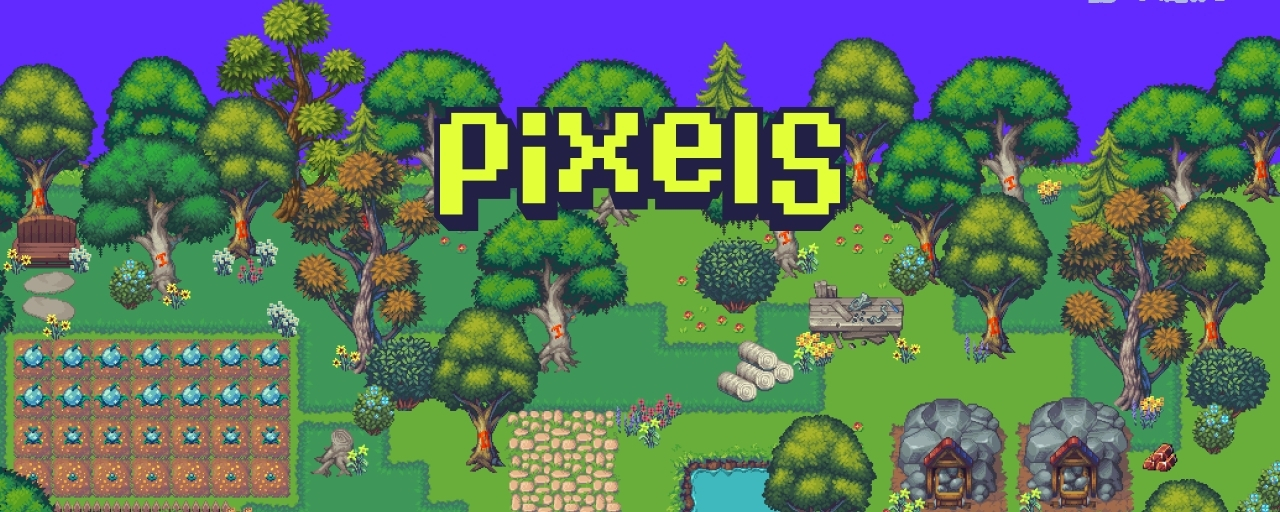

At first glance, Pixels don't seem revolutionary. There are no aggressive promises of "fast big earnings," no overwhelming mechanics designed to hold your attention, no loud marketing shouts about life-changing rewards. It feels… slow. Almost too easy.
That's where its cool benefits begin.
The part most people miss
In the early days, players came expecting the typical Web3 pattern: optimize, extract, move on. They plant crops, complete work, maybe flip some resources. It looks familiar.
But after a while, something subtle happens.
Don't push the game back.
There is no urgent pressure to force you to grind every day. No system penalizes you severely for moving. You can log off, disappear for days or weeks, and when you come back, the world hasn't collapsed around you.
That design choice seems small. it is not
Most Web3 games are built like fragile economies - if players stop playing, everything collapses. The Pixel quietly avoids that trap by not relying on constant pressure to survive.
The real advantage: Time works with you, not against you
In many blockchain games, time is your enemy. If you're not early, you're late. If you don't grind, you lose.
Pixels that flips dynamically.
Here, time softens somewhat. Progress is not erased by absence, and value is not tied purely to speed. It changes the behavior of the players:
They test rather than optimize
They explore rather than rush
They live longer without realizing it
Instead of extracting value as quickly as possible, players start living inside the system. This is a rare change in Web3.
good side
This quiet framework produces some powerful results:
1. Less burnout
Players don't feel like they're doing a second job. The game breathes, and so do they.
2. More genuine engagement
While earning is not the only motivation, people actually play for curiosity, creativity and social interaction.
3. A more stable economy (potential)Because not everyone is in a rush to extract value at once, the system has a chance to stabilize rather than inflate and collapse.
4. Return-friendly design
Most Web3 games punish absences. Pixel tolerates it. This alone boosts long-term retention in a way that hype never can.
bad side
But these same benefits come with trade-offs that aren't always obvious.
1. Feels slow to many players
For users trained by the fast-gain Web3 cycle, Pixels can feel uncomfortable. A lack of urgency can seem like a lack of opportunity.
2. Weak short-term excitement
Without aggressive incentives, it doesn't generate the same explosive hype. Growth may look flat compared to competitors.
3. The risk of passive behavior
If the system is too loose, some players quit altogether rather than form deep habits.
4. Economic uncertainty still exists
Even with better design, it's still a token-based ecosystem. If external demand falls, no amount of "good design" will fully protect the economy.
Quiet trade off
The Pixel isn't trying to win the short-term attention war. This is making a different bet:
A system built around patience, flexibility and resilience can outperform systems built on urgency and extraction.
It's not flashy. It does not trend easily. And it doesn't reward everyone immediately.
But it does something that most Web3 games fail to do—it places players.
underlying truth
The Pixel's quiet advantage isn't a feature you can point to. This is a feeling:
You are not being rushed.
You are not being forced.
You are not being drained.
And ironically, that may be the only way a Web 3 game can survive substantially.
The real question isn't whether pixels are perfect.
In this slow, speed-addicted world,Whether the cool design can hold players' attention.