
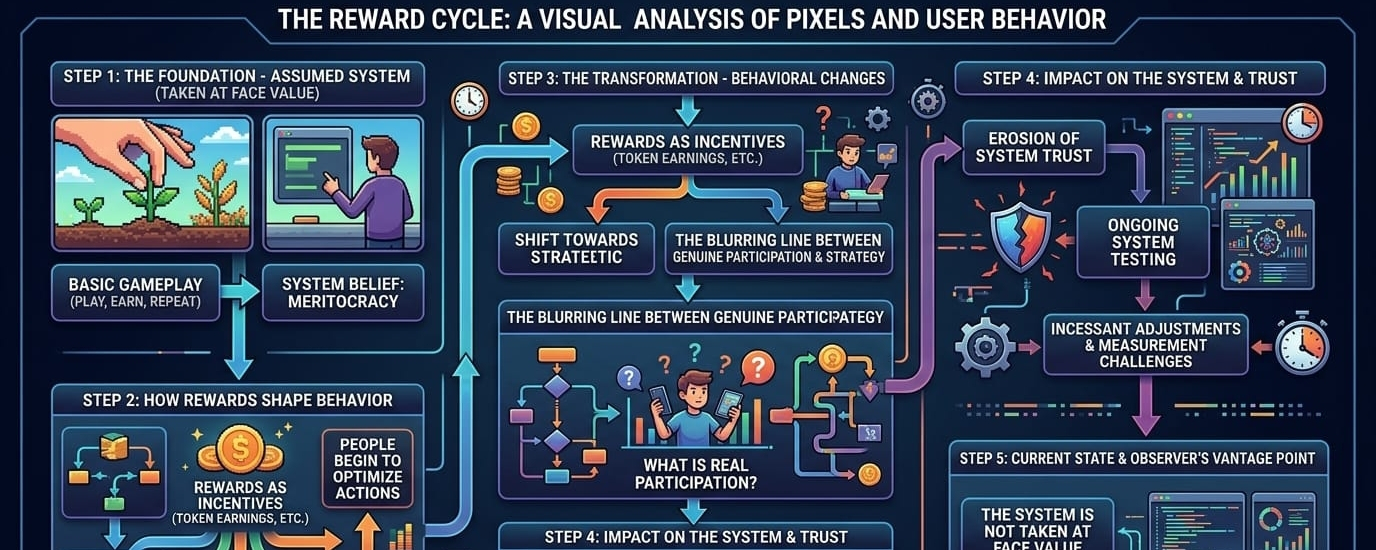
There is a persistent myth in Web3 gaming that “everything runs on-chain”—that gameplay, state changes, and interactions are all permanently executed and stored on a blockchain. In reality, modern Web3 games like Pixels, a social farming and exploration game built around the Ronin ecosystem, rely heavily on hybrid architectures that look far more like traditional high-scale online games than decentralized autonomous systems.
Understanding this distinction is essential if we want to evaluate both the promise and the limitations of Web3 gaming.
At the core of systems like Pixels is a conventional, highly optimized backend designed for responsiveness and scale. The majority of gameplay logic—movement, farming cycles, crafting interactions, world exploration—is handled off-chain through event-driven server architectures. These servers process player actions in real time, emit events, and maintain authoritative game state without ever touching the blockchain. This design is not accidental; it is a necessity. Blockchains are inherently slow compared to modern backend systems, and introducing on-chain latency into moment-to-moment gameplay would make the experience unplayable.
Instead, these systems typically rely on asynchronous event pipelines. When a player performs an action, the backend logs it as an event, processes it through distributed services, and updates relevant game states. This architecture allows horizontal scaling, meaning thousands or even tens of thousands of concurrent users can interact with the world without bottlenecks. Event queues (such as Kafka-like systems or lightweight equivalents) help decouple services so that inventory updates, farming cycles, social interactions, and analytics processing do not block one another.
Behind this event layer sits a carefully structured data infrastructure. Relational databases like PostgreSQL are often used for persistent, structured data: player accounts, progression states, item definitions, and economic records. These systems provide consistency guarantees that are essential for avoiding duplication or corruption of in-game assets.
However, relational databases alone are not enough for real-time gaming environments. This is where in-memory systems like Redis become critical. Redis is often used as a real-time state layer for active sessions, caching frequently accessed data, and managing ephemeral gameplay states such as current map positions or active interactions. By keeping this data in memory, the system avoids constant database hits and reduces latency to milliseconds—an essential requirement for maintaining the illusion of a seamless, responsive world.
The blockchain layer is deliberately narrow in scope. Rather than governing gameplay, it functions as a settlement and ownership system. Assets like NFTs, tokenized rewards, or marketplace transactions are recorded on-chain via blockchain APIs. In the case of ecosystems like Ronin, this typically involves batching transactions or syncing periodic state changes rather than writing every in-game event directly to the chain. This selective approach ensures that the system benefits from blockchain properties—ownership transparency, tradability, and provenance—without sacrificing performance.
Latency optimization is the central design constraint that shapes everything. If a farming action had to wait for blockchain confirmation, gameplay would grind to a halt. So instead, actions are validated and reflected instantly off-chain, while the blockchain is updated asynchronously. This introduces a subtle but important abstraction layer: what the player sees is not the blockchain state, but a fast-moving simulation maintained by centralized infrastructure.
This hybrid model, while practical, comes with trade-offs.
The most obvious is dependency on external APIs and infrastructure layers. If the blockchain network experiences congestion, if RPC providers degrade, or if indexing services lag behind, discrepancies can emerge between on-chain truth and in-game representation. These systems often require custom reconciliation logic to resolve conflicts between off-chain state and blockchain state.
Another challenge is desynchronization risk. Because game state is effectively split between a fast off-chain system and a slower decentralized ledger, edge cases inevitably arise: delayed transactions, failed mints, or mismatched asset ownership states. Developers must build fallback systems, retry mechanisms, and sometimes even manual intervention tools to maintain consistency.
There is also a philosophical tension at the heart of this architecture. The more optimized and responsive the off-chain system becomes, the less “on-chain” the actual gameplay feels. At some point, blockchain becomes more of a financial and ownership backend than a meaningful part of the game loop itself.
Despite these issues, hybrid architectures remain the only viable approach for scaling Web3 games today. Fully on-chain games exist, but they are limited in complexity, speed, and user experience. The hybrid model is a compromise between decentralization and usability—one that favors performance where it matters most.
Which leads to a deeper question: as these systems grow more complex, with multiple layers of off-chain infrastructure, synchronization services, and blockchain settlement mechanisms, are we truly building decentralized games—or are we just building traditional game architectures with a blockchain-shaped accounting layer attached? And if so, does that architectural complexity eventually become the very constraint that limits Web3 gaming’s long-term scalability and philosophical promise?
