
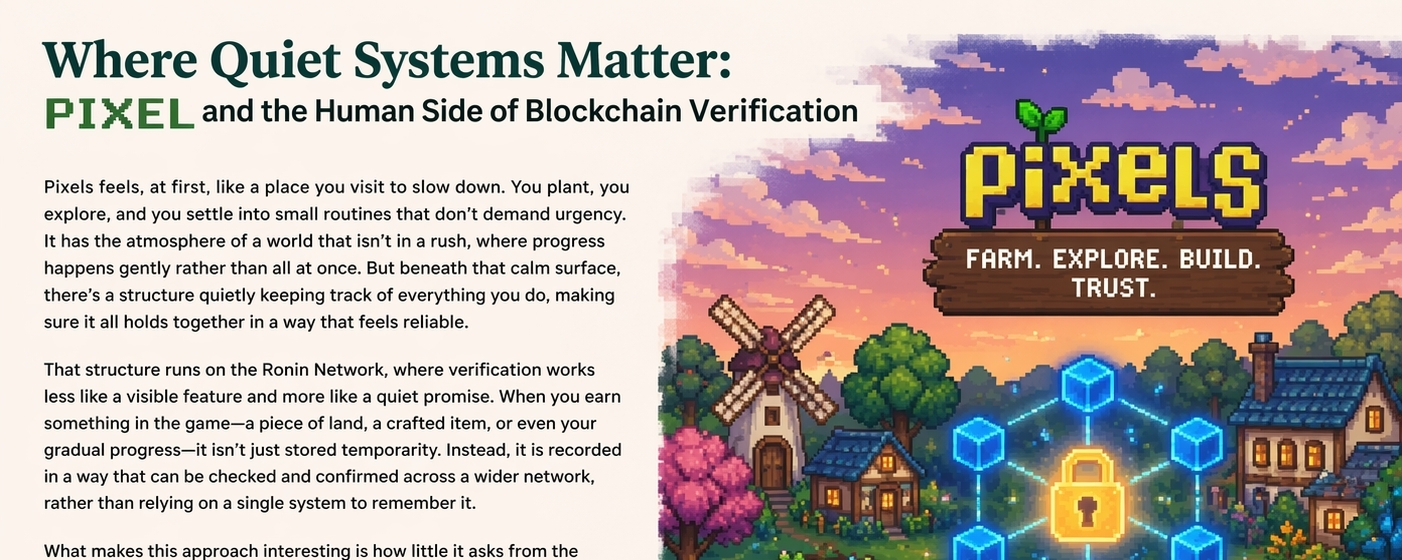
Pixels feels, at first, like a place you visit to slow down. You plant, you explore, and you settle into small routines that don’t demand urgency. It has the atmosphere of a world that isn’t in a rush, where progress happens gently rather than all at once. But beneath that calm surface, there’s a structure quietly keeping track of everything you do, making sure it all holds together in a way that feels reliable.
That structure runs on the Ronin Network, where verification works less like a visible feature and more like a quiet promise. When you earn something in the game—a piece of land, a crafted item, or even your gradual progress—it isn’t just stored temporarily. Instead, it is recorded in a way that can be checked and confirmed across a wider network, rather than relying on a single system to remember it.
What makes this approach interesting is how little it asks from the player. There’s no moment where the game pauses to explain what’s happening behind the scenes, and no need to engage with technical steps. The system simply works, almost invisibly, allowing the experience to remain smooth and uninterrupted. It’s a kind of background reliability that you notice only when you stop to think about it.
Over time, this creates a subtle but meaningful sense of trust. You don’t find yourself worrying about whether your progress will last or if what you’ve built might disappear. The game feels consistent, as though it remembers you even when you’re away. That quiet continuity shifts the experience from something temporary into something that feels more lasting.
In the end, Pixels doesn’t try to showcase blockchain verification as its main attraction. It lets the technology stay in the background, doing its work quietly. And in doing so, it gives the world a sense of steadiness that feels both technical and, in a simple way, human.
