
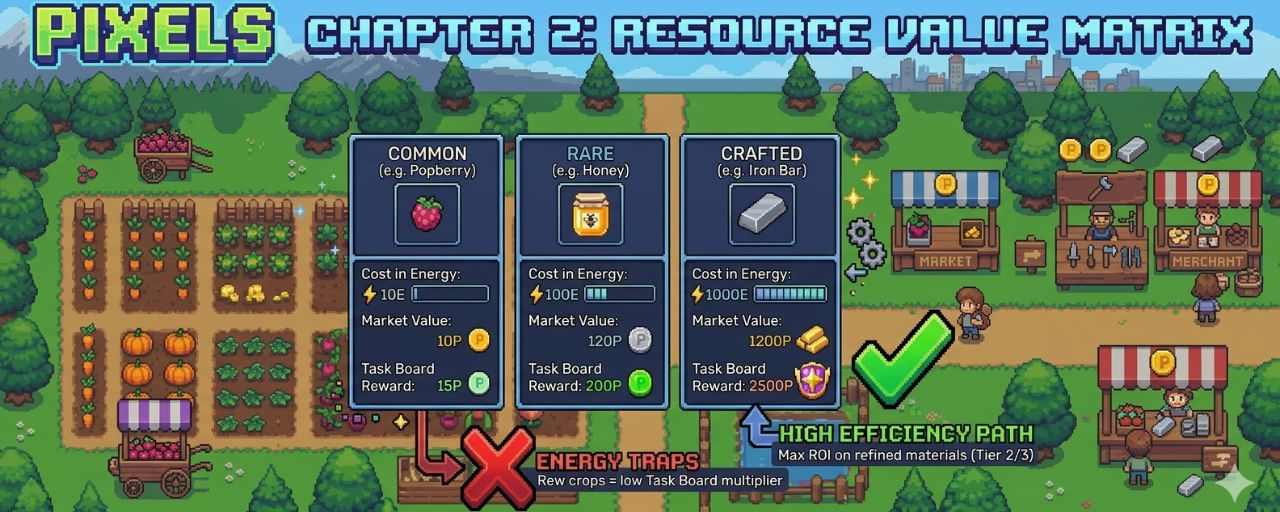
If you are treating the Task Board like a simple 'to-do list', you are likely operating at a deficit. In Chapter 2, the algorithm that generates rewards is designed to test your economic discipline. To reach the top rankings, you must transition from a worker to a manager who understands the Energy-to-Pixel (E2P) ratio.
The core problem for many players is the 'Sunken Cost Trap'. You spend 200 energy growing crops, only to deliver them for a reward that barely covers the cost of the seeds and the energy consumed. In this article, we will break down the Resource Value Matrix to help you identify which tasks are worth your time and which are designed to drain your progress.
Step 1: The Energy Floor
Every action in Pixels has a hidden cost in Energy. To calculate the true value of a task, you must establish your 'Energy Floor'. If 1000 Energy can be converted into 50 $PIXEL through your most efficient activity, then 1 Energy is worth 0.05 $PIXEL. If a task asks for resources that cost 500 Energy to produce but only offers 10 $PIXEL, you are effectively losing 15 $P$PIXEL potential value. Top-tier players never accept a task that falls below their established Energy Floor.
Step 2: Identifying 'Resource Traps'
Certain resources are 'traps' because their market value or crafting complexity is not reflected in the Task Board rewards. Common examples in the current meta include:
Low-tier raw crops: High energy consumption, very low reward multiplier.
Complex multi-stage crafts: Sometimes the raw materials are worth more on the market than the final product is worth to the Task Board.
Our Resource Value Matrix infographic shows that the highest ROI (Return on Investment) currently lies in Tier 2 refined materials. These are items that require a specialized skill level of 15-25 but do not yet require the extremely expensive legendary resources.
Step 3: The Cycle of Refreshing
The most powerful tool on the Task Board is not the 'Deliver' button—it is the timer. High-ranking accounts are built on the 'Selective Cycle' strategy. They check the board, complete only the 10% of tasks that offer a 'Mega-Reward' (tasks with a yellow or glowing border), and then ignore the rest. They allow the board to refresh naturally or use the skip mechanic to wait for the next high-value cycle.
By focusing only on high-multiplier tasks, you preserve your energy for activities that actually grow your account balance. This strategy requires patience, but it is the only way to climb the leaderboard without spending a fortune on energy refills.
Stop being a delivery driver for the game. Start being an analyst. Calculate your Energy Floor, skip the traps, and only deliver when the multiplier is in your favor.
Are you tracking your Energy-to-Pixel ratio? Let's share our most profitable craft recipes in the comments.