

You open the game and it looks like something you’ve played a dozen times before—tiny crops, blocky characters, that soft, harmless vibe that says “relax, nothing serious here,” except this time there’s money tangled up in the dirt and suddenly the whole thing feels different.
It’s not nothing.
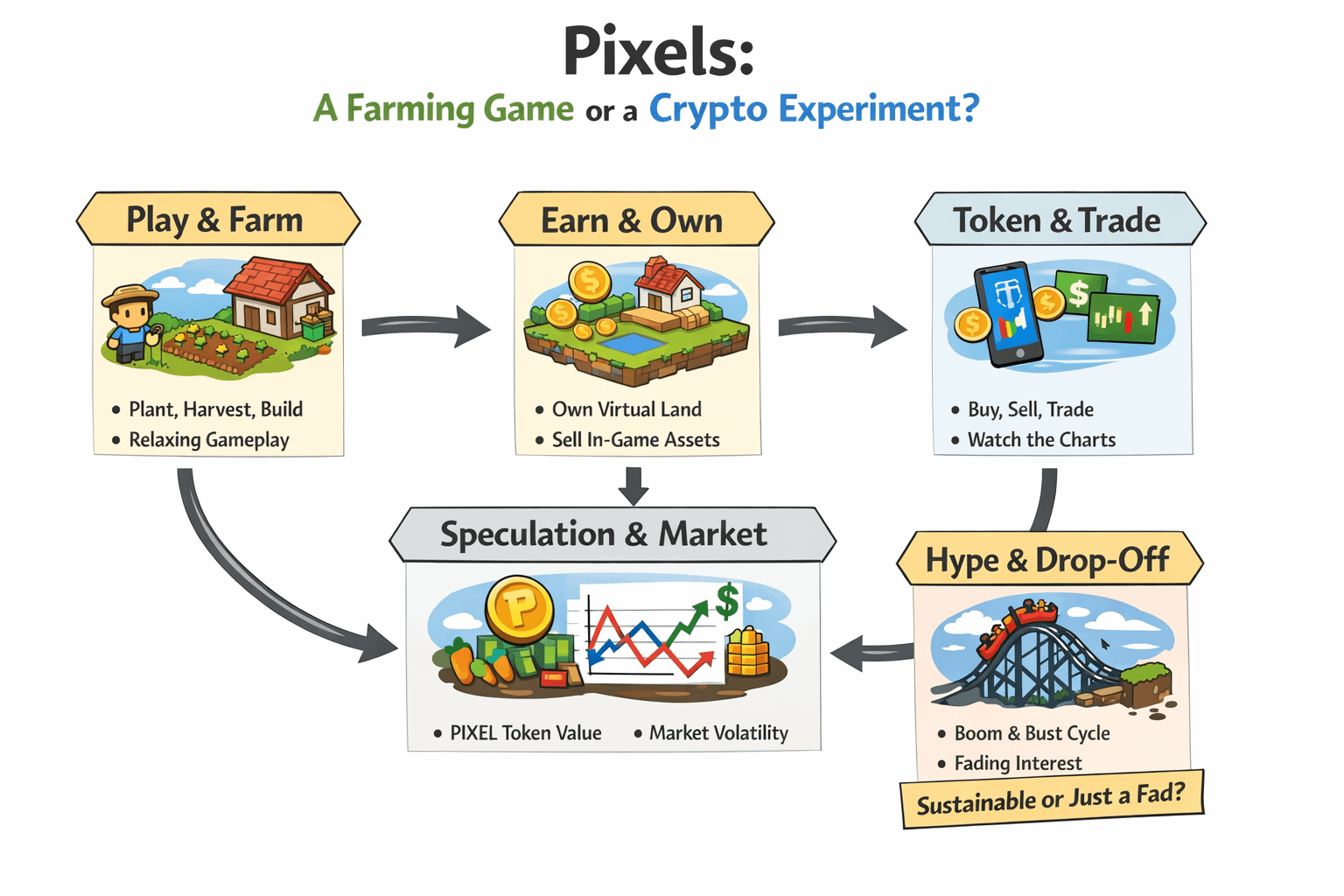
Pixels is supposed to be this Web3 farming world where your time actually means something outside the game, where the carrots you plant and the wood you chop aren’t just lines of code sitting on someone else’s server but assets you can move, sell, maybe even profit from if the timing doesn’t betray you.
That’s the pitch.
And you’ve heard it before.
Play, earn, own—same trio of promises dressed up in slightly different clothes, except now it’s running on Ronin, which is faster, cheaper, less annoying than older chains, and honestly that part does help because no one wants to click a button and then wait like they’re sending a fax in 2003.
Speed matters.
But here’s where it gets messy.
You’re not just playing anymore, you’re thinking in terms of value, which crops are worth planting, which items other players might actually want, whether it’s smarter to grind for hours or just step back and watch the market swing like it always does.
It changes you.
And maybe that’s the point.
Or maybe that’s the problem.
Because what starts as a chill farming loop—plant, water, harvest—slowly morphs into something else, something a bit more calculated, where every action has this quiet question attached to it: “Is this worth it?”
That question sticks.
You’ll see it in how people move around the world too, some players just wandering, clearly here for the vibe, while others are locked in, optimizing routes, tracking resources, treating the whole thing like a spreadsheet with graphics layered on top.
You can tell.
It’s not subtle.
Then there’s land, which sounds harmless until you realize it’s basically digital property with real stakes attached, and suddenly you’re not just farming, you’re managing space, thinking about placement, efficiency, maybe even passive income if you’re the type who likes squeezing value out of everything.
It gets serious.
Actually, scratch that—it gets weird.
Because now you’re asking yourself questions you never used to ask in games, like whether it’s worth buying virtual land early before prices climb, or whether that’s just you falling into the same speculative loop people fall into everywhere else.
Feels familiar.
The PIXEL token sits right in the middle of all this, quietly dictating the mood of the entire game because when it’s up, everything feels exciting, and when it’s down, suddenly the grind feels heavier, slower, a little pointless if you’re being honest.
Numbers matter.
I might be wrong, but that’s the real engine here—not farming, not community, not even ownership, just the constant movement of value pulling people in and pushing them out depending on which way the chart leans that day.
It’s fragile.
And yeah, the game itself is decent, which is more than you can say for a lot of these projects that feel like finance apps pretending to be games, because Pixels at least understands that if it’s not fun, people won’t stay, no matter how many tokens you throw at them.
Fun still wins.
But here’s the part no one tells you.
Even if the gameplay holds up, even if the economy doesn’t collapse tomorrow, you’re still inside a system that depends on attention, new players, constant activity—because without that, the whole structure starts to creak in ways you can’t ignore.
It needs momentum.
And momentum doesn’t last forever.
You can feel that tension if you play long enough, that quiet uncertainty sitting behind everything, like everyone’s enjoying it but also kind of watching the exits at the same time, just in case things shift too quickly.
People notice.
So where does that leave you?
You can jump in, try it out, see if the loop grabs you, maybe even make something from it if you’re early or smart or just lucky enough to be on the right side of the timing.
That part’s real.
But don’t pretend this is some stable new reality where games suddenly respect your time out of pure goodwill, because they don’t, and they won’t, and this—whatever Pixels is—still has one foot in the same old cycle of hype, attention, and eventual drop-off.
Nothing’s changed that much.
And maybe that’s the uncomfortable truth sitting underneath all of this.
You’re not just farming crops.
You’re farming belief.