
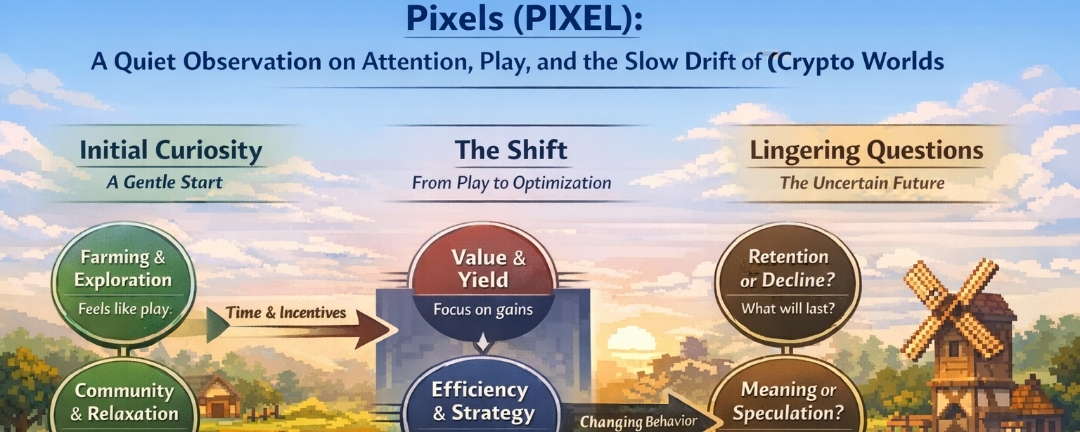
I keep watching Pixels (PIXEL) the same way I’ve started watching most of this market lately—without urgency, without the old instinct to label everything as early or late. Just observation. A kind of quiet attention that comes after you’ve seen enough cycles repeat themselves in slightly different clothing.
What I notice first isn’t the game itself, but the feeling around it. Farming, exploration, creation—these are calm words. They’re almost grounding in a space that usually isn’t. And for a moment, it actually feels like that matters. Like there’s room for something slower here, something less aggressive than the usual rush of charts and narratives.
But then I remember how this usually unfolds.
In the beginning, everything feels like play. People show up because it’s light, because it doesn’t demand too much. There’s curiosity, sometimes even genuine relaxation in it. You can tell when a system still has that stage because no one is talking like they’re calculating yet. They’re just inside it.
And then, slowly, without a clear turning point, something shifts.
The same actions are still happening, but the feeling behind them starts to change. Farming becomes repetition with purpose. Exploration starts to carry direction. Creation starts to feel like output. Nothing breaks, nothing announces itself, but the emotional tone inside the activity quietly rewrites itself.
I’ve seen this enough times to recognize it even when it’s subtle.
Pixels feels like it’s holding both versions of itself at once right now. One side is still genuinely playful—people engaging with it like a small world they can return to without pressure. The other side is already slightly more serious, where every action sits next to an unspoken question about value, timing, or outcome. Those two mindsets can coexist for a while, but they rarely stay balanced.
What usually decides the direction isn’t the design. It’s attention.
Attention always starts soft. It arrives as interest, then curiosity, then habit. But in crypto environments, attention almost never stays neutral for long. It gets pulled toward optimization. Even when a project tries to remain a world, it slowly gets treated like a system. And once that shift happens, the experience inside it changes whether the developers intend it or not.
Pixels is still early enough that the shape hasn’t settled. That’s what makes it interesting in a cautious way. It hasn’t fully become anything fixed yet. But I don’t trust “not yet” as a stable condition anymore. In this space, “not yet” often just means “transitioning quietly.”
Ronin as an ecosystem carries its own memory too. I find that impossible to ignore. Every network has a kind of emotional history attached to it—periods of excitement, periods where engagement thins, periods where everything feels overhyped in hindsight. That memory doesn’t control what comes next, but it colors how quickly belief forms and how quickly it fades.
With Pixels, I keep coming back to one question that doesn’t have a clean answer: how long can something stay meaningful when meaning and incentive are sitting in the same room?
Because that’s always the tension. If there’s no incentive, attention is harder to sustain in crypto. If there is incentive, meaning starts to bend around it. And somewhere in that tension, projects either stabilize or slowly hollow out without anyone noticing right away.
I don’t feel convinced either way here. Not that it matters what I feel. The market doesn’t really respond to personal readings of it anyway. But I’ve learned to trust the moments where conviction doesn’t arrive quickly. Those are usually the ones that reveal the most later.
So I keep watching Pixels in that unfinished space where it still feels like a world to some people and a system to others. Those two interpretations will eventually collide or separate. That part always happens, even if the timing is unclear.
And I think what I’m really waiting for isn’t growth or collapse. It’s the moment when the early emotional texture fades enough that you can finally see what was actually holding people there in the first place.