
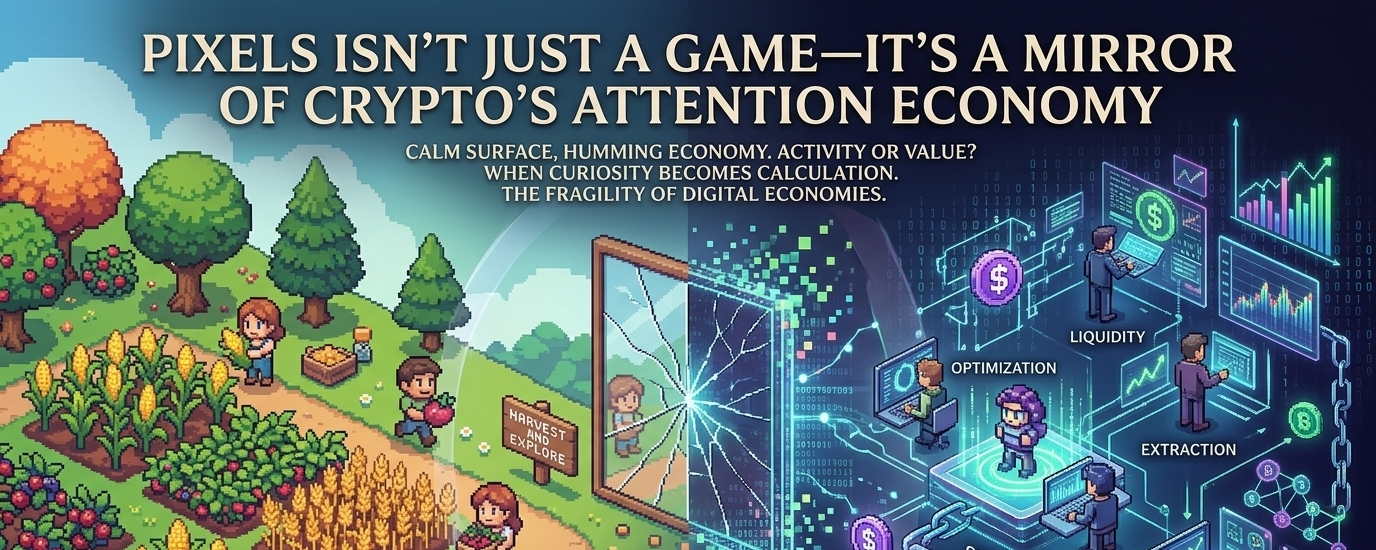
I logged in expecting noise the usual crypto urgency but instead I found something softer. Crops growing at their own pace. Simple routines. A world that didn’t demand, just waited. I planted, harvested, walked around. It felt less like a game I needed to win and more like a place I could return to.
But that calm surface didn’t last.
The longer I stayed, the more I started to notice the structure underneath. Every action had a purpose beyond itself. Farming wasn’t just farming—it was production. Exploration wasn’t curiosity—it was optimization. Creation wasn’t expression—it was part of an economy quietly humming beneath the experience.
That’s when the question shifted for me.
Not what is Pixels?
But why does it exist this way?
Like most Web3 systems, it’s ultimately trying to solve a familiar problem: how to hold attention and turn it into sustained economic activity. Not just users but users who return, engage, and contribute liquidity in the form of time, tokens, and behavior.
And Pixels does this cleverly.
It builds loops.
You log in to harvest, which lets you craft, which lets you progress, which nudges you to return. These loops are simple individually, but together they create rhythm. A daily pattern. A sense of momentum. And for a while, that momentum feels like value.
But I started to notice something uncomfortable.
Activity isn’t the same as value.
Just because I’m logging in every day doesn’t mean the system is getting stronger. It might just mean I’ve adapted to it. I’ve learned the most efficient routes, the best crops, the optimal timing. My behavior shifts from curiosity to calculation.
And when enough users make that shift, the system changes.
It becomes less about discovery and more about extraction.
That’s where fragility begins to show. Because optimized users don’t behave the same way as curious ones. They’re more sensitive. More reactive. They follow incentives closely—and leave just as quickly when those incentives weaken.
Pixels, like many tokenized environments, sits in that tension.
On one side, there’s growth—new users, new land, new activity. On the other, there’s retention—how many people stay when the novelty fades, when rewards normalize, when routines become repetitive.
Governance exists, but in practice, it often feels distant. Decisions shape the economy, yet most players interact with outcomes, not influence. And over time, subtle forces begin to accumulate: inflation from rewards, dilution of effort, small shifts in earning potential.
Nothing breaks suddenly.
It just slowly changes.
What once felt generous starts to feel average. What once felt engaging starts to feel like maintenance. And the system depends more and more on new energy to sustain old expectations.
That’s the balance I see in Pixels.
It has real potential. The design is thoughtful. The loops are effective. It understands how to onboard and engage in a way many crypto projects don’t. But it also carries the same structural risks—where engagement can mask underlying weakness, and where growth can temporarily hide slow erosion.
The real test isn’t happening now.
It comes later.
When growth slows. When fewer new players arrive. When the system has to rely not on expansion, but on its core design to keep people there.
That’s when we find out what was real.
For me, Pixels isn’t just a game. It’s a reflection.
It shows how easily we confuse motion with progress. How quickly curiosity becomes strategy. And how fragile digital economies can be when they depend more on behavior than belief.
I still log in sometimes.
But now, I pay less attention to what I’m doing—and more to why I’m doing it.
