
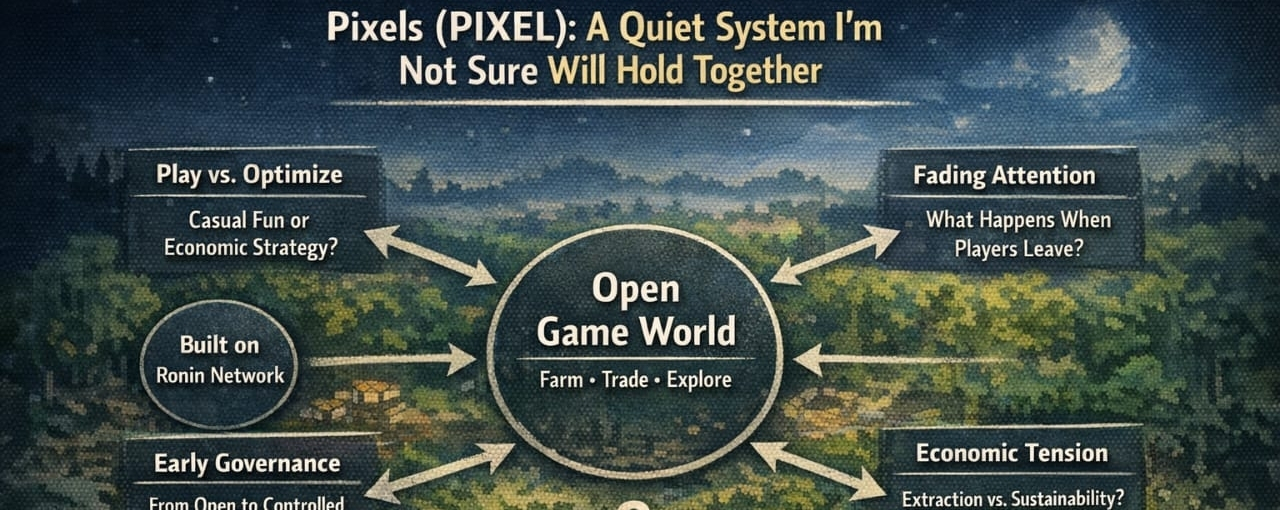
I keep drifting back to Pixels in a way I don’t fully understand. It’s not the kind of thing that demands attention. It doesn’t try to overwhelm you with complexity or ambition. If anything, it feels almost too simple at first glance. And yet, it lingers in my mind longer than projects that are objectively more advanced.
Maybe it’s because it doesn’t feel finished—not in a broken way, but in a way that suggests it’s still quietly becoming something.
On the surface, it looks harmless. You plant, you gather, you move around, you interact. It feels closer to a routine than a system. But I can’t shake the sense that underneath that softness, there’s something more structured, something that behaves less like a game and more like a set of incentives slowly arranging people over time.
It’s built on Ronin Network, which already carries its own quiet assumptions about scale, efficiency, and who ultimately gets to matter. I don’t think most players think about that while they’re playing. And maybe they shouldn’t. But infrastructure has a way of shaping outcomes without asking for attention.
That’s where my curiosity starts to turn into uncertainty.
I find myself wondering what happens when the feeling of novelty wears off. Right now, there’s enough activity to make everything seem alive. People log in, interact, trade, experiment. It creates the impression of a self-sustaining world. But attention can imitate stability. It can make something look balanced when it’s actually being held up by participation that isn’t guaranteed to last.
If fewer people show up, the system doesn’t just get quieter—it changes character.
And I’m not sure Pixels has revealed what it looks like under that kind of pressure.
There’s also this subtle tension between playing and optimizing. At first, they feel like the same thing. You engage, you progress, you learn. But over time, those paths can split. Some people keep playing. Others start solving. They look for patterns, efficiencies, shortcuts. The system becomes something to decode rather than experience.
And once that shift happens at scale, it’s hard to reverse.
I don’t think that’s a flaw unique to Pixels. It’s something most systems drift toward. But here, it feels more delicate because the entire experience is built on something that looks casual. When optimization seeps into something that’s meant to feel light, it changes the atmosphere. Quietly, but noticeably.
I also keep thinking about how control forms over time.
In the beginning, everything feels open. Anyone can join, participate, contribute. But openness doesn’t always last in the way people expect. Over time, familiarity becomes an advantage. The people who understand the system best start to shape it more than others. Not because they’re trying to dominate, but because they’re the ones still there, still engaged, still aligned with how the system works.
And slowly, that can start to look like coordination—even if no one calls it that.
Governance, if it exists in any meaningful way, tends to follow that same path. It begins as something broad and inclusive, then gradually narrows into something more procedural, more influenced by those who have the most context and the most at stake. Decisions don’t feel imposed, but they also don’t feel entirely neutral anymore.
It’s a quiet drift, not a sudden shift.
Then there’s the economy underneath all of this, which I don’t think is as stable as it appears when things are going well. Systems like this depend on a kind of balance that’s easy to maintain in growth and much harder to maintain in stagnation. If too much value is extracted, the system weakens. If too little is extracted, people lose interest.
The space between those two outcomes is narrow, and it relies on behavior staying within expected limits.
But behavior doesn’t stay still. People adapt. They coordinate. They push systems into corners they weren’t designed for. And when that happens, the original intent of the system becomes less relevant than how it’s actually being used.
That’s the part I can’t fully resolve.
There’s a version of Pixels that becomes something steady and unremarkable in the best way—a place that continues to function even when no one is paying close attention. But there’s also a version where it slowly leans on cycles of engagement, where activity needs to be constantly refreshed to keep things from thinning out.
Both versions feel plausible. Neither feels guaranteed.
And maybe that’s why it keeps resurfacing for me. Not because I believe in it, but because I don’t feel comfortable dismissing it either.
It feels like something that could quietly matter, but only if it survives the moment when things stop feeling easy.
I don’t know if it’s built for that moment. I don’t know if any system like this really is.
But I can’t tell yet whether it’s holding together—or just being held up.