
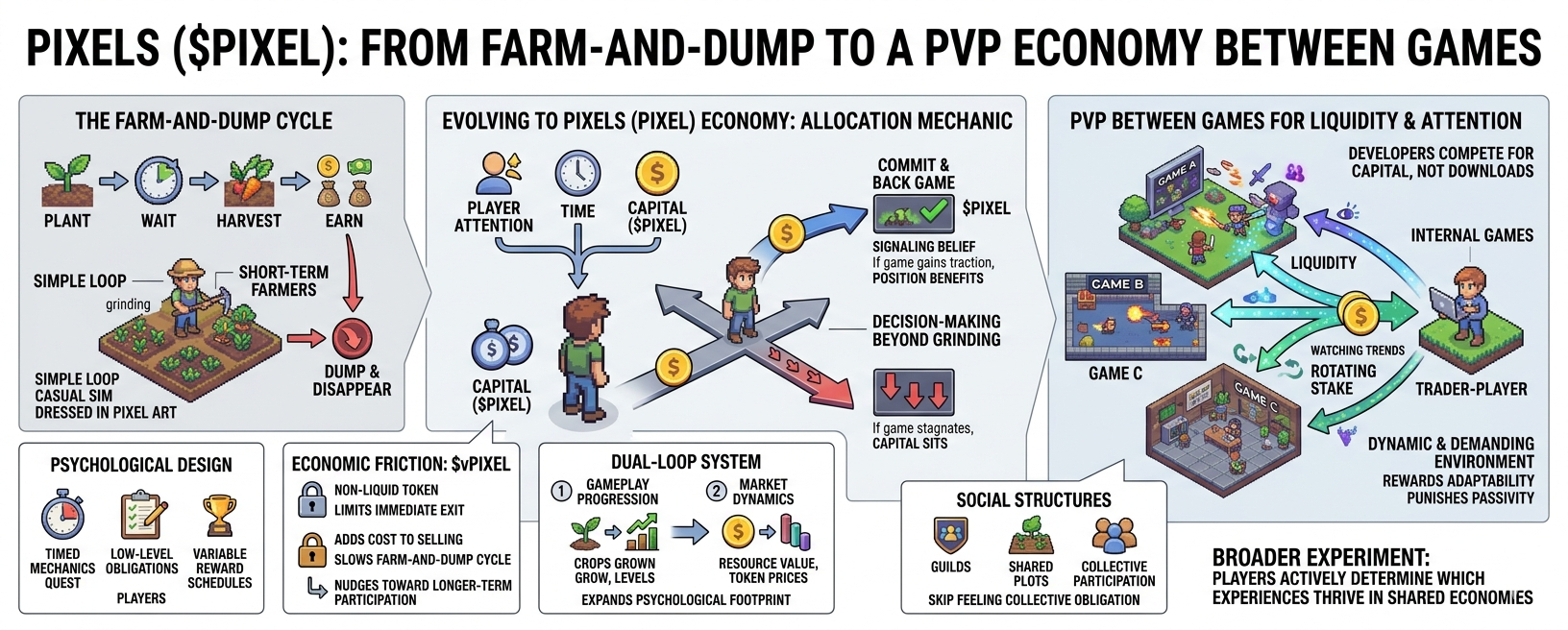
At first glance, Pixels (PIXEL) looks like another familiar GameFi loop: plant, wait, harvest, earn, repeat. The kind of system that has historically attracted short-term farmers more than long-term players. It’s easy to dismiss it as just another “farm → dump → disappear” cycle dressed in pixel art and token rewards.
But that surface read misses what’s actually happening underneath.
Pixels isn’t really about farming. It’s about allocation—specifically, how players allocate attention, time, and capital across competing games inside the same ecosystem. And once that clicks, the entire experience starts to feel less like a casual sim and more like a live market.
The key shift is this: games within Pixels don’t just exist for you to play—they compete for your stake.
When you commit your $PIXEL to a game, you’re not just participating. You’re effectively backing it. You’re signaling belief in its ability to attract and retain players. If that game gains traction, your position benefits. If it stagnates, your capital sits in something the market has already moved past.
That dynamic turns the ecosystem into a form of PvP—not between players directly, but between games fighting for liquidity and attention. Developers aren’t just building engaging experiences; they’re competing in an open arena where player behavior directly determines survival.
This creates a feedback loop that feels closer to trading than gaming.
You start watching trends. Which games are gaining players? Where is activity increasing? Which mechanics are holding attention, and which ones are losing it? Instead of passively earning, you’re rotating—moving your stake before momentum peaks or collapses. In that sense, Pixels introduces something GameFi has struggled with for years: meaningful decision-making beyond grinding.
Of course, the system isn’t frictionless—and that’s intentional.
The introduction of $vPIXEL, a non-liquid counterpart to $PIXEL, initially feels restrictive. It limits immediate exit and adds cost to selling, which can frustrate players used to instant liquidity. But that friction serves a purpose. It slows down the classic farm-and-dump cycle that has undermined many Web3 games.
By making it harder to extract value quickly, the system nudges players toward longer-term participation. It doesn’t eliminate speculative behavior, but it reshapes it. Instead of “earn and exit,” the question becomes “where should I stay?”
That shift is subtle but important.
Still, the economic layer is only part of why Pixels retains players. The psychological design plays an equally significant role.
Like traditional farming sims, Pixels relies on timed mechanics—crops that need harvesting, quests that reset, resources that accumulate over time. These systems create low-level obligations. You log in not necessarily because you’re excited, but because something is ready. Something needs collecting.
This is classic retention design, rooted in variable reward schedules. The anticipation of reward—combined with the effort already invested—pulls you back in.
Pixels amplifies this by layering financial incentives on top. Now, you’re not just managing crops; you’re also monitoring value. Resources, tokens, and in-game outputs all carry economic weight. This creates a dual-loop system: one driven by gameplay progression, the other by market dynamics.
Together, they expand the game’s psychological footprint.
Add social structures—guilds, shared plots, cooperative systems—and the pull becomes even stronger. Participation isn’t just personal; it becomes collective. Skipping a session can feel like letting others down, not just missing out yourself.
None of this is inherently negative. These are standard tools of game design. But combined with financial stakes, they can blur the line between engagement and obligation.
That’s where self-awareness matters.
There’s a difference between logging in because you want to play and logging in because leaving feels costly. Pixels occasionally leans into that tension. Some sessions feel genuinely rewarding—progress is visible, goals are achievable, and the sense of growth is satisfying. Other sessions feel mechanical, like checking a box.
Recognizing that difference is important, especially in a system where time and value are intertwined.
To its credit, Pixels lowers the barrier to entry. Its free-to-play model reduces the pressure of sunk cost, making it easier to step away compared to games that require heavy upfront investment. That flexibility gives players more control over their engagement.
But the broader experiment is what makes Pixels interesting.
If this “games competing for stake” model holds, it could reshape how GameFi ecosystems evolve. Developers would no longer just compete for downloads or users—they’d compete for capital within shared economies. Players, in turn, would become active participants in determining which experiences thrive.
That’s a more dynamic—and more demanding—environment.
It rewards attention, adaptability, and timing. It punishes passivity.
Pixels isn’t perfect. It still grapples with inflation, player churn, and the same economic fragility that affects most Web3 games. But it’s at least attempting to move beyond the standard loop.
And that alone makes it worth watching.
Because the real question isn’t whether Pixels succeeds—it’s whether players are ready to play a game where the real mechanic isn’t farming.
