
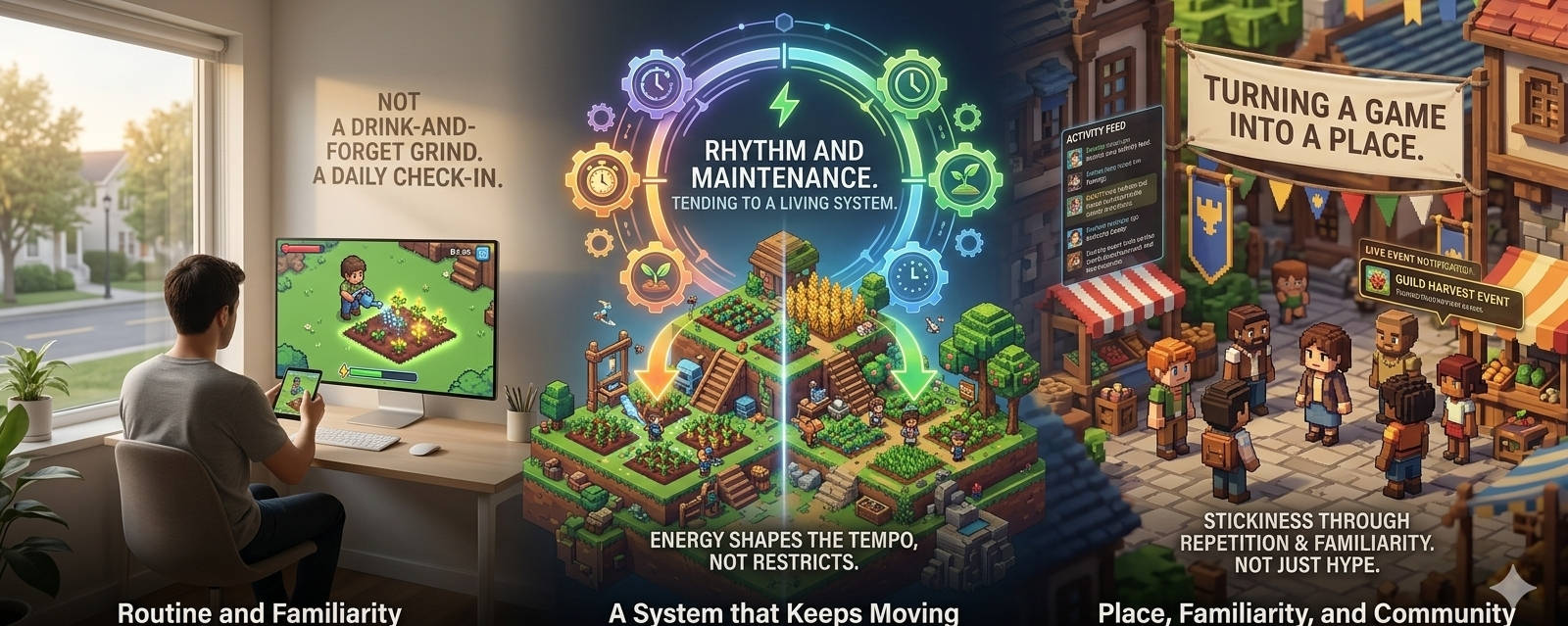
What makes Pixels different is that it rarely feels like a game you sit down with, grind for a few hours, and then forget about until you are bored again. It feels like something you check in on. Something you keep an eye on. Something that quietly becomes part of your day without asking for a big dramatic commitment every time you open it.
That is why it lands differently from a lot of other Web3 games.
Most games, especially in crypto, try to hook people with moments. Big rewards, big launches, big promises, big speculation. Pixels works in a more subtle way. It is not really built around one explosive session. It is built around returning. You log in, handle what needs to be handled, use your energy, take care of your farm, clear a few tasks, maybe adjust your setup, maybe talk to people, maybe prepare your next move, and then leave. A few hours later, or the next day, there is a reason to come back and do it again.
That simple rhythm changes everything.
When a game is designed around return behavior instead of one-time intensity, it starts to feel less like entertainment you consume and more like a world you maintain. That is exactly where Pixels lives. You are not just entering a match or completing a mission. You are tending to a system that keeps moving whether you are there or not.
A big part of that feeling comes from farming itself. In most games, farming is background content. It is filler. In Pixels, it is part of the game’s identity. Planting, watering, harvesting, waiting for the next cycle, and thinking about when to come back creates a completely different kind of engagement. You stop thinking only about what you can finish right now. You start thinking ahead. What should I plant before I leave? When do I need to return? How much can I get done with the energy I have left? What makes the most sense for the next loop? Those are not the thoughts of someone playing a one-off session. Those are the thoughts of someone managing a routine.
That is why Pixels sticks in your head even when you are offline. The game creates small unfinished threads in your mind. Your crops, your tasks, your timing, your next move. Nothing feels overwhelmingly urgent, but enough feels active that you want to check back in. And honestly, that is one of the smartest things the game does. It creates attachment through repetition instead of trying to manufacture constant excitement.
The energy system plays a huge role in that. Normally, players hear “energy system” and immediately think about restriction, but in Pixels it does more than just slow people down. It shapes the tempo of the whole experience. You cannot do everything in one go forever, so naturally the game pushes you toward pacing yourself. You log in, spend energy, decide what is worth doing most, maybe recover some of it, then choose whether to keep going or save part of the loop for later.
That design matters because it prevents the experience from becoming a mindless binge. In a lot of crypto games, if there is profit somewhere, people will try to squeeze every possible drop out of it until the experience becomes mechanical and exhausting. Pixels still has that economic side, of course, but it wraps it inside a structure that feels more sustainable. The game is constantly nudging you toward steady participation instead of one long exhausting grind.
And that is why it starts to feel like a routine. Not because it forces you into anything, but because the game quietly teaches you a certain pace. You do not need to finish everything right now. There will be another refresh, another harvest, another task cycle, another event window, another reason to return. Over time, that stops feeling like a design choice and starts feeling like part of your daily pattern.
The task-based systems add to that feeling too. Once rewards are tied to recurring objectives, resets, and repeatable loops, the game naturally builds a check-in habit. You stop asking yourself whether you feel like sitting down for some huge game session. Instead, you start asking whether you checked Pixels today. That is a very different relationship. One is about spending free time. The other is about maintaining momentum.
That is where Pixels separates itself from a lot of games that only know how to chase hype. Hype can bring people in, but routine is what keeps them there. A token can attract attention. Airdrops can create noise. Speculation can make people curious. But none of that builds attachment on its own. Pixels feels stickier because it does not rely only on the economy. It builds familiarity.
That familiarity is more powerful than it sounds. After a while, you know your land, your routes, your preferred tasks, your timing, your little habits inside the game. You know what is worth doing first when you log in. You know how your account is progressing. You know what needs attention and what can wait. That kind of familiarity is comforting. It gives the game a lived-in feeling.
And that is important, because a lived-in feeling is what turns a game into a place.
Once a game starts to feel like a place, your connection to it changes. You are no longer just chasing rewards. You are maintaining presence. That is where the social side of Pixels becomes more important than people sometimes admit. Guilds, shared activity, live events, casual interaction, and the sense that the world is still moving without you all make the game feel ongoing. You are not stepping into a frozen environment that only exists when you click play. You are returning to something that feels active.
That makes people want to come back even when they are not in full grind mode. Sometimes they log in to make progress. Sometimes they log in just to see what is happening. Sometimes they log in because the game has become part of the shape of their day. That is a very different kind of retention from the usual crypto model.
From my view, that is one of the strongest things about Pixels. It understood something that many older play-to-earn games missed completely. You cannot build a lasting game only around extraction. If players are there just to take value out, they leave the moment it stops making sense. What keeps people around longer is rhythm. The feeling that checking in still matters, even when you are not expecting some huge payout that day.
Pixels is strongest when it feels like a digital routine with personality, not just a reward machine.
Of course, that same design is also why some players bounce off it. The truth is, the very thing one player finds relaxing, another player will call repetitive. If someone wants constant action, dramatic progression, or high-pressure gameplay, Pixels may feel too soft or too repetitive. That criticism is understandable. The game absolutely runs on loops. It absolutely asks players to repeat actions, manage cycles, and return regularly. There is no point pretending otherwise.
But I think that is also what gives the game its identity.
Pixels is not trying to be a game where every login feels like a huge moment. It is trying to become familiar enough that logging in feels natural. That is a completely different goal, and honestly, a much smarter one for a persistent Web3 world. The game does not need to overwhelm you every time. It just needs to keep giving you enough reason to return, enough comfort to stay, and enough progression to make that return feel worthwhile.
That is why it feels less like a game session and more like a daily routine. You are not just playing it. You are checking on it, maintaining it, and slowly building your place inside it. The rewards matter, the systems matter, the economy matters, but the real glue is the habit. Pixels becomes something you fit into your day almost without noticing.
And in a space where most projects tried to buy attention with hype, that quieter kind of stickiness is probably the smartest move they could have made.
If you want, I can also make this even more natural and publication-ready in a single polished final version with a stronger opening and ending.