
I remember logging into a highly anticipated Web3 game last cycle, only to realize that 90% of the players around me were just automated scripts blindly farming the native token. Bots are the silent killers of crypto economies, draining liquidity before real users even get a chance to build anything. So, when I initially saw that Pixels had millions of active wallets, my immediate assumption was that it was heavily botted and destined to crash. But spending time digging into how their Smart Reward Platform actually operates behind the scenes, I noticed a different approach to Sybil resistance that starts to look like a real solution.
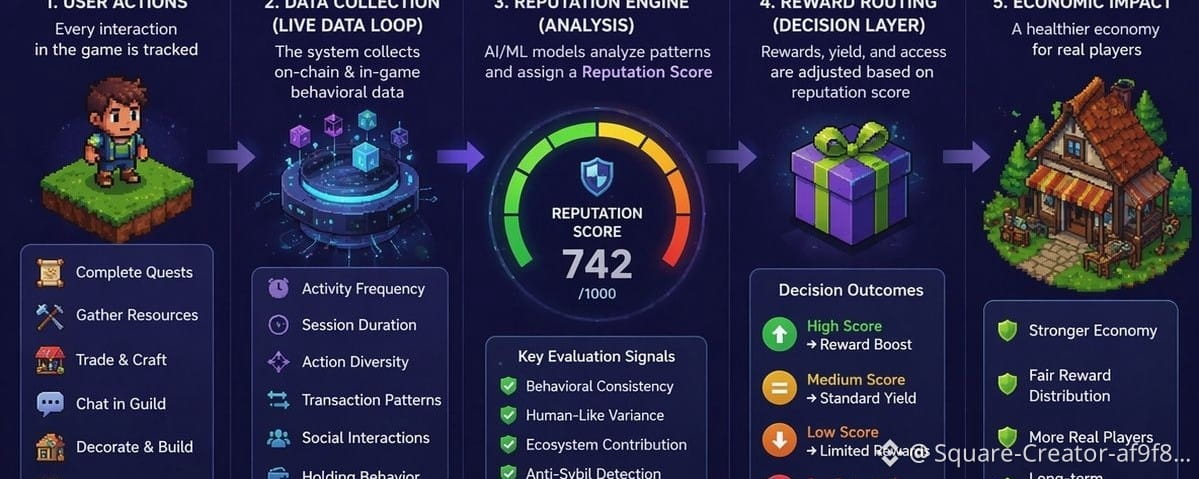
Instead of just relying on annoying captchas or expensive paywalls to keep bots out, Pixels is utilizing a behavioral data loop. They introduced a Reputation System that tracks how a wallet actually interacts with the ecosystem over a sustained period. If an account only logs in, extracts raw materials, and immediately dumps tokens on an exchange without any other interaction, the system flags that exact pattern. However, if a user completes diverse quests, interacts with guilds, and shows organic, human like inconsistencies in their gameplay, their reputation score gradually increases. It essentially functions as a decentralized credit score.
This data loop directly dictates how rewards are distributed. High reputation players gain access to better resource pools and actual yield, while suspected bot farms get silently nerfed out of the economy. I’ll admit, building a flawless behavioral algorithm is incredibly difficult, and there’s always an inherent risk of accidentally penalizing a real player who just happens to have a very repetitive farming style. It is definitely an ongoing cat and mouse game between the developers and bot farm operators, and it remains to be seen how well this holds up as the network continues to scale.
Still, seeing a project actively try to defend its internal economy through a proof of merit data system is a necessary shift away from the lazy print and dump models of the past. If this Smart Reward Platform functions as intended, it begins to separate genuine digital societies from simple clicker farms. It makes me wonder if the next phase of Web3 isn't just about how much capital a user can deploy, but rather how effectively they can prove they are a genuine participant adding actual value to the network.
@Pixels#pixel $PIXEL