
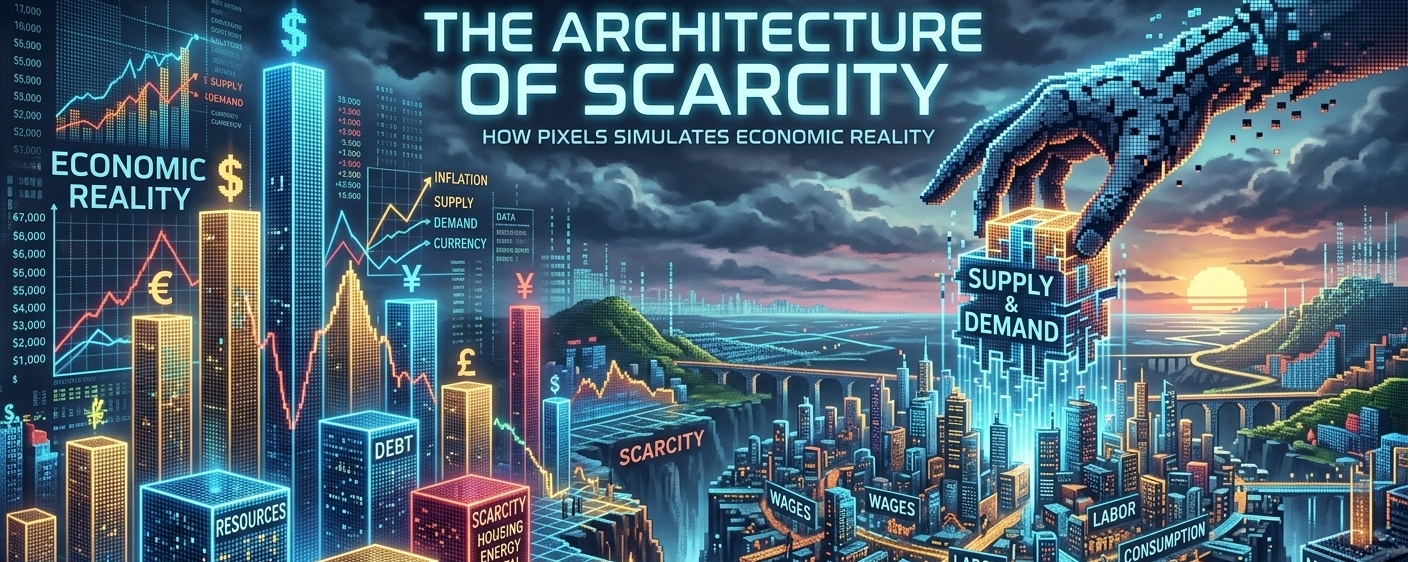

It is a mistake to view resource gathering in digital worlds as mere "grinding." In Pixels, what begins as a repetitive loop of farming and collecting quickly matures into a sophisticated system of resource allocation. By introducing friction through uneven availability, the game transforms mindless clicks into a series of deliberate economic choices.
In this environment, resource gathering isn't just the base layer of progression; it is the primary driver of opportunity cost.Every action is governed by three pillars:
Time, energy and access.
When a player chooses to plant one specific crop over another, they aren't just farming, they are making a speculative investment of their limited daily energy, betting that the utility of the output will outweigh the cost of the input. This mirrors the real world "Theory of Value", where worth is derived not just from utility, but from the difficulty of acquisition.
Rarity functions as a natural regulator of player behavior, creating a tiered hierarchy of materials. Common goods provide a stable but low-margin floor for all players, while gated resources locked behind specific land types or high level progression create "bottlenecks" in the supply chain. The system doesn't need to explain supply and demand to the player, the player feels it the moment they lack a specific material needed to complete a high tier craft.
The land based mechanics introduce a digital version of "Geographic Determinism". Ownership and access dictate the means of production, where certain areas offer superior yields or exclusive resources. This creates a form of spatial inequality, players without land must navigate the environments of others, creating a symbiotic yet unequal relationship between landowners and laborers. Players are forced to decide whether to optimize within their current constraints or pay a "tax" in time or fees to access more fertile ground, reflecting how infrastructure and geography shape production in real world economies.🚀🚀
As these mechanics intersect, the gameplay shifts from linear progression to ecosystem management. 🔥The player ceases to be a simple collector and becomes a manager of scarcity. The brilliance of the system lies in its ability to turn arbitrary digital assets into capital. When a player begins to plan their week around resource cycles, they are no longer just playing a game, they are navigating a market.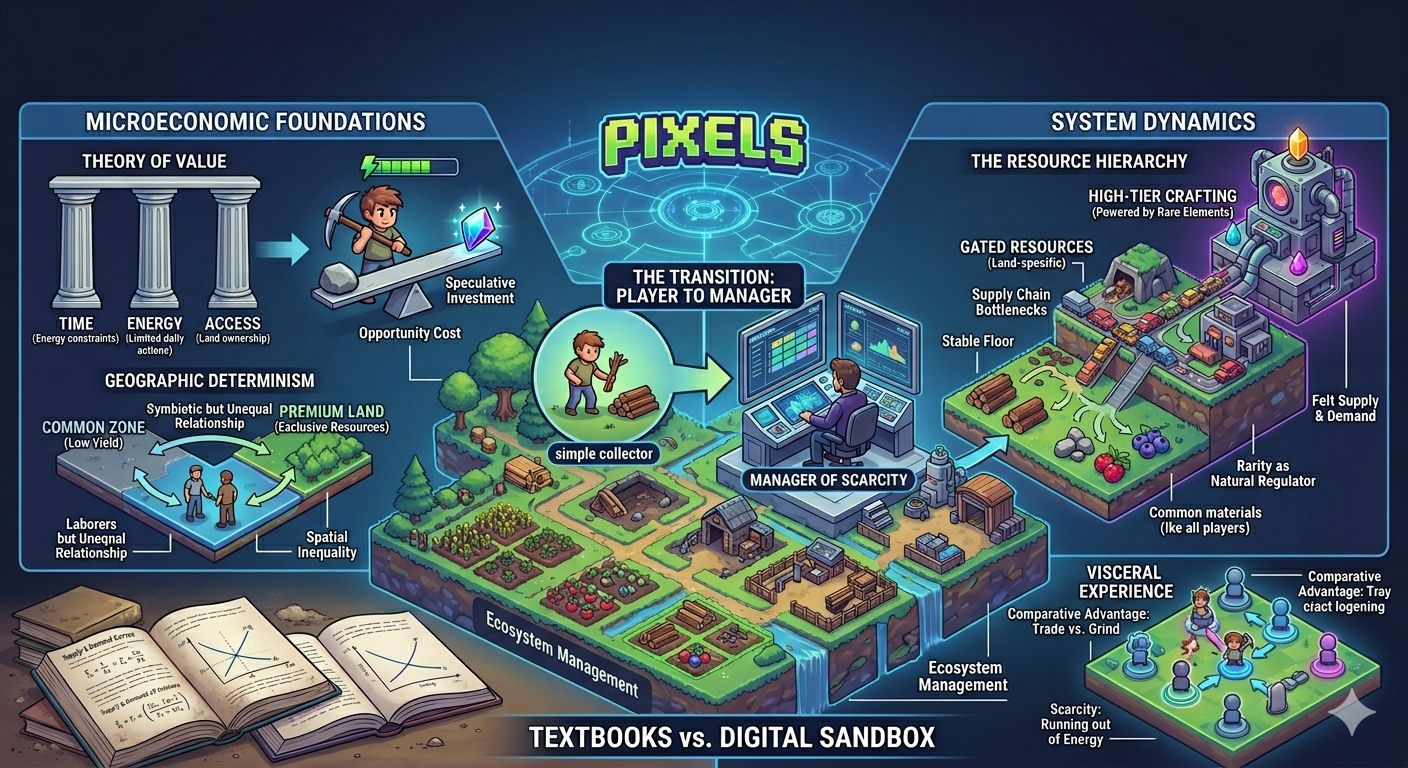
The clarity of this economy raises a provocative question:
Are these digital environments actually superior to textbooks for teaching economic principles?
Traditional economics often feels abstract, buried under formulas and "all things being equal" assumptions. In a digital world, those principles are visceral. You don't read about scarcity, you experience the frustration of running out of energy. You don't study Comparative Advantage, you realize it’s more efficient to trade for a resource than to spend hours trying to farm it yourself. While these systems are simplified reflections of our "real" world, they provide a sandbox where the core logic of human behavior how we respond to limits is laid bare for anyone to see.
How do you feel the introduction of player driven trading would change the "clarity" of this system would it make the economic principles easier to see, or would it just add a layer of market noise?🤔🤔