
Most people have been tricked by a reward system at least once. You download a game because it promises you can earn something real. You spend twenty minutes watching an ad for a brand you have never heard of, tap through a repetitive quest that was clearly designed around ad impressions rather than fun, and eventually receive a reward so small it barely registers. The game was never built around you. You were the product. The reward was the excuse to keep you watching.
Pixels, built on the Ronin Network, is trying to make a game where that equation runs the other way.
Ronin is a blockchain built specifically for gaming by Sky Mavis, the team behind Axie Infinity. It handles fast, low-cost transactions, which matters enormously for a game economy where players are earning and spending in small increments throughout every session. When you earn something inside Pixels, it is not sitting in a database that a company controls. It moves on-chain, which means it is actually yours in a way that most game currencies never are. That technical foundation is worth understanding because it changes what "earning" means inside the game. It is not points. It is not a number on a screen that disappears when you stop playing. It is a transferable asset.
But the infrastructure alone does not explain what Pixels is actually doing differently on the rewards side. The more interesting shift is in what gets rewarded and why.

Inside most play-to-earn games, the systems that give out rewards are designed primarily to keep players inside the app for as long as possible. The reward becomes a substitute for genuine engagement rather than a recognition of it. You earn by logging in every day. You earn by repeating the same action until a timer resets. You earn by watching something nobody wanted to watch in the first place. The game is optimizing for time-on-device because that metric is easy to measure and easy to sell to advertisers.
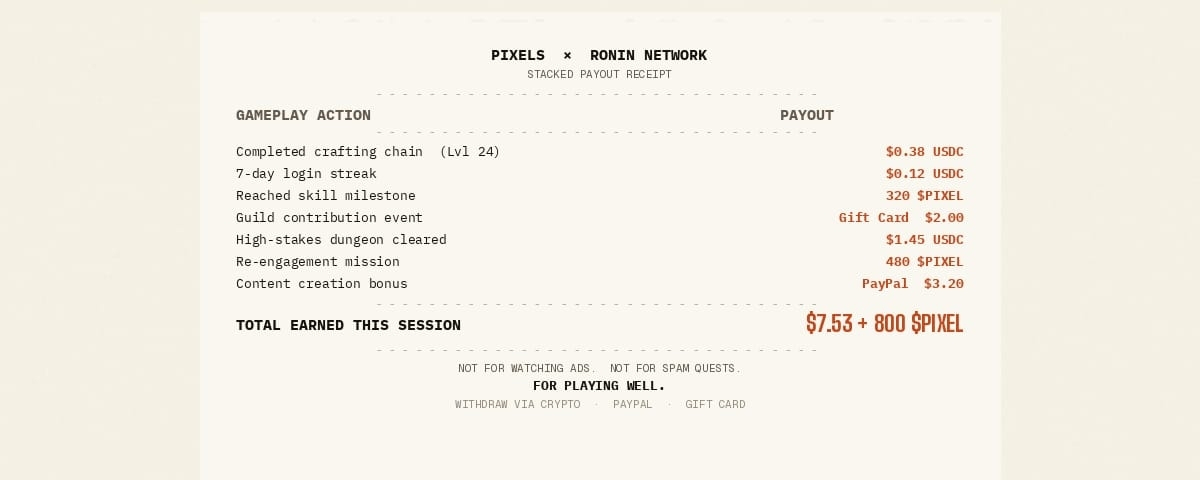
Pixels and Stacked, the rewards infrastructure that powers it, are optimizing for something different. Through Stacked, the system tracks what players actually do inside the game: how they progress through skills, whether they come back consistently over days rather than just logging in and leaving, whether they spend and reinvest rather than just extracting. A player who farms crops, completes crafting chains, builds their character meaningfully over time, generates a very different signal to the system than someone who tapped open the app to claim a daily bonus and closed it. Stacked reads both of those patterns and treats them very differently.
The practical result is that the rewards flowing through the Pixels ecosystem are not distributed equally to everyone who shows up. They are targeted toward the players whose behavior suggests they are genuinely inside the game, doing things that require attention and decision-making. When Stacked surfaces a mission to you, it is because the system identified your play pattern as one that is likely to respond to that specific offer in a way that is meaningful for both you and the game's economy. You are not seeing the same quest as every other player. You are seeing something calibrated to how you actually play.
This matters for what you can do with what you earn. Stacked supports withdrawals through crypto, PayPal, and gift cards. That range is deliberate. Not everyone who plays Pixels wants to navigate a crypto wallet or understand exchange rates. Some players just want to see a real number in a payment platform they already use. The ability to withdraw to PayPal treats the reward like what it actually is: money you earned by doing something that had value inside a real economy. A gift card is something you spend in the physical world. These exit paths are not an afterthought. They are a recognition that the player base for games like Pixels is not all crypto natives, and that the reward loses meaning if the person earning it cannot access it in a way that feels normal to them.
There is a metric the Pixels team tracks internally called Return on Reward Spend. The idea is straightforward: for every dollar the game puts out in rewards, how much value comes back into the economy through player spending and engagement. A ratio below one means the game is hemorrhaging value, subsidizing behavior that is not generating enough return to sustain itself. This is what kills most play-to-earn games eventually. They give out more than they take in, the token inflates, the economy hollows out, and the players who stayed longest end up holding the least.
Pixels has been building toward a ratio that stays above one. That means when you earn something by playing genuinely well, the economy behind you is healthy enough to make that reward worth something. Your earning is not being quietly devalued by a system that is giving the same reward to ten thousand bots running the same loop at three in the morning.
Playing a game and walking away with real money in your PayPal account sounds too simple to be meaningful. But the reason it has not worked until recently is that building the infrastructure to do it honestly, without the rewards going to automated accounts or being given out so broadly that they become worthless, is genuinely hard. Pixels spent four years learning how hard. What exists now on Ronin is the product of those years, running live, paying real players for real gameplay, in a form they can actually spend. That is a smaller claim than most web3 gaming projects make. It is also a much harder one to actually deliver.