
I've been sitting with this one for a couple of weeks now, watching the charts, checking the Ronin explorer, and actually playing the game a bit more than usual. What started as casual curiosity has turned into a pretty firm view on $PIXEL that feels different from the usual noise you hear in crypto circles. Most folks still see it as that pixel art farming game that had its moment back in '24 and has been grinding lower ever since. Fair enough on the surface. But the part that keeps me coming back and the reason I'm more constructive here than I've been in months is a quiet mechanical reality that's playing out in the token itself, almost in the background. The monthly unlocks aren't creating the selling pressure everyone assumes they will. Instead, they're getting absorbed faster than the market seems to realize, thanks to staking mechanics that are actually working in practice. It's not hype. It's just supply tightening in a way the price hasn't fully reflected yet.
Let me walk you through why this lands as a real edge for me, without the usual recap of the game or Ronin backstory. I've tracked this token long enough to see the pattern repeat in the data, and right now the numbers line up in a way that feels underappreciated.
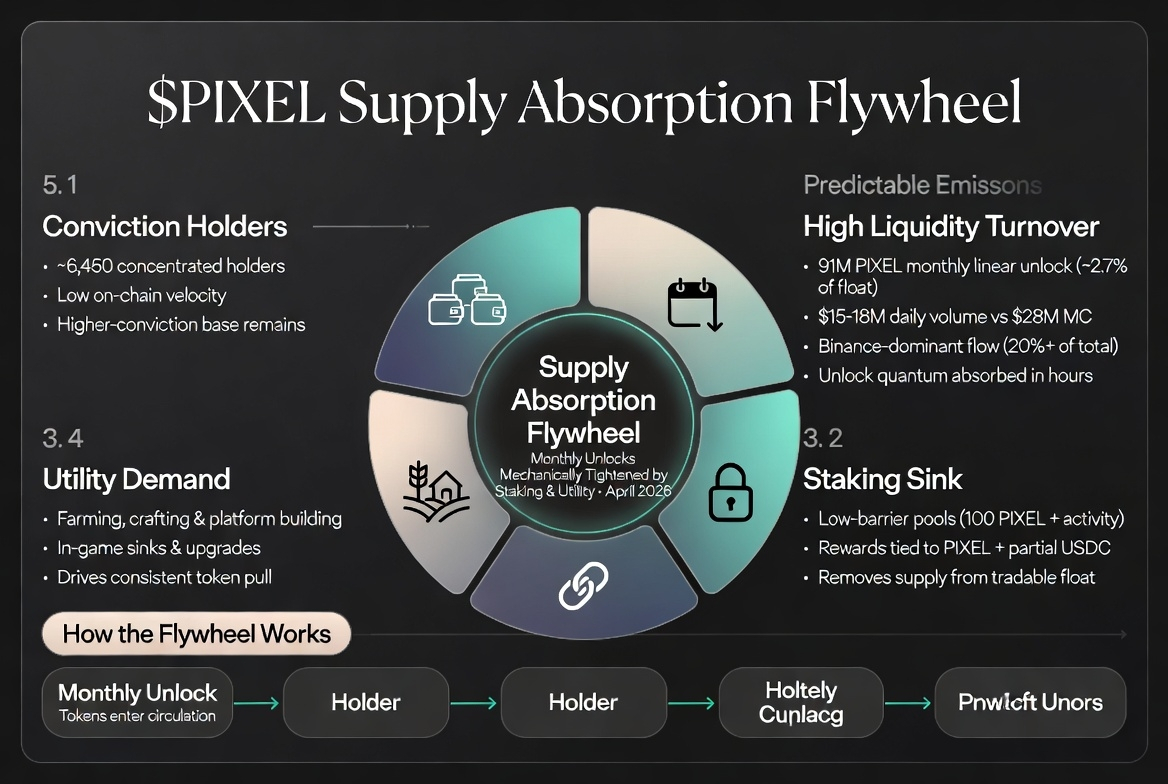
Take the supply picture first. We're sitting at roughly 3.38 billion circulating out of 5 billion total about 67-68% unlocked after two-plus years of steady linear releases. That puts the market cap around $28-29 million at current prices near $0.0084. The FDV sits at about $42 million. What's easy to miss is how much of the heavy dilution already happened early on. The remaining schedule is predictable monthly drips, nothing like the cliff events that used to spook people. Tomorrow, April 19, another 91 million tokens (roughly 2.7% of the current float) hit the market, valued at around $745k. That's real money, sure, but it's smaller than a typical day's trading volume, which has been running $15-18 million lately. In my experience watching these things, when daily turnover sits north of 50% of market cap, even scheduled supply can get eaten without drama especially when the buyers aren't just flippers.
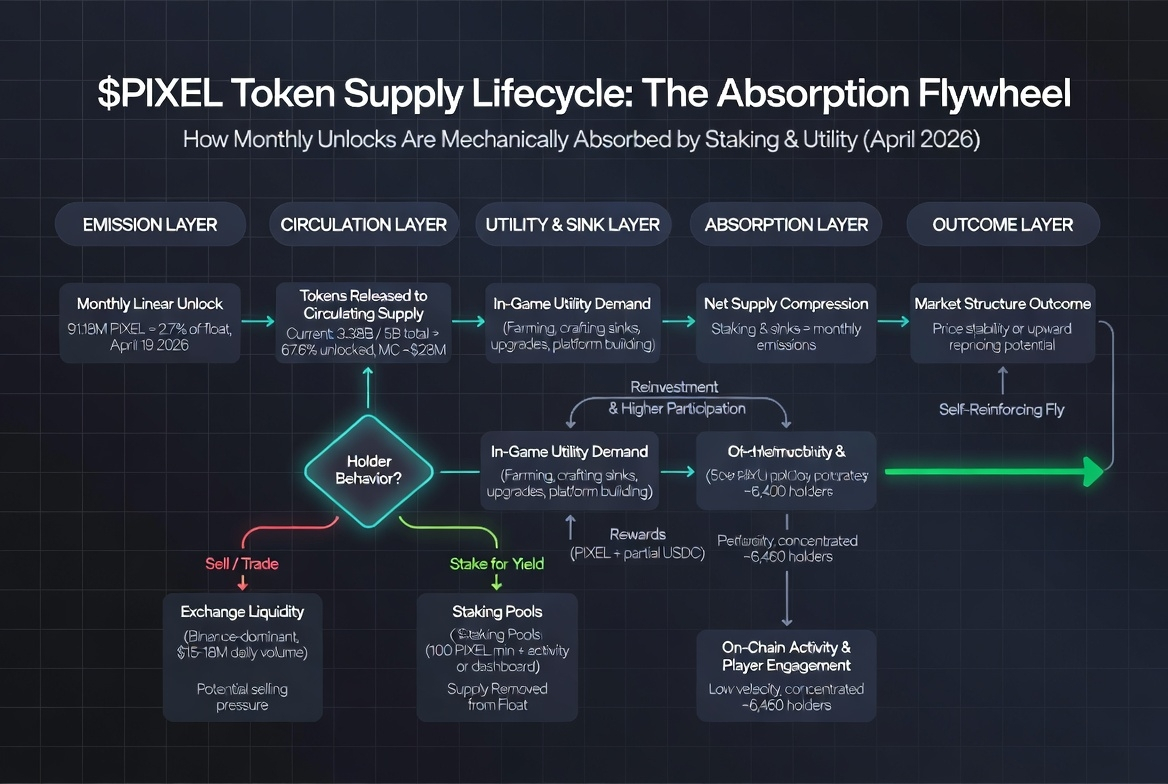
Then there's the staking side, which is where the absorption really shows up. The game's multi-pool staking setup now expanded beyond just Pixels itself requires relatively low barriers (100 PIXEL plus some activity for in game perks, or even lower thresholds on the external dashboard). Rewards are still tied to PIXEL but with some smart tweaks, like shifting portions of studio payouts toward USDC to blunt forced selling. I checked recent on-chain snapshots; participation has held steady even through the drawdown, and every token locked up is one that isn't hitting the order books. This isn't theoretical. It's creating a self-reinforcing sink where utility demand from players and builders pulls supply off the table faster than the unlocks add it. The result? Net supply growth feels closer to flat or even negative in practice on days when activity ticks up.
Holder behavior backs this up too. We're looking at only about 6,460 wallets holding the token in any meaningful way. That's concentrated, no question, and it's a valid risk I'll get to in a minute. But it also means the base that's still here is higher conviction. These aren't the dust wallets that flood out at the first sign of unlock pressure; many are the same addresses that have been farming, building, or staking through the bear. On-chain velocity has stayed low relative to the float, and average wallet balances aren't shrinking the way you'd expect in a pure sell-the-news environment.
Liquidity dynamics add another layer I don't see talked about much. Binance still dominates the flow often 20%+ of daily volume and the pair there is deep enough that the unlock quantum tomorrow is basically a rounding error on a busy day. Combine that with the fact that the token's utility (crafting sinks, upgrades, governance hints) keeps pulling real in game demand, and you get this odd situation where the market structure is tighter than the headline numbers suggest.
None of this requires the game to suddenly explode in users or the whole sector to rotate back into gaming tokens. It's internal to PIXEL's own contract and ecosystem loops on Ronin. I've run the numbers backward and forward: if volume holds anywhere near current levels and staking participation doesn't drop off, those monthly prints become features, not bugs.
Of course, I'm not blind to the counter. The low holder count and Binance heavy liquidity do create fragility. If a couple of larger wallets decide to rotate out or if macro risk-off hits and volume dries up the same mechanics that absorb supply on the way up can amplify moves on the way down. If the team keeps shifting more rewards to stablecoins and players start treating staking as optional rather than core, the flywheel slows. Concentration risk is real here; this isn't some broad retail distribution play.
Still, the setup feels asymmetric to me in a positive direction right now. What would confirm this thesis over the next few months? Steady or higher staking TVL on the dashboard, post-unlock price action that doesn't gap down meaningfully (say, no sustained 10%+ drops tied directly to the release), and volume to market cap ratios staying elevated above 40-50%. Bonus if we see holder growth that's slow but paired with rising average balances evidence the conviction base is expanding rather than rotating. On the flip side, clear invalidation would be repeated unlock day breakdowns despite volume, or a visible decline in staked percentage and on-chain activity. Those would tell me the absorption story is breaking.
I've been wrong on plenty of these before, but this one feels like the kind of quiet inefficiency you only spot after watching the same token through a full cycle. The market's still pricing PIXEL like it's just another exhausted GameFi relic waiting for narrative rescue. I'm seeing something more mechanical: a token whose own design is doing the heavy lifting on supply, almost invisibly. Whether that reprices or not is the open question, but the data is there if you're willing to look past the surface.