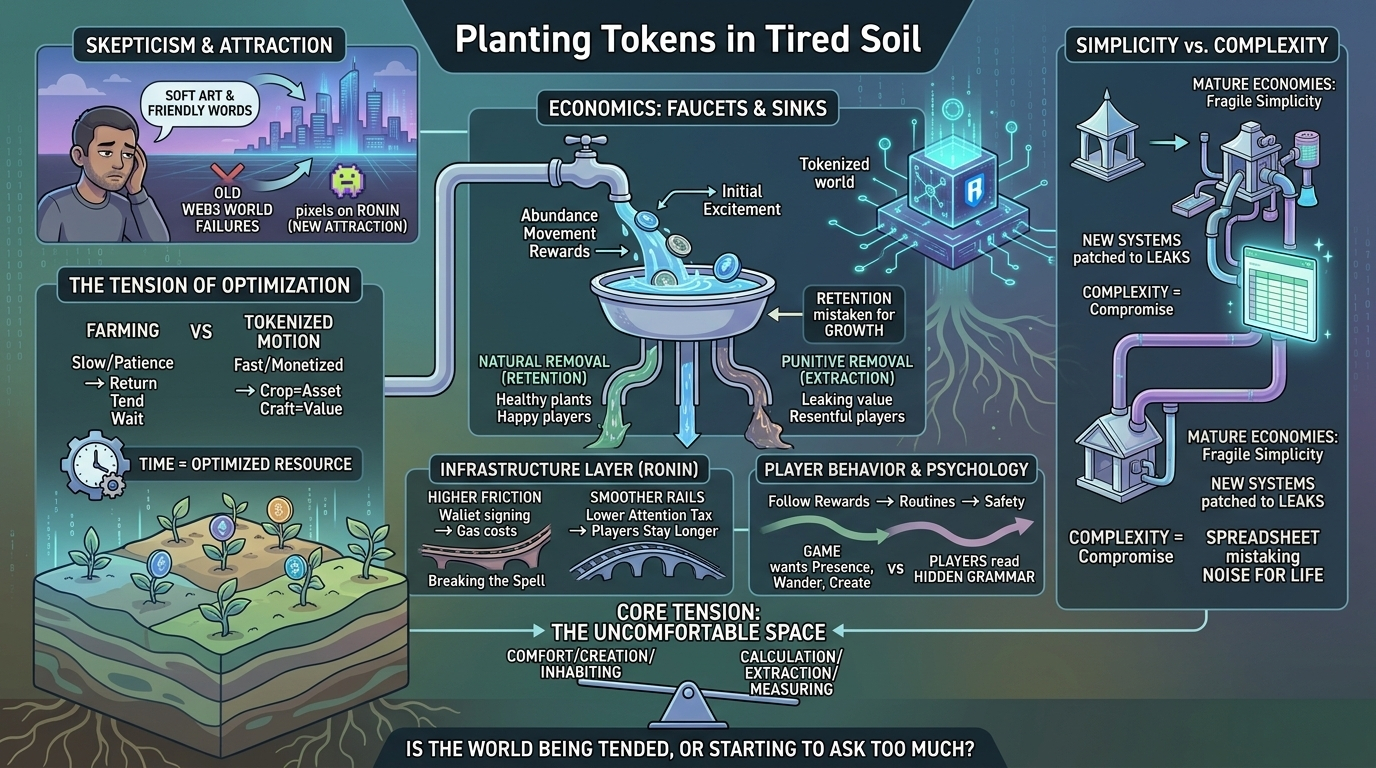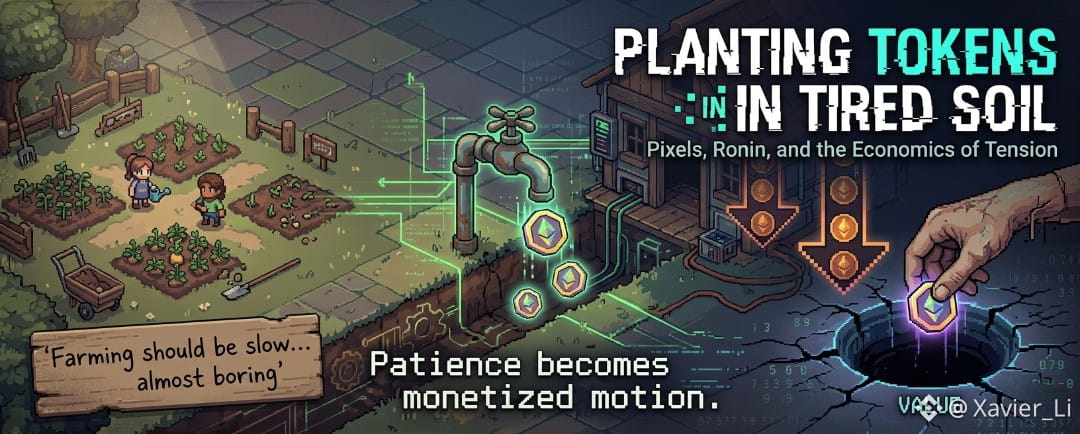
I didn’t take Pixels seriously at first, and honestly, that was mostly self defense. I’ve watched too many Web3 worlds arrive with soft art, friendly language, and a promise that this time the loop will be healthier, the token will behave, the players will stay for reasons that feel almost human. Then the numbers start moving, the incentives tighten, and suddenly the whole thing looks less like a world and more like a machine looking for hands. So when I first looked at Pixels on Ronin, I had that tired little instinct to step back and assume I already knew how the story went.
But I keep coming back to it anyway.
Maybe because farming, of all things, is such a strange vessel for tokenized ambition. Farming should be slow, almost boring in the best way. You return, you tend, you wait, you return again. But once a token enters the picture, patience becomes a kind of monetized motion. Every action starts to carry a second meaning. A crop is no longer just a crop. A craft is never just a craft. The world begins to split into what feels playful and what can be optimized, and those two things do not always sit well together. That tension is the part I notice first, not the feature list, not the branding, just the way the system nudges the player toward seeing time as a resource to be spent efficiently.
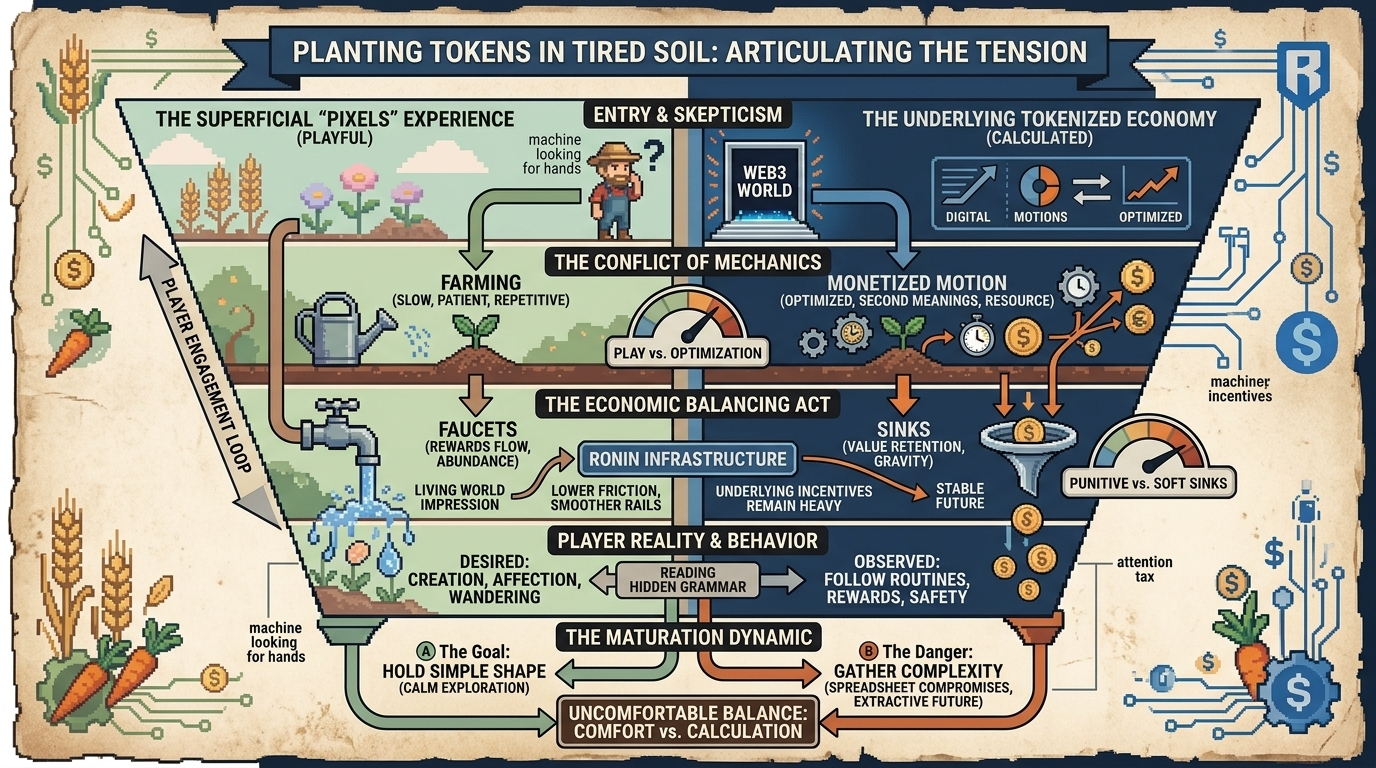
That is where the economy thinking starts creeping in, whether anyone wants it or not. Faucets are easy to admire in the beginning because they make the place feel alive. Rewards flow, people show up, and there is movement everywhere. It gives the impression of abundance, which is useful, maybe even necessary. But abundance without sinks is just a delay before gravity returns. Value has to go somewhere. Tokens have to leave circulation in ways that feel natural enough that players do not resent them. If the sinks feel punitive, the whole thing turns sour. If they are too soft, the economy leaks outward until every participant is just trying to get out ahead of the next decline. I have seen that pattern enough times to know that the first weeks of excitement can hide a very ordinary future, one where retention gets mistaken for growth and extraction gets mistaken for engagement.
Ronin matters here in a quieter way than people like to admit. The infrastructure is part of the game, even when it is trying not to be. Wallet friction, gas, clunky signing, all of that is a kind of static that breaks the spell. In older setups, every on chain action felt like being reminded that the game was also a financial instrument, which is exhausting after a while. Smoother rails do not solve the deeper problem, but they do lower the amount of attention tax you pay just to participate. That alone changes behavior. People stay longer when the machine stops interrupting itself. They are less likely to bounce when every interaction does not feel like a small administrative task. Still, friction is only one layer of the story. Even when the UX gets lighter, the underlying incentives can remain heavy.
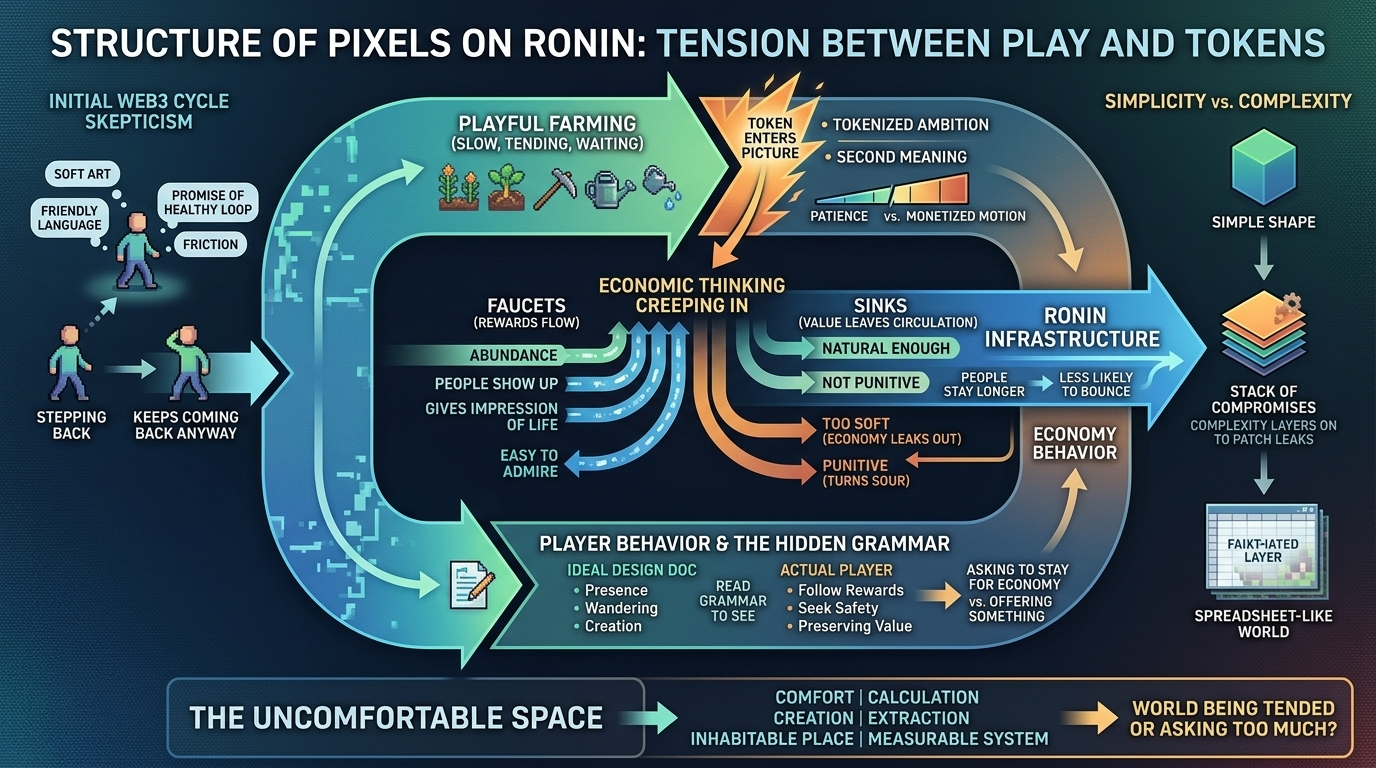
That is what makes these systems interesting and a little sad. Players rarely behave the way design documents hope they will. They follow rewards, then routines, then whatever feels safest for preserving value. A social casual game wants presence, wandering, creation, maybe even a little affection for the world itself. But players, especially ones who have lived through enough token cycles, learn to read the hidden grammar. They can tell when the game is asking them to stay because it has something to offer, and when it is asking them to stay because it needs their activity to keep the economy breathing. Maybe that is too cynical, but I do not think it is wrong.
What keeps me thinking about Pixels is the possibility that it is still trying to hold onto a simple shape while complexity gathers around it. That is usually the hard part. Simplicity looks fragile once an economy matures. New systems get added to patch leaks, new incentives get layered on to keep people engaged, and suddenly the world that began as a calm place to farm and explore starts to feel like a stack of compromises. The game becomes slightly more spreadsheet like every month, and everyone pretends not to notice because the spreadsheet is still making noise and the noise can be mistaken for life.
Maybe there is something worthwhile in that tension, if only because it refuses to disappear. I like that Pixels sits in the uncomfortable space between comfort and calculation, between creation and extraction, between a place you might actually want to inhabit and a system you can never quite stop measuring. I do not know if that balance lasts. I do not know if the loops remain healthy once the early enthusiasm thins out and the easy growth is gone. I just know I keep looking at it and wondering whether the world is being tended, or whether it is already starting to ask too much of the people inside it.