
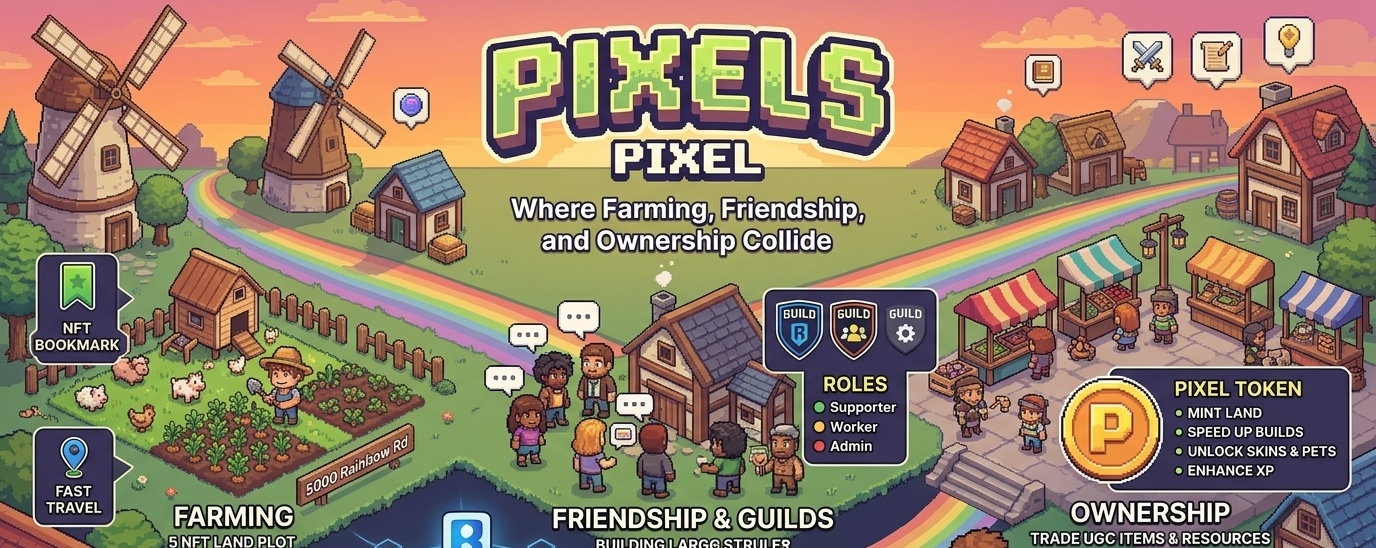
Pixels is one of those games that looks gentle at first glance and then quietly reveals how much is going on underneath. Officially, it describes itself as an open-ended world of farming and exploration, built around gathering resources, advancing skills, building relationships, and moving through quests in a blockchain-backed universe. Its own site frames it as a place to “play with friends,” “build your own world,” and own what you create, while the broader Ronin ecosystem is built specifically for gaming with fast onboarding, sponsored transactions, and integrated marketplace tools. That combination is the real hook: Pixels is not just a game with crypto bolted on, but a social world where progression, ownership, and community all pull in the same direction.
A cozy game that hides a serious design philosophy
What makes Pixels stand out is that it understands something many Web3 games miss: players do not stay for jargon, they stay for routine. The official lite paper describes the experience as a “mesmerizing blend” of managing, creating, and exploring, with progression tied to relationships, quests, and the work of building a life inside the world. On the homepage, the pitch is similarly human: make a home, master skills, play with friends, and build communities. That matters because the game’s emotional center is not speculation or hype; it is the slow satisfaction of turning a blank plot into something personal. In other words, Pixels feels built around the psychology of a good life-sim, not the mechanical flash of a typical crypto project.
Why Ronin is such a natural fit
Pixels makes much more sense once you look at the chain beneath it. Ronin positions itself as “purpose-built for gaming,” with an emphasis on speed, scale, and smooth onboarding. Its official site highlights frictionless user accounts and wallet integration, sponsored transactions, and an in-game marketplace and token swap SDK. That is not just infrastructure trivia; it shapes how a game like Pixels feels in practice. A farming game lives or dies on repetition, and repeated actions are much easier to tolerate when the chain side of the experience stays quiet. Ronin’s design is about lowering friction, which is exactly what a social, always-on game needs if it wants players to come back day after day instead of treating each session like a chore.
Land is not a side feature; it is the stage
Pixels gives land real personality. Its help center explains that NFT Farms are special areas where players can farm, gather resources, and craft, and that each farm is numbered from 1 to 5000 along the Rainbow Road. Even the route into land ownership has a little theater to it: left for odd-numbered farms, right for even-numbered ones. The game also offers bookmarking, so players can fast travel back to farms they care about, and it supports Speck Farms as a smaller entry point for free-to-play users. That mix is important. Pixels is not saying land should be rare for the sake of rarity; it is saying land should be useful, navigable, and embedded into the rhythm of play whether someone is a collector, a builder, or just testing the waters.
The social layer is where Pixels stops being “just farming”
A lot of games have communities. Pixels goes further and turns social structure into game structure. Its help center shows that landowners can associate their NFT Farm Land with a guild, set access to guild members, and assign roles inside the guild ecosystem. The role system itself matters because it creates hierarchy without making everything feel rigid: supporter, member, worker, admin. Then there is reputation, which Pixels uses to reward loyal, genuine players while helping support distinguish good actors from bad ones. Reputation also affects access to features like the marketplace. That is a subtle but clever choice: social trust is not treated as a vague vibe. It becomes an actual layer of the game, shaping what players can do and how visible they are inside the world.
Creation is limited on purpose, and that is part of the charm
Pixels also leans hard into user-generated content, but it does so with boundaries. Its UGC guidelines make clear that submissions must fit the game’s style, avoid certain categories, and remain decorative rather than functional. In other words, you are not simply uploading arbitrary objects into a sandbox and hoping for the best. The game wants player creativity, but it wants that creativity to feel like it belongs in the same world as everything else. That restraint is one reason Pixels’ aesthetic stays coherent. Plenty of projects ask players to “create”; fewer of them are disciplined enough to prevent the world from dissolving into visual noise. Pixels seems to understand that a shared world is fragile, and that cohesion is a kind of trust.
PIXEL is more than a token label
The PIXEL token sits at the center of the economy, but the official whitepaper is careful about how it frames that role. It describes PIXEL as a premium in-game currency used for items, upgrades, and cosmetic enhancements outside the core gameplay loop. It is also meant to support features like minting new land, speeding up build times, boosting energy, unlocking skins, unlocking XP and skill enhancers, unlocking crafting recipes, and unlocking pets. That list tells you a lot about the game’s priorities. PIXEL is not supposed to be the reason the game exists; it is supposed to deepen the experience for players who want to go further. That distinction is rare, and it is one reason Pixels has felt sturdier than many token-first game experiments.
Staking, progression, and the value of staying active
Pixels also ties its token economy back into actual play. Its help center says staking $PIXEL lets players support different game projects, with rewards tied to continued in-game activity rather than passive holding alone. That is an important design choice because it keeps the economy from drifting too far away from the world itself. The game also uses mechanics like discovery points and farm charm points to shape visibility on the Top Farms list and increase surplus drops. So the game quietly rewards both effort and taste: the player who manages well, places rare items thoughtfully, and keeps a distinctive farm can end up with more visibility and better output. It is an economy built to make presence matter, not just balance sheets.
What Pixels gets right, and why it feels different
Pixels works because it understands that a world becomes sticky when several kinds of motivation overlap. Some people will come for farming. Others will care about land. Others will chase guild status, reputation, or the aesthetic pleasure of building something that looks unmistakably theirs. The game gives each of those motives a place to live instead of forcing everyone through one narrow progression ladder. Ronin’s infrastructure helps keep that experience smooth, while Pixels’ own systems make sure the world still feels like a community rather than a spreadsheet. That is a difficult balance to hold. Too much game, and the ownership layer disappears. Too much ownership, and the game becomes cold. Pixels sits in the middle with unusual confidence.
Conclusion
Pixels is not trying to dazzle you with noise. It is trying to make you care about a place. That is a much harder trick. By combining farming, exploration, crafting, guilds, reputation, land ownership, and a token economy that supports rather than dominates the experience, it creates a Web3 game that feels closer to a living social space than a marketing pitch. Its best idea may be the simplest one: give players a world that is pleasant to return to, then make their actions inside that world actually mean something. That is why Pixels has real staying power. Not because it shouts the loudest, but because it understands what makes a virtual life feel worth tending.