
Look, I’ve seen this movie before. A friendly-looking game shows up, soft colors, simple mechanics, something you could explain in thirty seconds. Then you scratch the surface and realize it’s not really a game. It’s an economy. Or at least it’s trying to be one. Pixels fits that pattern almost too neatly.
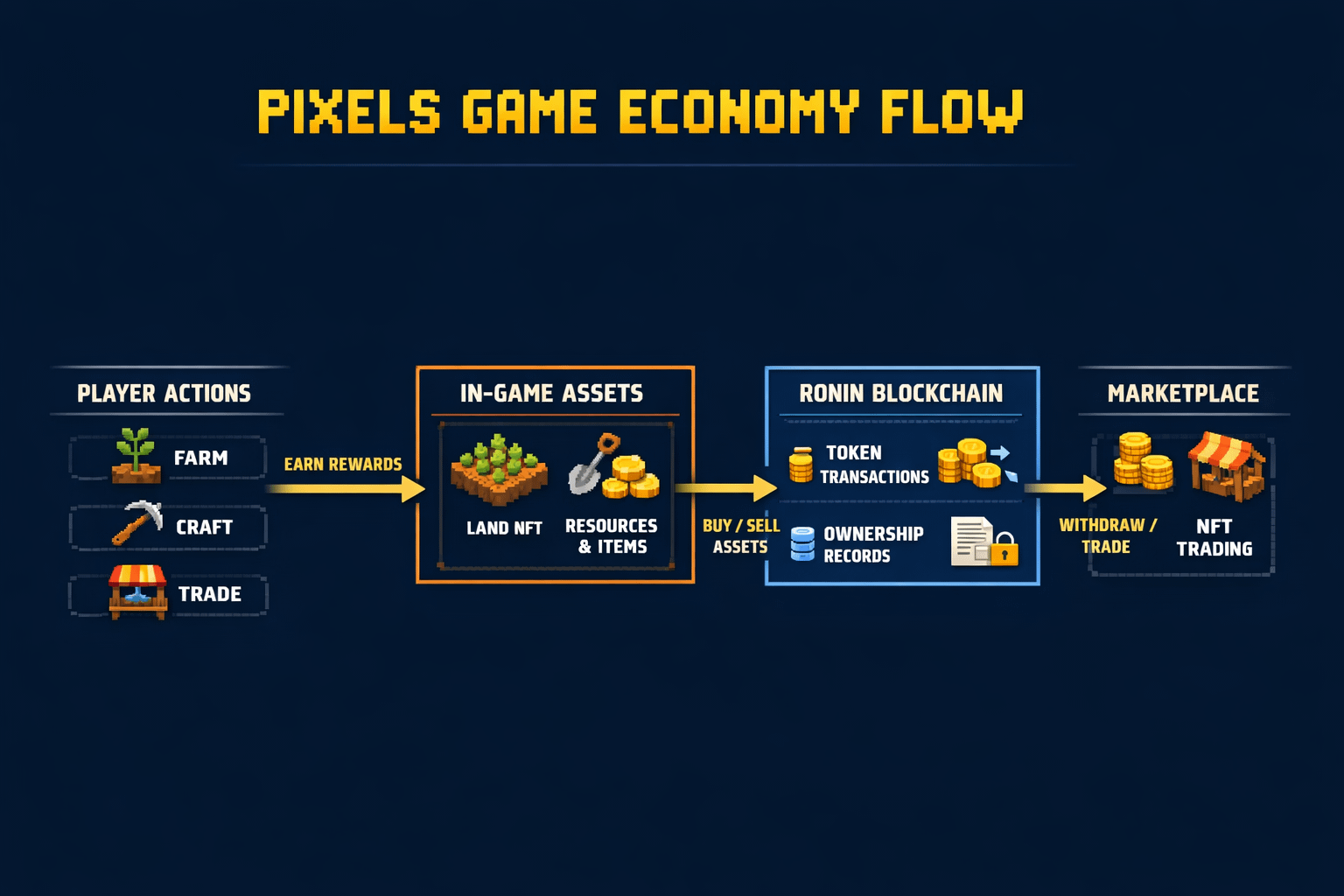
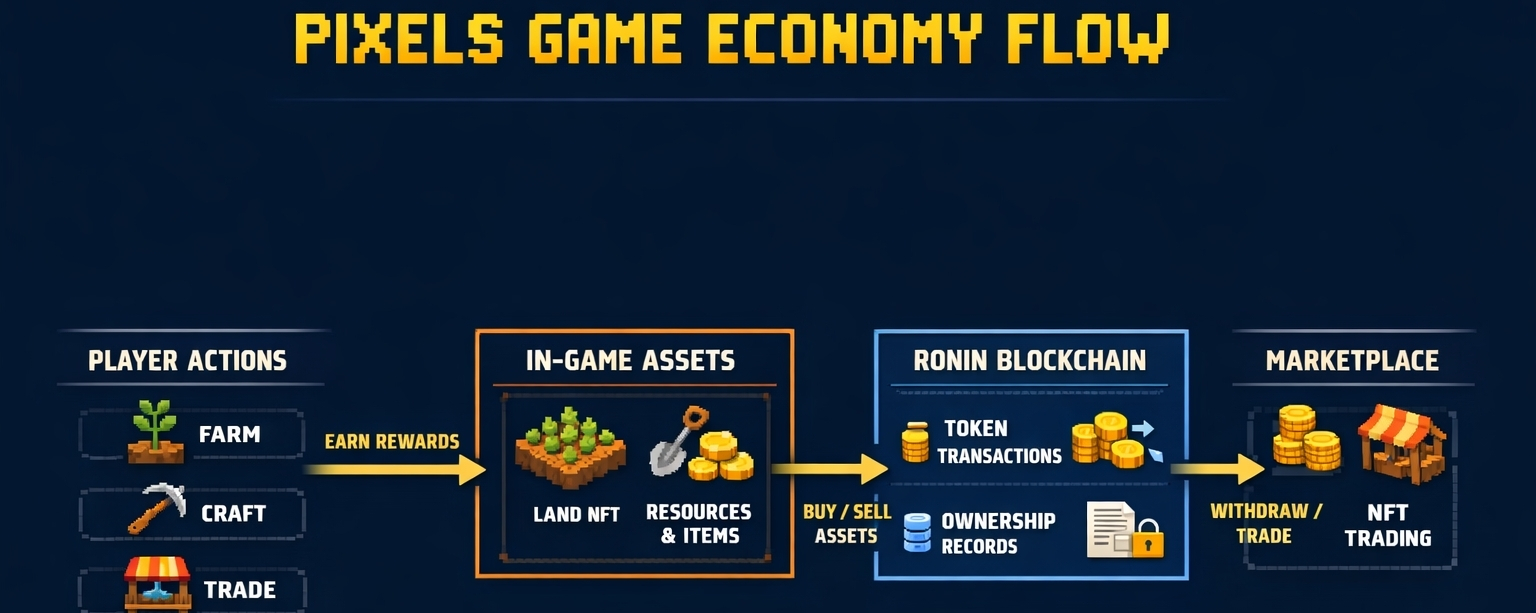
On the surface, it’s farming. Plant crops, collect resources, talk to other players. Nothing controversial. But sitting underneath is Ronin Network, which tells you immediately this isn’t about virtual carrots. It’s about ownership, tokens, and markets. That’s where things start to get complicated.
Let’s be honest about the problem they say they’re fixing. Traditional games are closed systems. You grind for hours, maybe spend money, and everything you earn stays locked inside the developer’s world. You don’t own it. You can’t sell it freely. If the game shuts down, it’s gone. That’s the pitch Web3 games have been making for years: give players real ownership, let them trade assets, turn time into something that has value outside the game.
It sounds tidy. On paper, at least.
But here’s the part people tend to skip over. The moment you introduce real ownership and tradable assets, you stop running a game and start running a market. And markets behave very differently from games. They don’t care about fun. They care about incentives.
I’ve seen this play out already with Axie Infinity. It worked. Until it didn’t. Early players made money. Later players funded them. Then the growth slowed, the token price dropped, and the whole system started to wobble. Not because the tech broke, but because the economics did.
Pixels is trying to do the same thing, just more quietly. More cautiously. You’ve got tokenized assets, land you can own, resources you can trade, and a system where your in-game actions tie directly into something that has real-world value. That’s the hook.
Now here’s the catch. Actually, there are a few.
First, the incentives. Who is really making money here? Early adopters, asset holders, and the people who understand the system before everyone else piles in. That’s not unique to Pixels. That’s how these economies tend to work. The game needs new participants to keep the cycle going. Without fresh demand, the rewards shrink. When rewards shrink, people leave. It’s not complicated.
Second, centralization. Yes, it’s on a blockchain. Yes, assets are technically owned by players. But the game itself—the rules, the economy design, the reward structure—is still controlled by the developers. Sky Mavis sits in the background here, and they’ve already shown how much influence they have over the system. So you end up with this strange hybrid where ownership is decentralized, but control isn’t. That tension doesn’t go away.
Third, complexity. This is the part that gets glossed over in marketing. For a casual player, this isn’t just a game. It’s wallets, tokens, marketplaces, price volatility, and a constant awareness that what you’re doing has financial implications. That’s a lot of cognitive load for something that’s supposed to be relaxing. Most people don’t want to think about yield strategies while planting digital crops.
And then there’s human behavior. This is the big one. Give people a system where they can earn, and they will optimize the life out of it. They will farm resources as efficiently as possible, automate where they can, and treat the game like a job. At that point, the “fun” layer starts to erode. What you’re left with is work disguised as play.
Pixels tries to soften this. Slower rewards. More emphasis on social interaction. Less aggressive extraction, at least for now. I get the intention. I really do. But the underlying structure hasn’t changed. You still have a token that needs demand. You still have assets that need buyers. You still have players who will leave the moment the numbers stop making sense.
And when that happens, you find out very quickly what the system is actually built on.
Look, none of this means Pixels collapses tomorrow. It might keep growing for a while. It might even look stable compared to earlier attempts. But stability in these systems often depends on conditions that don’t last—market sentiment, user growth, speculative interest.
I’ve seen enough of these cycles to know how they tend to end. Not with a bang. More like a slow thinning out. Fewer players. Lower volumes. Less noise.
And then one day, you log in, and the fields are still there.
Just quieter than they used to be.
