
Nobody told me a simple browser farm game would make me feel like I actually own a piece of its future.
I’ve been playing video games since I was seven. Twenty-plus years of controllers, keyboards, epic battles, and endless grinding. I’ve saved kingdoms, built cities, and beaten final bosses. But in all those worlds, not once did the game ever ask me what I thought about where it was going next.
@Pixels did.
It happened on an ordinary day. I was in Terra Villa, the main town, reading a community update about changes to crafting and the economy. At the bottom, the team asked a real question: What should we work on next?
Not a fake survey. Not something that disappears into a black hole. A genuine ask from a team that built $PIXEL staking, governance, and a future DAO around the idea that players should actually have a voice.
I sat there thinking for a long time. Every other game treated me like a customer who just spends time and money. Pixels was treating me like a co-author of the world.
That moment changed everything.
When I bought my first plot of farmland on the Ronin marketplace, the shift became real. I stopped playing like a tourist just passing through. I started acting like someone who lives there.
I weeded my land more carefully. I thought harder about what crops to plant. I joined a guild not just for quick rewards alone, but because my plot was close to theirs and it made sense for both of us. Without even noticing, I was behaving like a founder not like a player - someone who cares about the long-term health of the place because it’s partly mine.
This quiet change from consumer to stakeholder is what makes Pixels special. It’s not flashy. It’s not even listed as a main feature. But it makes every other part of the game feel meaningful instead of empty.
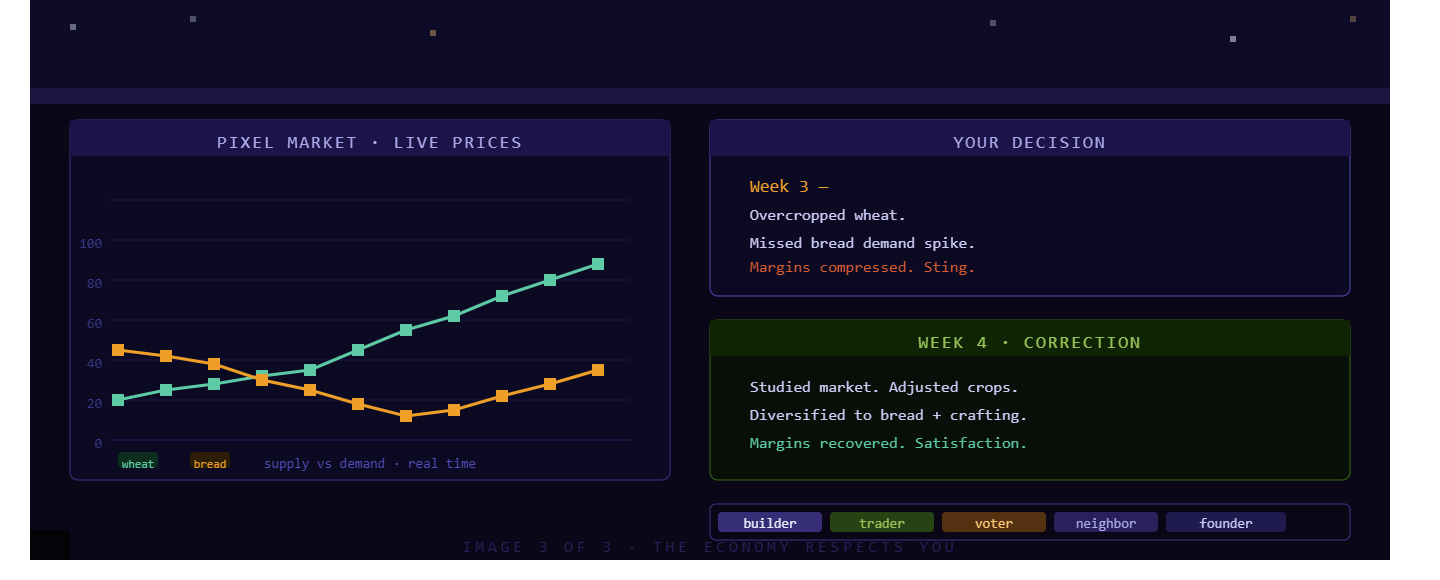
The economy in Pixels respects your brain. It’s not a slot machine designed to keep you hooked. It’s a real player-driven market. If too many people grow wheat, prices drop. If a new recipe needs certain materials, demand jumps and smart players profit.
I learned this the hard way in my third week. I over-planted one resource, missed a demand spike on another, and watched my earnings shrink. It hurt a bit. Then I studied the market, changed my plan, and recovered the next week.
No other game ever made me feel the real sting of a bad decision : or the satisfaction of fixing it. Pixels taught me how economies actually work, not just how they look in a textbook.
When people ask me about Pixels, I don’t say it’s a farming game on blockchain.
I say: It’s the first digital world where I logged in as a normal player and slowly got handed the tools to become something more - a builder, a trader, a neighbor, and even a founder.
The game didn’t force those roles on me. It simply built a world where choosing them was possible, then stepped back and let me try.
And honestly, that small difference is huge. For the first time, I don’t just play in a world.
I help shape it.
One plot, one decision, and one vote at a time.