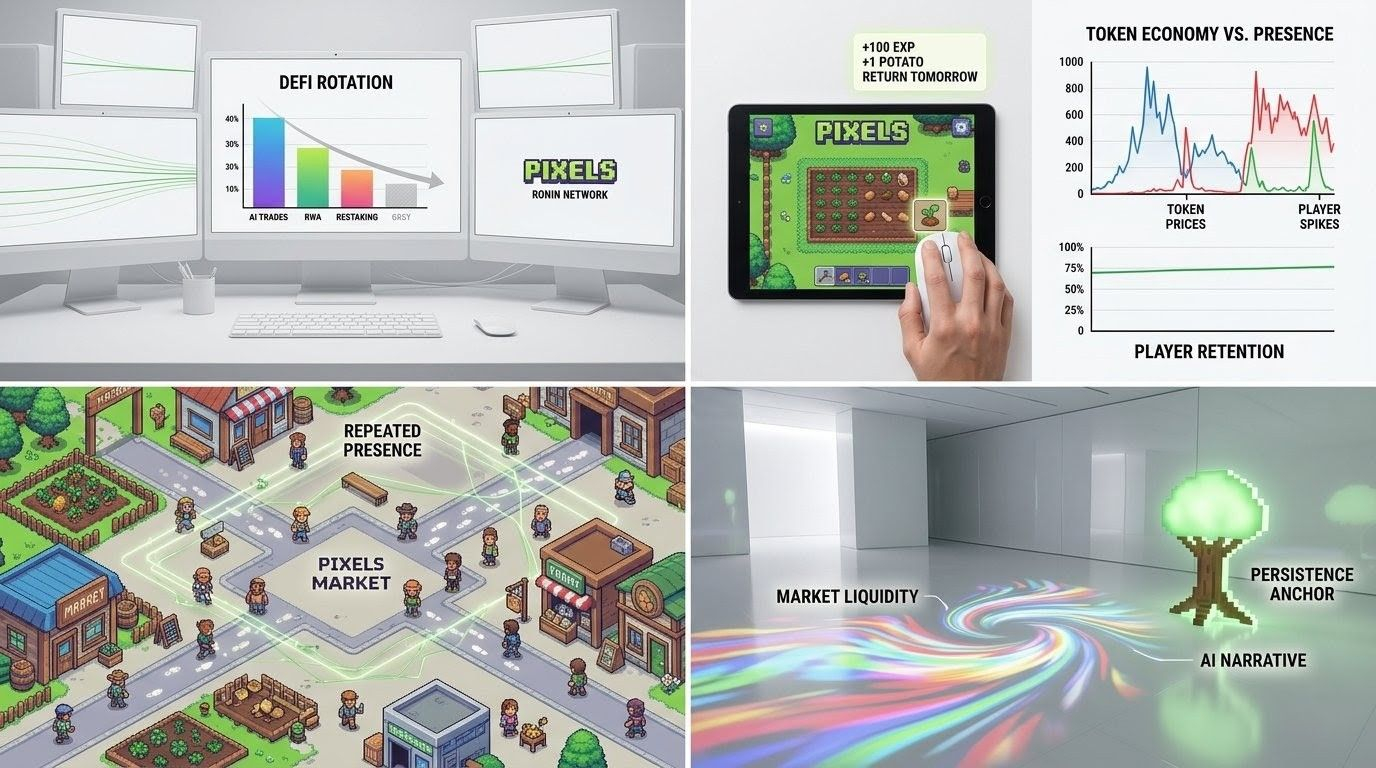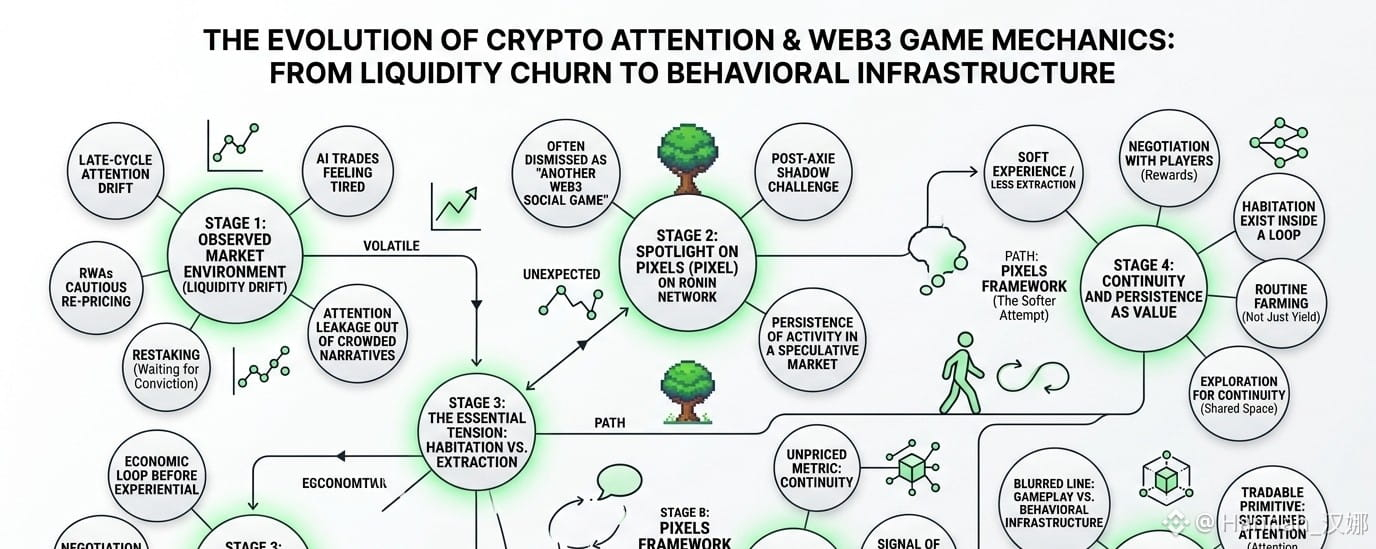

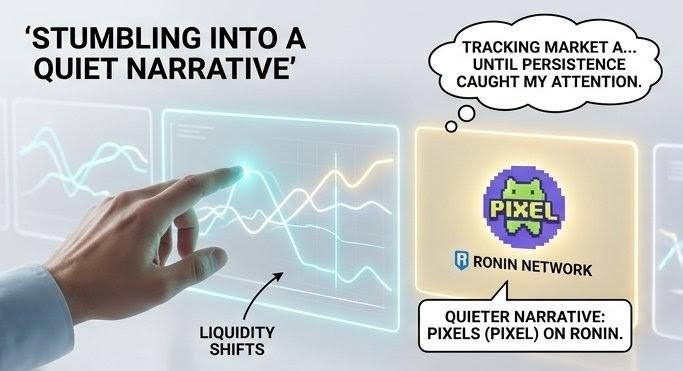
I wasn’t even looking for anything like this. I was originally tracking a different rotation the usual late-cycle drift where attention quietly leaks out of whatever narrative was crowded last month. AI trades had started to feel tired at the edges again, RWAs were being re-priced more cautiously, and restaking, despite all the structural promise people still talk about, had that familiar sense of capital waiting for conviction that never fully arrives.
In that kind of environment, you start noticing smaller things. Not because they are loud, but because they aren’t.
That’s how I ended up looking at Pixels (PIXEL).
At first glance, it’s easy to dismiss it as another social Web3 game. Farming, exploration, creation the familiar vocabulary we’ve seen recycled across cycles. But the interesting part isn’t the genre. It’s the persistence of activity in a market that usually abandons anything that doesn’t immediately reflect in liquidity or speculation velocity.
The game runs on the Ronin Network, which already frames it in a certain way. Ronin has always carried this post-axie shadow a chain trying to prove that gaming economies can survive beyond one breakout moment. So when you see something like Pixels building on it, you can’t help but read it as another attempt at answering a question the market hasn’t fully resolved yet: can Web3 games create retention that isn’t just incentive-driven churn?
Because that’s really the tension here.
Most crypto games still feel like they are negotiating with their own players. You come in, you get rewarded, you optimize, and eventually you leave when optimization flattens. The loop is economic before it is experiential. Pixels, at least in its framing, seems to try something softer. Less extraction, more habitation. You don’t just “play” it you exist inside a loop of repetitive presence. Farming isn’t just yield mechanics; it becomes routine. Exploration isn’t about discovery rewards; it’s about maintaining continuity in a shared space.
And continuity is a strange thing in crypto. We don’t usually price it well.
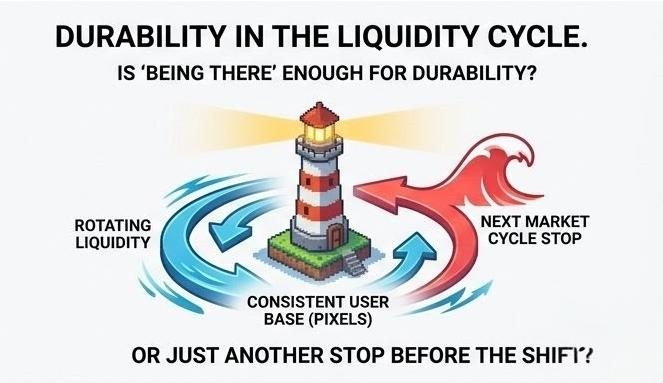
In this market, liquidity moves like weather. It rotates faster than narratives can stabilize. One week it’s modular blockchains, the next it’s AI agents, then it’s RWAs again when macro conditions tighten and everyone starts craving “real yield” language. Within that cycle churn, most projects are optimized for attention capture, not attention retention. Pixels feels like it is trying intentionally or not to anchor itself on the latter.
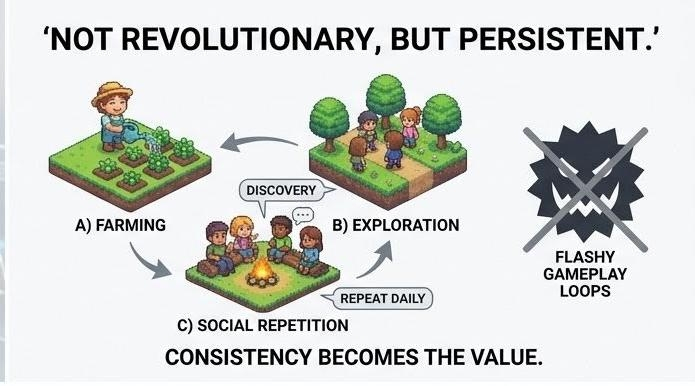
What stands out is how little it asks from the user at any single moment, but how consistently it asks them to return. That design choice matters more than it looks on paper. Because retention in crypto isn’t just a product metric; it’s a signal of whether a system is becoming culturally sticky or just economically temporary.
Still, I can’t fully decide if this stickiness is organic or carefully engineered incentive gravity.
There’s always a risk that what looks like “presence” is just well-disguised reward dependency. We’ve seen versions of this before systems that feel alive until incentives change, and then suddenly the world empties out. That’s the uncomfortable question with anything in Web3 gaming right now. Are we building spaces people want to inhabit, or just environments where it makes sense to stay until the yield curve shifts?
The technology itself doesn’t feel overcomplicated, which might actually be part of the strategy. It doesn’t try to impress with infrastructure narratives. It sits on-chain, uses familiar loops, and lets behavior carry most of the weight. In some sense, it’s closer to a social simulation than a “game” in the traditional crypto sense. The token layer exists in the background, but it doesn’t dominate the experience in an obvious way at least not immediately.
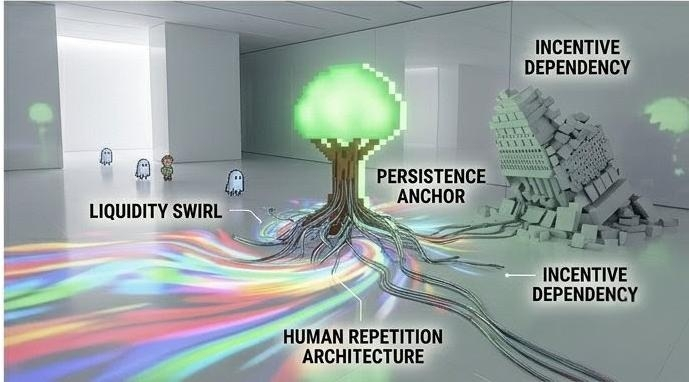
But token design always finds its way to the surface eventually.
If rewards are tied too closely to activity, you get farming behavior instead of cultural behavior. If they are too loose, you lose the retention loop entirely. Striking that balance is where most of these ecosystems quietly fail, even when everything else looks functional on the surface.
What I find more interesting is how Pixels seems to rely on repetition as value creation. Not in the abstract “time spent” sense, but in the idea that repeated presence itself begins to form a kind of lightweight memory layer across the world. You don’t just log in; you leave traces. And those traces accumulate into something that feels like continuity, even if nothing fundamentally permanent is being built underneath.
That’s the part that stays with me.
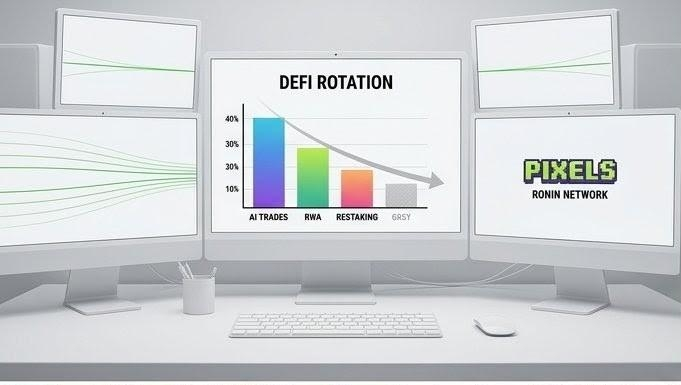
Because it starts to blur the line between gameplay and infrastructure simulation. Not infrastructure in the technical sense, but in the behavioral sense systems where human repetition becomes the architecture itself.
The contrarian thought here is uncomfortable: maybe this isn’t a game trying to become a better game. Maybe it’s an experiment in whether sustained attention can itself become a tradable primitive. Not attention capture, which we already understand too well, but attention persistence something slower, less reactive, and harder to extract value from quickly.
And that raises its own uncertainty.
If persistence becomes the product, then what exactly is being built? A world people inhabit, or a dataset of behavioral continuity waiting to be monetized later in ways we don’t fully see yet? Crypto has a habit of turning participation into abstraction over time, even when it starts with seemingly harmless loops.
So I keep coming back to a simple tension.
It’s easy to say Pixels is “just a game,” and equally easy to oversell it as something more foundational than it is. The truth probably sits in the uncomfortable middle a live system trying to stabilize itself in a market that rarely lets anything stabilize for long.
And maybe that’s what makes it worth watching. Not because it is solving anything definitively, but because it’s quietly testing whether presence can hold value in a space built almost entirely on movement.
Which leaves me with a question I can’t fully settle yet: if a world only exists because people keep returning to it, is that enough for it to be called real or is it just another well-designed pause inside the constant rotation of liquidity?