
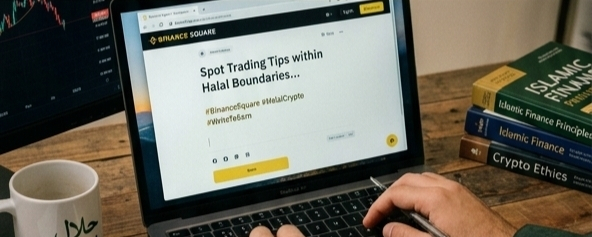
In Spot, you are buying the actual asset (the Mal), which removes the interest-based debt (Riba) and extreme gambling (Maysir) often found in high-leverage futures.
Here are four high-impact tips written specifically for your profile:
1. Use the "Math of Proportions" for Position Sizing
Many traders fail because they "all-in" on one price. Instead, use a mathematical scaling-in strategy.
The Tip: Never use more than 10% of your total capital on a single trade. Divide that 10% into three entry points (e.g., 3%, 3%, and 4%).
The Math: If the price drops slightly after your first entry, your "Average Entry Price" improves. This reduces the emotional pressure and keeps your risk-to-reward ratio healthy.
2. Prioritize "Utility" Over "Hype"
In halal trading, the asset should ideally have an underlying value or utility.
The Tip: Before clicking that "Buy" button, ask: What does this token actually do? Stick to projects that provide infrastructure (like $BNB or $ETH) or acting as a store of value (like $BTC).
The Math: High-utility tokens generally have higher liquidity and lower slippage, meaning your math-based technical analysis (TA) will be more accurate compared to "pump and dump" coins.
3. Set a "Hard" Risk-to-Reward Ratio
Since you specialize in shortcuts, use the 1:2 Rule as your mental baseline.
The Tip: For every $1 you are willing to lose (your Stop Loss), you must aim to make at least $2 (your Take Profit).
The Math: If you win only 40% of your trades using a 1:2 ratio, you will still be profitable over time.
Example: Lose 6 trades ($6) + Win 4 trades ($8) = $2 Profit. Math proves you don't need to be right every time to succeed.
4. Master the "Time-Frame" Logic
Spot trading is a game of patience, not just speed.
The Tip: Use the 4-Hour (4H) or Daily (1D) charts to find the trend, then use the 15-Minute (15M) chart for your entry "shortcut."
The Halal Angle: Trading on longer time frames reduces "Gharar" (excessive uncertainty). It turns trading from a "bet" into a calculated business decision based on establish