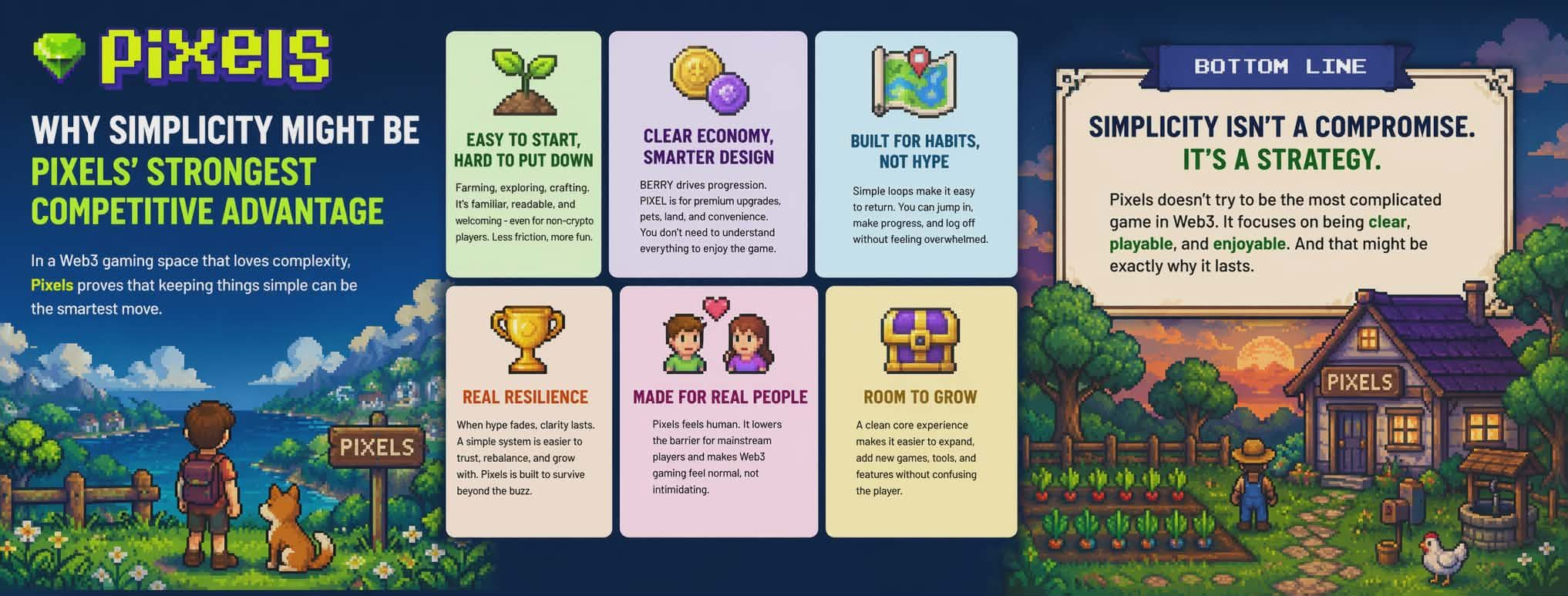
I have always felt that one of the biggest mistakes in Web3 gaming is the obsession with looking complicated.
Somewhere along the way, complexity started being treated like proof of quality. If a game had multiple tokens, layered economies, staking mechanics, NFT utility, guild structures, land systems, and reward loops stacked on top of each other, people assumed it must be “serious.” But the more I watch this space, the more I think the opposite is often true. A lot of Web3 games are not deep. They are just crowded.
That is why Pixels catches my attention.
Not because it is perfect. Not because it has solved every problem in blockchain gaming. But because it seems to understand something many other projects still miss: a game does not need to feel heavy to feel valuable.
In fact, I think Pixels’ biggest strength may be that it feels lighter than most of its competitors.
And I do not mean lighter in a bad way. I mean it in the way a well-designed product feels lighter than a badly designed one. It gets out of your way. It lets you settle in. It does not force you to wrestle with the system before you can enjoy the experience.
To me, that is not a small design choice. That is a competitive edge.
My issue with most Web3 games is that they ask for too much too early
One thing that has always frustrated me about blockchain games is how quickly they stop feeling like games and start feeling like explanations.
Before a player can even decide whether they like the world, they are often expected to understand the token structure, the asset hierarchy, the progression economy, the staking logic, and the long-term incentive design. It is like being invited to dinner and being handed the kitchen accounting before you even sit down.
That approach might impress people who already live inside crypto, but it creates distance for almost everyone else.
Pixels feels different because it does not open with pressure. It opens with familiarity. Farming, crafting, exploring, collecting, building. The loop makes sense quickly. You do not need to decode the product before you can interact with it.
That matters to me because I think the future winners in blockchain gaming will not be the projects that are hardest to understand. They will be the ones that make on-chain gaming feel normal.
And Pixels is closer to that than many people give it credit for.
What I like about Pixels is that it does not constantly try to impress me
A lot of Web3 projects feel insecure. You can sense them trying to prove their importance at every moment. More features, more utility, more systems, more promises. There is always this feeling that the project is afraid of seeming “too simple,” so it keeps adding layers until the user experience becomes bloated.
Pixels, in my view, is stronger because it does less showing off.
It does not feel desperate to convince you that it is revolutionary every five minutes. It just gives you a world you can understand and a loop you can return to. That confidence is underrated.
I think that is part of why it has remained more interesting than many louder projects. It does not build all of its identity around spectacle. It builds around usability.
And honestly, usability is one of the rarest things in crypto.
I think simplicity is underrated because people confuse it with lack of depth
This is where my perspective probably differs from a lot of the market.
I do not look at simplicity and think, “This game has less to offer.” I often look at simplicity and think, “This team may actually understand player behavior.”
Because the truth is, most people do not stay with a game because it has the most complicated economy. They stay because the experience feels good enough to become part of their routine.
That is why I think Pixels has more staying power than people assume.
Its loop is not trying to exhaust the player. You can enter, do something useful, make progress, and leave without feeling like you just navigated a financial instrument. In a space where many games feel like second jobs with token wrappers, that is refreshing.
To me, Pixels feels less like a grand promise and more like a space built for repeat visits. That distinction is important.
A lot of Web3 games are built like events. Pixels feels more like a habit.
And habits usually outlast events.
I also think simplicity gives Pixels more resilience when hype cools down
This is the part that interests me most.
When the market is hot, almost any game can look smarter than it really is. Speculation fills in the gaps. Token excitement creates the illusion of strong design. Incentives can temporarily make weak gameplay look stronger than it is.
But when that energy fades, all the decoration falls away.
Then you are left with a much more honest question: does the product still make sense when people are no longer being carried by hype?
That is where simplicity becomes powerf