
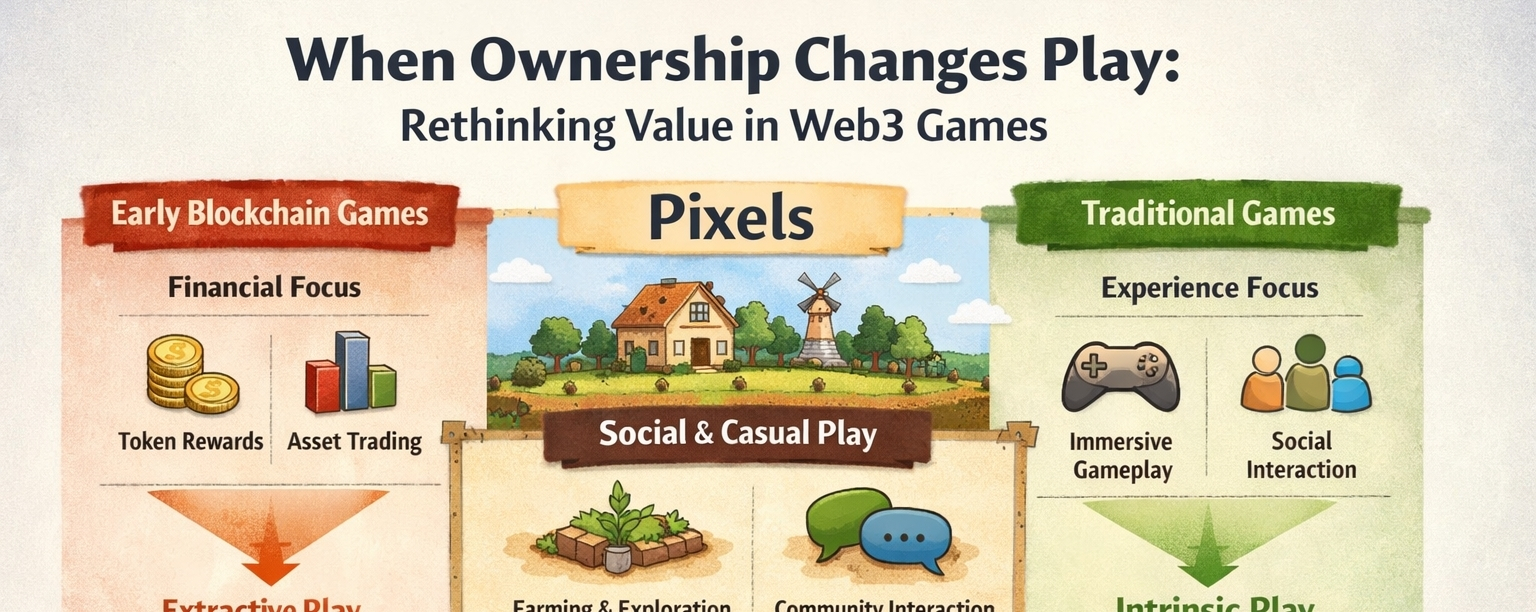
This question sits beneath much of the experimentation in Web3 gaming. For years, the industry has tried to merge two very different systems: games, which are designed around engagement and experience, and blockchains, which are designed around verification and value transfer. The assumption has been that combining them would naturally improve both. In practice, the result has often been tension rather than harmony.
Before projects like Pixels, blockchain games struggled with a structural imbalance. They introduced ownership and tokenized assets, but in doing so, they often shifted player behavior toward extraction rather than immersion. Players were no longer just participants in a virtual world; they became operators within an economy. This changed how time, effort, and even enjoyment were perceived. Activities were evaluated not by how engaging they were, but by how efficient they were. The underlying problem remained unresolved because the tools of blockchain were applied without fully reconsidering the psychology of gameplay.
Earlier solutions attempted to correct this imbalance through iteration. Developers reduced upfront costs, simplified onboarding, and experimented with different economic models. Some removed initial barriers entirely by allowing free entry, while others introduced more complex reward systems to stabilize participation. Yet these approaches often addressed symptoms rather than causes. The presence of tradable assets and tokens continued to influence behavior in ways that traditional game design was not built to handle. Even when games became more accessible, they rarely became more meaningful.
Pixels emerges within this context as a different kind of attempt, not by rejecting blockchain principles, but by repositioning them. Built on the Ronin Network, it frames itself as a social, casual open-world game centered on farming, exploration, and creation. These are not innovations in themselves; they are among the most familiar mechanics in gaming. What is notable is the decision to start from simplicity rather than complexity, suggesting a deliberate move away from systems that require constant optimization.
One of the project’s central claims is that it reduces the cognitive distance between traditional and blockchain gaming. In practical terms, this implies that players can interact with the game without needing to think about the underlying infrastructure. Transactions are intended to be fast and low-cost, and the overall experience aims to resemble that of a standard online game. This reflects a broader shift in design philosophy, where blockchain is treated as a background layer rather than a defining feature.
Another claim relates to how value is generated and recognized. Pixels suggests that everyday in-game actions such as farming and exploration contribute to a player-driven ecosystem. These activities are linked to blockchain-based assets, which introduces the idea that time spent in the game has a persistent form of representation. However, this raises an important question about perception. If players are not actively engaging with or benefiting from this ownership in a tangible way, does it meaningfully change their experience, or does it remain an abstract layer?
The project also places emphasis on social interaction, positioning itself as a shared environment rather than a collection of isolated users. This is a notable departure from many earlier Web3 games, where interaction was often limited to marketplaces or coordinated strategies. In Pixels, the intention appears to be that social behavior becomes part of the gameplay itself. Whether this emerges organically or requires active design intervention remains uncertain, as social systems in games tend to evolve in unpredictable ways.
From a critical standpoint, some aspects of Pixels appear grounded in practical considerations. The use of Ronin suggests an awareness of the technical limitations that have affected other blockchain games, particularly in terms of cost and scalability. This choice aligns with the needs of a game that depends on frequent, low-friction interactions. However, infrastructure alone does not determine user behavior. The more complex challenge lies in aligning incentives with experience in a way that does not distort either.
The concept of ownership continues to be one of the more ambiguous elements. While blockchain provides a mechanism for verifiable control, it does not define why that control matters. In traditional games, value is often contextual and emotional rather than transferable. Introducing tradable assets changes this dynamic, sometimes subtly, sometimes significantly. Even in systems designed to emphasize play over profit, the possibility of exchange can influence how players engage with the game.
There are also trade-offs in design simplicity. By focusing on familiar mechanics, Pixels lowers the barrier to entry and potentially broadens its audience. At the same time, simplicity can limit the range of experiences available to players, particularly over longer periods. Sustaining engagement may require continuous expansion, which introduces new layers of complexity that the original design seeks to avoid.
The question of audience is equally important. Pixels appears to cater to users who value relaxed, social gameplay and are open to the presence of blockchain without being driven by it. This may exclude players who are primarily interested in competitive depth or financial optimization. In this sense, the project is not attempting to serve all segments of the market, but rather to define a specific type of experience within it.
What makes Pixels worth examining is not that it claims to resolve the contradictions of Web3 gaming, but that it approaches them from a different angle. Instead of trying to make blockchain more visible or more central, it experiments with making it less noticeable. This raises a broader question about the future direction of the space.
If the most effective use of blockchain in games is one that players barely notice, then what exactly distinguishes a blockchain game from a traditional one—and does that distinction still matter?#pixel. @undefined $PIXEL