
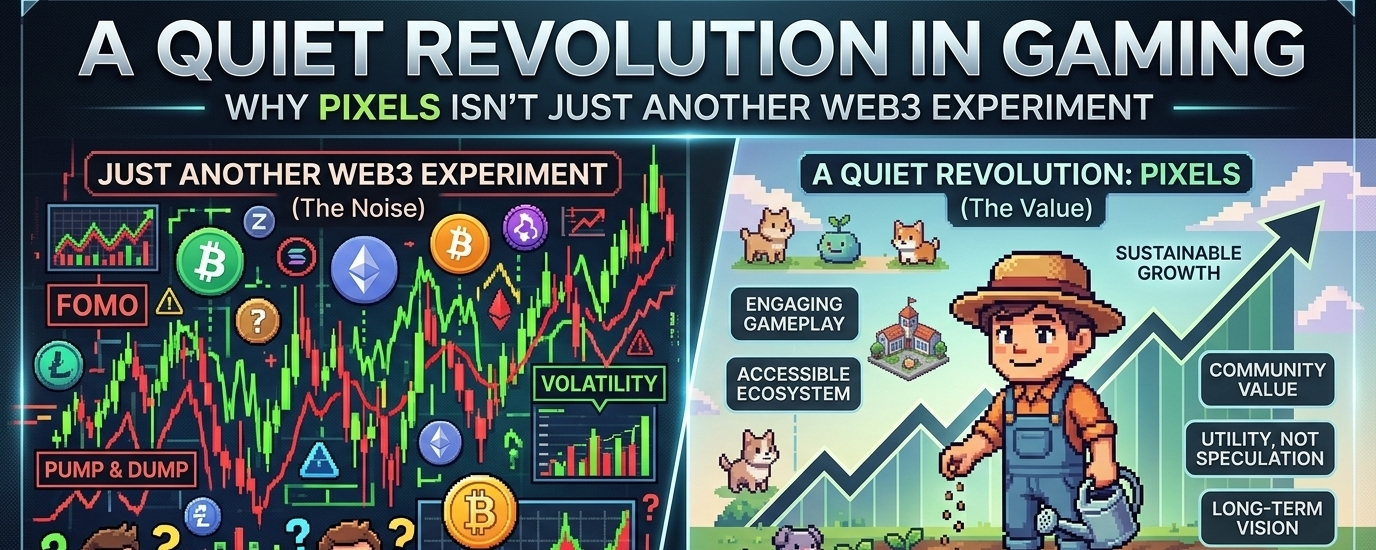
imagine blockchain games as clunky experimentshalf game, half financial tool, and rarely satisfying as either. Then something like Pixels comes along and quietly disrupts that narrative
At first glance, Pixels doesn’t scream “revolution.” It looks almost nostalgic—soft pixel art, farms, trees, cozy little avatars wandering around. But spend an hour inside its world, and you begin to notice something different. It’s not trying to impress you with tech. It’s trying to keep you there
And that’s where it succeed
The Foundation: A Game Built on Ronin, Not Just Blockchain Hype
Pixels runs on the Ronin Network, a blockchain ecosystem originally developed to support large-scale games like Axie Infinity. That matters more than it sounds
Ronin isn’t just infrastructure—it’s battle-tested. It was built to handle millions of transactions without making players feel like they’re “using blockchain.” That’s a subtle but critical distinction. In Pixels, you’re not constantly reminded that you’re interacting with wallets, tokens, or gas fees. You’re just… playing
That seamlessness is what most Web3 games get wrong. They front-load the tech. Pixels hides it in the background
Farming, Yesbut Also Something More
Calling Pixels a “farming game” is technically accurate, but it undersells the experience
Yes, you plant crops. You harvest them. You manage resources. But that’s just the surface layer. Underneath, there’s a living economy and a social fabric that feels closer to a small town than a traditional game
Players don’t just grindthey specialize. One person might focus on agriculture, another on crafting, another on trading. Over time, you start recognizing names, seeing familiar avatars, even forming informal partnerships
It’s less like playing a game and more like participating in a shared ecosystem
The Role of the PIXEL Token: Incentive Without Obsession
At the heart of the economy sits the PIXEL token. But unlike many Web3 projects, Pixels doesn’t shove token mechanics into your face every five minutesYou earn PIXEL through gameplaycompleting tasks, contributing to the ecosystem, or simply being active in meaningful ways. It becomes a reward for engagement rather than the sole purpose of playing
That distinction is important
In earlier blockchain games, players often treated gameplay as a means to extract value. The result? Burnout, speculation, and short-lived communities. Pixels flips that dynamic. The value comes because the game is enjoyable, not the other way aroundLand Ownership and Digital Identity
One of the more intriguing aspects of Pixels is land ownership. Players can own plots of land, customize them, and even turn them into hubs of activity
This isn’t just cosmetic. Landowners can:
Host other players
Grow specific resources
Build reputations within the community
Over time, certain plots become knownalmost like neighborhoods with personality. It’s fascinating to watch how digital space starts to mirror real-world dynamics
You’ll find “busy” areas where players gather, quieter corners for solo play, and even places that feel like local markets
Social Play: The Real Hook
What keeps people coming back isn’t the farming loop. It’s the people
Pixels has leaned heavily into social mechanics without forcing them. You can play solo, surebut the game subtly nudges you toward interaction. Trading, chatting, collaboratingit all happens naturally
And because there’s real value tied to activity, interactions carry weight. Helping someone isn’t just goodwillit can ripple through the in-game economy
There’s something oddly satisfying about seeing a player you helped days ago now thriving, contributing, and interacting with others
A Shift Away From “Play-to-Earn” Toward “Play-and-Belong
The phrase play-to-earn” has done more harm than good in gaming circles. It reduces everything to transactions. Pixels seems to understand that
Instead, it leans into what you might call “play-and-belong
You log in not just to earn tokens, but to check your crops, see who’s around, maybe trade a few items, maybe just wander. The game becomes part of a routine, not a grind
That emotional stickiness is something traditional MMOs have mastered for decades. Seeing it emerge in a Web3 environment is a strong signal that the space is maturing
Accessibility: A Low Barrier That Changes Everything
Another quiet strength of Pixels is how easy it is to start
You don’t need deep crypto knowledge. You don’t need to understand wallets or DeFi. The onboarding process is surprisingly smooth, especially compared to earlier blockchain games
That accessibility opens the door to a broader audience
people who care about gameplay first and technology second
And once they’re in, many don’t even realize they’re participating in a blockchain-based economy. That’s not a flawit’s the point
The Economy Feels Alive (Because It Is
In many games, economies feel artificial. Prices are fixed. Systems are predictable. Pixels is different
Because real players drive supply and demand, the in-game economy shifts constantly. Crops fluctuate in value. Resources become scarce or abundant. Strategies evolve
It creates a subtle tension: do you sell now, or wait? Do you diversify, or specialize
These decisions give weight to even simple actions like planting wheat or crafting an itemChallenges and Growing PainsOf course, Pixels isn’t perfect.Like any evolving online world, it faces issues:Balancing rewards so early players don’t dominatePreventing bots or exploitative behaviorMaintaining long-term engagement beyond noveltThere’s also the broader challenge of Web3 skepticism. Many gamers still associate blockchain with scams or cash grabs, and Pixels has to work against that reputation
But here’s the difference: it’s not trying to win arguments. It’s trying to win players—by being fun
Why Pixels Matters More Than It Looks
It would be easy to dismiss Pixels as “just another indie farming game with crypto.” That would miss the bigger picture
What Pixels represents is a shift in how Web3 games are designed
Gameplay first, technology secon
Community over speculation
Long-term engagement over short-term hype
It’s not about proving that blockchain belongs in gaming. It’s about quietly integrating it in a way that feels natural
Final Thoughts: A Glimpse of What’s Coming
Pixels doesn’t feel like the future in a flashy, headline-grabbing way. It feels like the future in a quieter sensethe kind that sneaks up on you
You log in for a few minutes. Then an hour passes. Then you come back the next day, not because you have to, but because you want to see what’s changed
That’s something no tokenomics model can fake
If this is the direction Web3 gaming is heading
toward worlds that prioritize connection, creativity, and genuine enjoymentthen Pixels might not just be a successful game
It might be an early blueprint
