
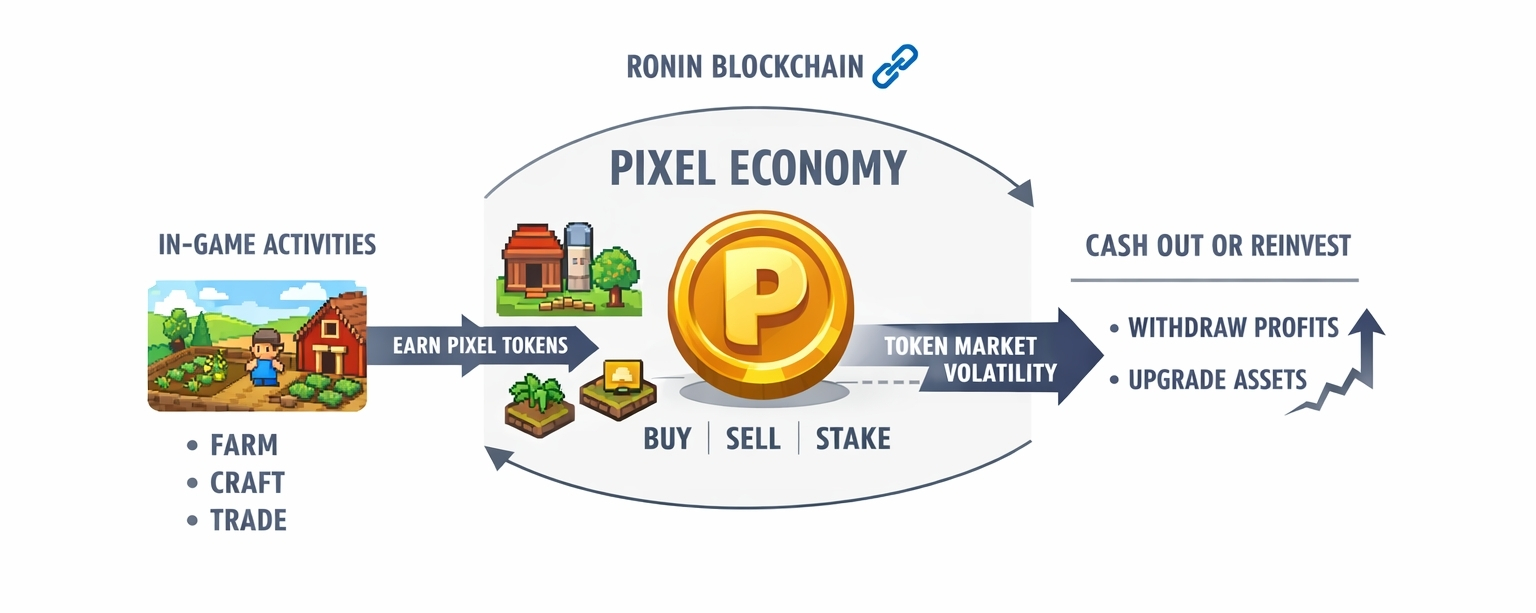
Look, I’ve seen this movie before. It usually starts with something simple, almost disarming. In this case, it’s Pixels—a soft, pixelated world where you plant crops, chat with other players, and slowly build something that feels like a digital homestead. Harmless. Nostalgic, even. Then you notice the plumbing underneath, and suddenly it’s not just a game anymore. It’s an economy. And economies have rules that games don’t.
Let’s be honest. The pitch here is familiar. Players don’t just play—they earn. They own assets. They participate in something bigger than a closed system. All of it runs on the Ronin Network, which is supposed to make everything transparent and user-controlled. That’s the story. It sounds tidy. On paper, at least. But once you sit with it for a minute, the cracks start to show.
Start with the problem they claim to fix. Traditional games, we’re told, are unfair. You spend time, maybe money, and you walk away with nothing. Your items are locked inside a publisher’s database. Your progress dies when you stop playing. Pixels positions itself as the antidote. Here, your time has value. Your items are yours. You can trade them, sell them, carry them outside the game.
That’s the theory.
But here’s the part people skip over: most players in traditional games are not actually trying to turn their hobby into a job. They play because it’s fun, not because they want exposure to a volatile token economy. Pixels takes something simple—farming, progression, social play—and ties it to financial incentives. Suddenly, every action has a price attached. Every decision has an opportunity cost. You’re not just playing anymore. You’re optimizing.
And that’s where things get complicated.
Because the “solution” here isn’t removing friction. It’s adding a new layer of it. To play seriously, you need to understand wallets, tokens, transaction fees, and market timing. You need to think about when to sell, when to hold, how emissions affect supply. That’s not gaming. That’s portfolio management in disguise. I’ve watched this happen over and over. The system gets more complex, not less, and the people it claims to empower end up needing to become part-time traders just to keep up.
Now let’s talk about incentives. This is where it always gets interesting. The PIXEL token sits at the center of everything. It’s the reward, the currency, and in some cases the governance mechanism. That sounds efficient. It’s not. It creates a constant balancing act. If the token price rises, early participants benefit. If it falls, new players absorb the hit. Someone is always on the wrong side of the trade.
Who’s getting rich here? It’s rarely the average player logging in to water crops. It’s the early entrants, the asset holders, the people who understand the system before it scales. Everyone else is, intentionally or not, providing liquidity. That’s the quiet engine behind most of these models. New users come in, buy assets, push demand up. Older users exit. The cycle repeats until it doesn’t.
And then there’s the question of decentralization. It’s marketed heavily. Ownership, control, freedom. But look closer. The game logic, the reward rates, the economic parameters—those are still controlled by the developers. The blockchain records who owns what, but it doesn’t decide how the game works. If the team tweaks emissions or changes progression, the entire economy shifts overnight. You don’t vote on that in any meaningful way. You react to it.
So what exactly is decentralized here? Ownership of assets, yes. Control of the system, not really.
You also can’t ignore the history. The network underneath all this is tied to Sky Mavis, which had a front-row seat to the Ronin Network hack. That wasn’t a small glitch. It was a massive failure that exposed how fragile these systems can be when security and governance don’t hold up. It’s been patched, improved, hardened. Fine. But systems don’t exist in a vacuum. Trust, once shaken, doesn’t reset just because the codebase does.
Now let’s get to the human reality. What happens when this thing slows down? Because it always does. Early on, rewards feel meaningful. Activity is high. The community is engaged. Then emissions increase, supply builds, and the token starts to wobble. Players who came for earnings start to leave. Engagement drops. The people who remain are either genuinely enjoying the game or hoping for a rebound.
And that’s the uncomfortable question. Strip away the token. Strip away the earning narrative. Would people still be here?
I’ve seen a lot of projects try to answer that question after the fact. It’s never easy. Once users are trained to expect financial returns, it’s hard to reset expectations back to pure entertainment. The system becomes dependent on maintaining that illusion of value, even when the underlying economics are under pressure.
Pixels is trying to walk a tighter line than its predecessors. It leans more on habit, on social interaction, on slower progression. That’s smart. It might even work for a while. But the core structure hasn’t disappeared. It’s still a game wrapped around a token economy that needs participation to sustain itself.
And participation, in systems like this, is rarely just about having fun.
