
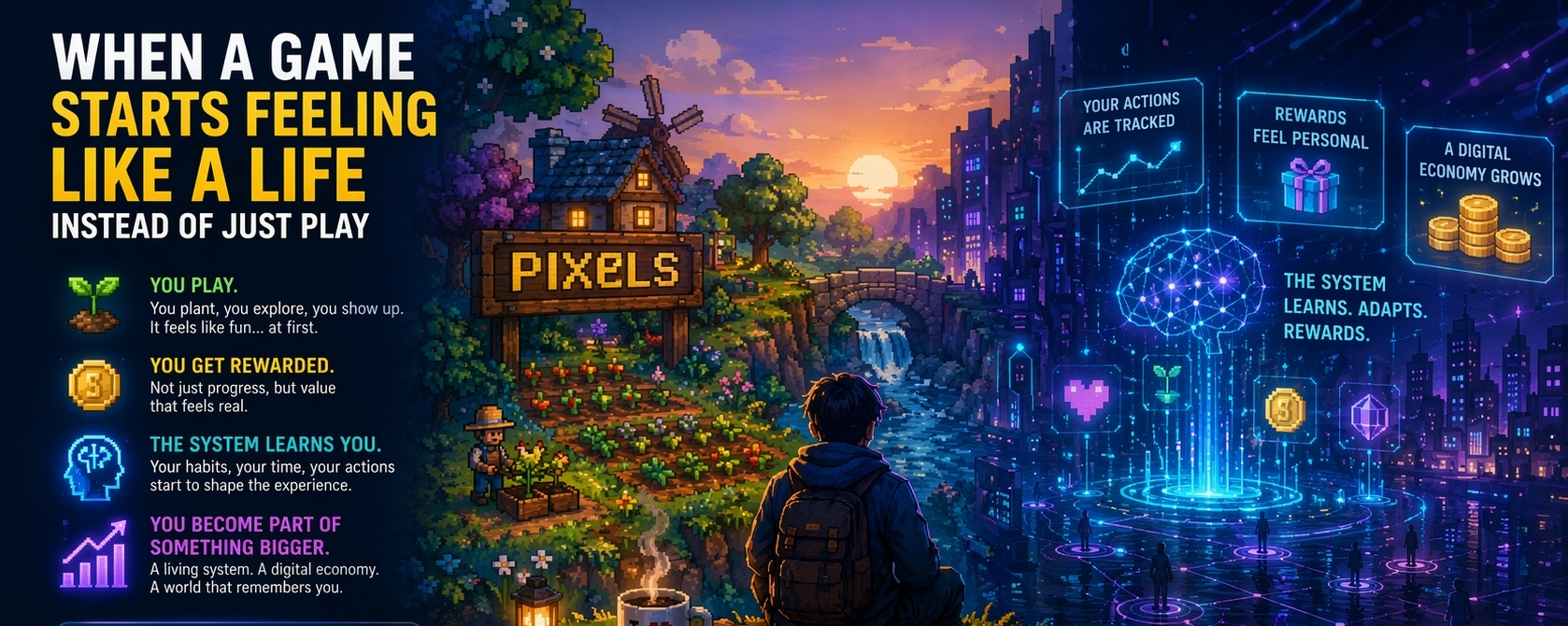
@Pixels When a Game Starts Feeling Like a Life Instead of Just Play I keep coming back to this question, and it never really leaves me alone. When does a game stop being just a game? Not in some obvious way, not with a clear line where everything suddenly changes, but slowly… quietly… the way something shifts without asking for your attention.
You log in, you play, you move through the world like you always have. It feels familiar. Comfortable, even. That’s exactly how something like Pixels begins to feel. You plant, you explore, you take your time. Nothing is forcing you forward. There’s a calm rhythm to it, almost like a place you return to rather than something you conquer.
But then, almost without noticing, something small starts to feel different. You played… and you got something back. Not just progress inside the game, not just a completed task or a level gained—but something that feels like it exists beyond it too. A reward that doesn’t fully belong to the game itself. And that’s when a strange thought appears: your time here isn’t just being spent… it’s being counted.
That feeling is subtle, but it changes everything.
Because games were never supposed to make you think about the value of your time. You played because you enjoyed it. That was enough. But here, there’s another layer quietly forming underneath. Your actions are being observed, your habits are being understood, and over time, your behavior becomes something the system learns from. Not in a scary way, but in a very real one.
And that’s when it stops feeling like just a game.
It starts to feel like a system.
A system where your presence matters, where consistency has weight, where simply showing up becomes part of a larger flow. You’re still playing, yes—but at the same time, you’re participating in something that is trying to sustain itself through you. The more you engage, the more the system adapts. Rewards aren’t random anymore; they begin to feel intentional, almost designed around you.
It’s fascinating when you think about it. A game that doesn’t just respond to what you do, but slowly learns how to keep you doing it.
And yet, there’s something delicate about that idea.
Because part of what made games special was unpredictability. That little spark of not knowing what might happen next. When systems become smarter, more optimized, more efficient… that unpredictability starts to fade. Everything begins to make sense in a way that feels clean, but maybe a little too clean.
And when everything makes sense, something emotional can quietly disappear.
Still, there’s another side to this that’s hard to ignore. What’s being built here isn’t just a better game—it’s something closer to an environment. A place where your identity doesn’t reset when you leave, where your actions carry meaning beyond a single session. You’re no longer just visiting. You’re existing inside a network that remembers you.
That’s a very different kind of experience.
It’s the difference between stepping into a world and slowly becoming part of it.
And when you look at it from that angle, the idea of a “digital economy” doesn’t feel so abstract anymore. It’s not about charts or trading or anything complicated. It’s about the simple fact that your time, your behavior, and your presence are all starting to connect in ways they never did before. Value isn’t being inserted from the outside—it’s being generated from within the experience itself.
But that’s also where the tension lives.
Because once value becomes part of the experience, it’s hard to ignore it. At first, it feels like a bonus. Something extra. But over time, there’s always a risk that it becomes the reason you’re there. And when that happens, the experience can start to feel less like play and more like a loop.
Not a bad loop. Not even an obvious one. Just something that quietly shifts your motivation without you realizing it.
And that leads to the real question, the one that doesn’t have a simple answer. If a game begins to track you, reward you, learn from you, and connect your actions to a larger system of value… is it still just a game?
Or has it become something else entirely?
Maybe the truth sits somewhere in between.
Maybe it’s still a game—but a different kind of game. One that carries more weight than before. One that extends beyond its own boundaries. One that doesn’t end when you log out, because a part of you—your data, your progress, your presence—remains inside it.
And maybe that’s not something to fear or celebrate just yet. Maybe it’s just something to observe.
Because at the end of the day, the future of this idea won’t be decided by technology or design. It will be decided by something much simpler.
Whether people still feel something when they play.
Whether they still enjoy being there, even when the rewards fade into the background. Whether the world still feels alive, not because of what it gives them, but because of what it lets them experience.
If that feeling stays, then maybe this evolution works. Maybe games can become economies without losing their soul.
But if that feeling disappears… then no system, no matter how advanced, will be enough to hold people there.
And that’s why this question matters so much.
Because we’re not just watching games change.
We’re watching what it means to play slowly being redefined.
