I have always thought the easiest way to misunderstand a gaming token is to evaluate it like a normal crypto asset first.
That framing is convenient, but it is incomplete. It pushes attention toward the loudest signals: price action, trading volume, momentum, narrative strength, exchange visibility. Those things matter, sometimes a great deal. But for a token tied to a live game economy, they rarely tell the whole story. A gaming token does not survive on attention alone. It survives on behavior. It survives on whether players actually need it, prefer it, reach for it, and keep reaching for it long after the market stops talking.
That is what makes PIXEL worth examining seriously.
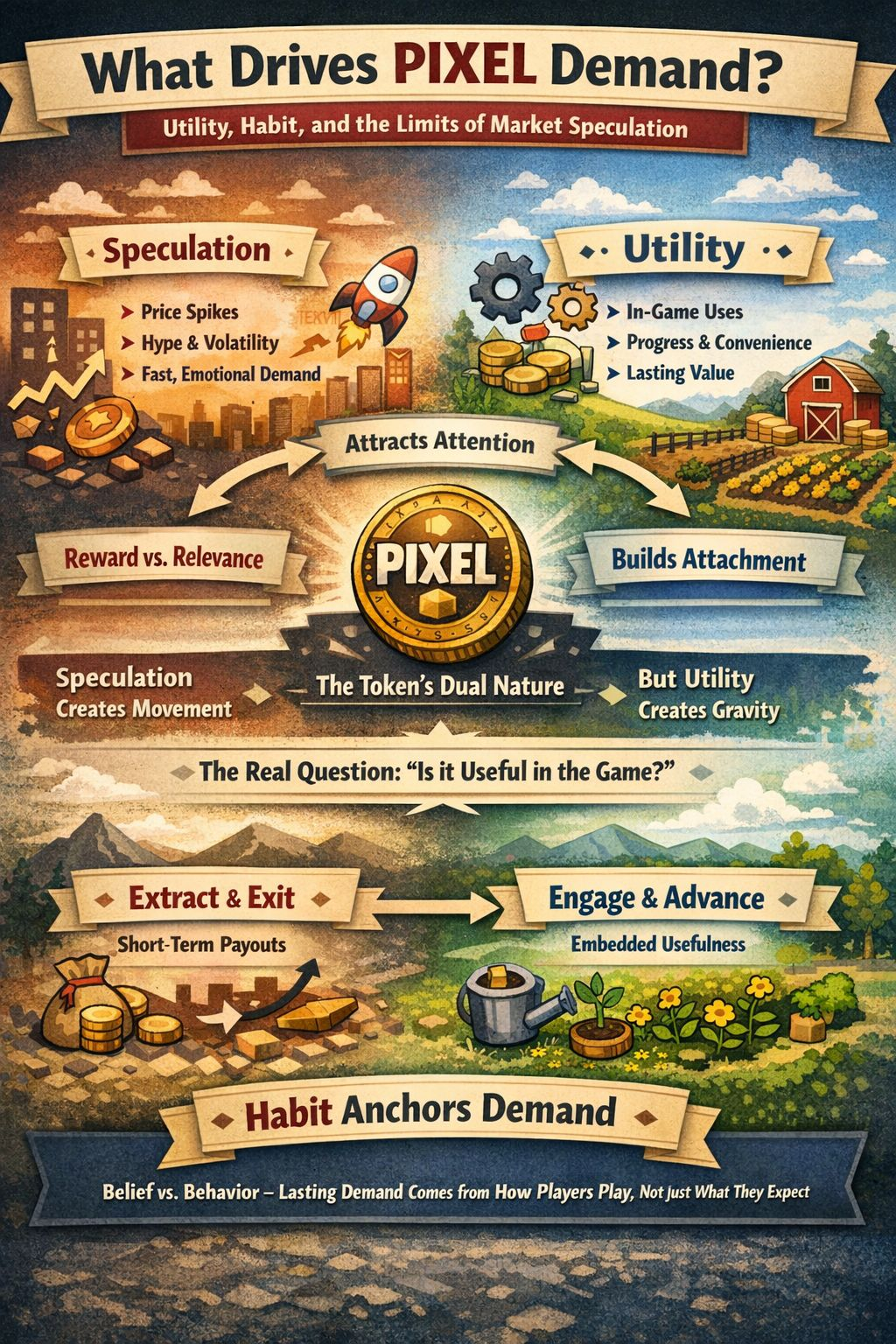
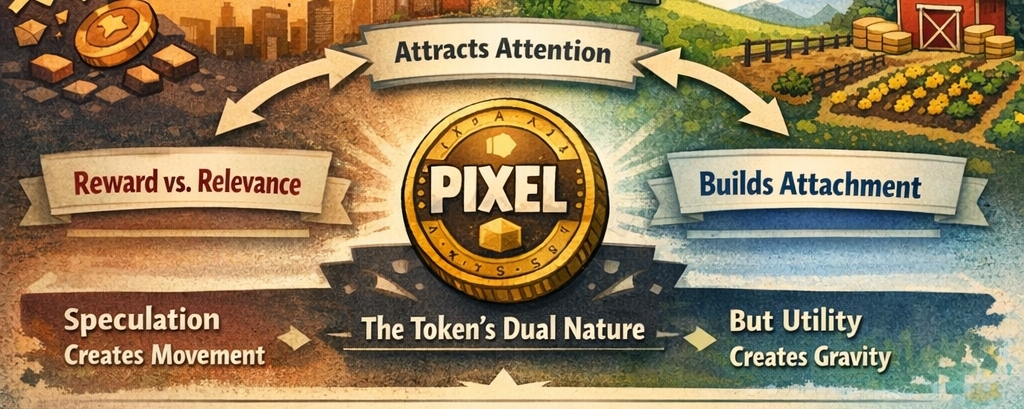
Not simply because it is a gaming token, and not simply because it belongs to Pixels, one of the more visible names in crypto gaming. What makes PIXEL interesting is that it sits at the intersection of two very different forces. One is speculative demand, which is fast, emotional, and highly visible. The other is utility-driven demand, which is quieter, slower, and often much more important. One creates movement. The other creates gravity.
That distinction matters because gaming tokens are often judged too early by the wrong standard. If the only question is whether traders want exposure, then the answer can change in an afternoon. But if the real question is whether players repeatedly find value in using the token inside a functioning game economy, then the analysis becomes deeper and far more revealing. In that context, demand is not just about excitement. It is about embedded usefulness.
Speculative demand is the easiest kind of demand to notice because it announces itself immediately. It shows up in volatility, breakout narratives, social media attention, and renewed market interest. It is the force that can reprice a token quickly, especially when sentiment shifts or a broader gaming narrative returns. In the case of PIXEL, speculation has clearly been part of the story. That is normal. Any token with enough visibility, liquidity, and community presence will attract traders looking for upside, rotation, or momentum. In crypto, attention itself is often treated like value.
But attention is not the same thing as retention.
Speculation can bring people toward a token, but it does not necessarily keep them there. In fact, speculative capital often has very little loyalty to the system it touches. It enters for opportunity, not attachment. It seeks asymmetry, not participation. It does not care much whether the underlying economy is frictionless, whether the reward loops are satisfying, or whether the token is becoming part of player routine. It cares whether the next move is likely to be higher than the last one.
That kind of demand is real, but it is fragile. It can inflate importance without creating permanence.
Utility-driven demand works differently. It does not usually arrive with the same noise. It builds through repeated use, through convenience, through progression systems that make the token more relevant over time rather than less. Its strength comes from integration. When a token becomes part of how players move through a game, unlock advantages, reduce friction, improve efficiency, or express commitment, demand stops being purely financial and starts becoming behavioral.
This is where gaming tokens separate themselves from ordinary crypto assets.
A general-purpose token can rely more heavily on market structure, narrative cycles, or ecosystem abstraction. A gaming token cannot. A gaming token lives inside a designed environment, and that environment determines whether the token has actual staying power. If using the token feels optional, awkward, or forced, demand remains shallow. If using it feels natural, rewarding, and increasingly sensible as a player advances, demand becomes much harder to dislodge.
PIXEL’s real test, then, is not whether the market can periodically become excited about it. The real test is whether Pixels can make PIXEL feel native to player behavior.
That is a much higher bar. It means the token must do more than circulate. It must matter.
In a game economy, convenience is often underestimated because it sounds less dramatic than scarcity or speculation. But convenience can be one of the strongest drivers of lasting demand. Players do not build habits around abstract tokenomics. They build habits around what saves time, reduces annoyance, accelerates progress, or improves outcomes in ways that feel worthwhile. If PIXEL becomes the easiest route to important actions inside Pixels, then it gains a kind of structural relevance that no amount of market hype can replicate.
That is because convenience changes decision-making at the point of use. It lowers friction. It shortens thought loops. It turns a token from something players hold into something they naturally spend, acquire, and account for. Once that happens consistently, demand becomes woven into routine.
Routine is more durable than excitement.
The same logic applies to progression. A token tied meaningfully to advancement can become far more powerful than a token tied only to rewards. Rewards attract attention, but progression shapes commitment. There is an important difference between a player asking, “What can I extract today?” and asking, “What helps me keep building?” The first mindset is transactional. The second is accumulative. One drains systems. The other inhabits them.
That distinction between extraction and loyalty is central to understanding sustainable gaming demand.
Many crypto game economies struggle because they overemphasize extractive incentives. They teach users to show up, harvest rewards, and leave. In those systems, the token becomes a temporary payout layer rather than a durable utility asset. Players may interact with it, but they do not develop attachment to it. They are not using the token because it is deeply relevant to how they play. They are using it because it is what gets paid out before conversion or exit.
That is not demand in the strongest sense. That is throughput.
For PIXEL to mean something lasting, it has to represent more than a reward people receive. It has to represent a relevance people feel. That relevance can come from premium features, from progression gates, from crafting advantages, from access to efficiencies, from time-saving functionality, from desirable in-game boosts, or from economic roles that players choose because they improve the actual experience of playing. The details matter, but the principle is simple: a token becomes stronger when using it feels better than avoiding it.
This is why premium in-game advantage deserves more respect in the token design conversation.
Crypto often treats “utility” as if any listed use case is automatically meaningful. It is not. A token is not valuable because a whitepaper says it can be spent in three places. Utility only matters when it improves the user experience enough to shape behavior. Premium advantages can do that very effectively, not by forcing players into token usage, but by making the token the sensible tool for players who care about efficiency, speed, or competitive edge.
Used properly, that creates demand with texture. Not everybody needs to be equally engaged, but the most committed users become economically aligned with the system. Their spending is no longer incidental. It becomes part of how they play well.
And that brings us to one of the most overlooked ideas in crypto gaming: habit can be a stronger foundation than hype.
Narrative hype can lift a token quickly, but it cannot substitute for repeated, low-resistance usefulness. Habit does something far more important than attract eyes. It normalizes demand. It makes token interaction ordinary. The more ordinary it becomes, the less dependent it is on extraordinary market conditions. A token held up by habit is not immune to volatility, but it is supported by something deeper than sentiment. It is supported by player routine.
That kind of embedded value is easy to miss from outside because it rarely looks spectacular in the moment. It accumulates quietly. A player who keeps a balance because they know they will need it. A player who uses the token because it saves steps. A player who values access, speed, convenience, or progression enough to keep interacting with the same economic rail. These are not dramatic events, but they are exactly the kinds of behaviors that make a token harder to replace and harder to forget.
In that sense, utility-driven demand is not just about usage volume. It is about psychological position.
A speculative token sits in the mind as an opportunity. A utility token inside a functioning game begins to sit in the mind as an instrument. The first invites trading. The second invites dependence. That dependence does not have to be absolute to be powerful. It only has to become common enough that the token remains relevant even when the narrative cools.
This is where PIXEL has a more interesting path than many gaming tokens that are discussed only in terms of emissions, price, and community excitement. If Pixels can keep making PIXEL useful in ways that players genuinely prefer, then the token’s long-term strength may come less from market storytelling and more from repeated in-game rationality. In other words, the most important buyer may not be the trader chasing a thesis. It may be the player trying to play better, faster, or with less friction.
That is a very different kind of demand, and in many ways a healthier one.
Speculation is not the enemy here. It plays a role. It expands awareness, attracts capital, improves liquidity, and gives the ecosystem moments of visibility that utility alone may not create. A token like PIXEL will likely always live with both forces at once. The mistake is not acknowledging speculation. The mistake is mistaking it for the whole foundation.
Because when speculation leads and utility lags, the token becomes dependent on renewed attention. Each cycle requires another story, another wave, another burst of belief. But when utility is strong, speculation becomes amplification rather than support. It can still accelerate the token, but it is no longer the only reason the token matters.
That is the difference between reward and relevance.
Reward gets users through the door. Relevance gives them a reason to stay.
In the end, the real question for PIXEL is not whether people can imagine it going up. Crypto is full of assets people can imagine going up. The real question is whether Pixels can keep making PIXEL increasingly natural to use, increasingly beneficial to hold within the game context, and increasingly tied to the kinds of habits that players do not want to abandon.
If the answer is yes, then demand will not just come from belief. It will come from behavior.
And behavior, especially repeated behavior inside a living game economy, is usually the more durable force. Hype can reprice a token. Habit can anchor it. Speculation can create attention. Utility can create attachment. One gives a token velocity. The other gives it a place to stand.
That is why gaming tokens should never be judged like ordinary crypto assets alone. Their true strength is not just in what the market says about them. It is in what players keep doing with them when nobody is watching.