
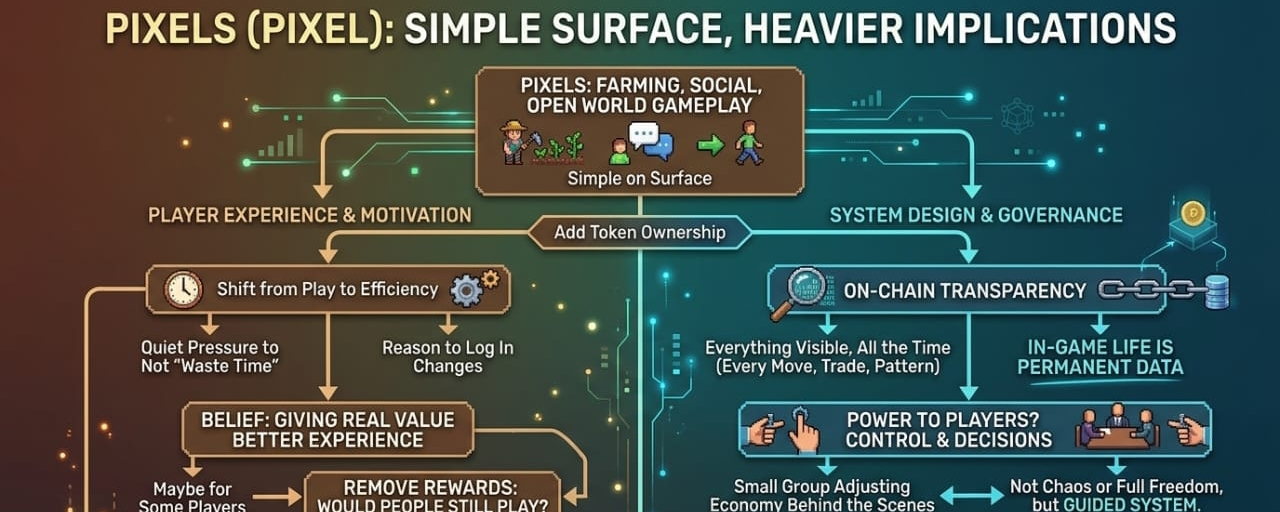
There’s a persistent narrative in Web3 gaming that everything—from player actions to world state—lives entirely on the blockchain. It’s a compelling idea: a fully decentralized game, transparent and immutable by design. But when you look closely at games like Pixels, that vision quickly collides with reality. What emerges instead is something far more pragmatic—and arguably more interesting: a hybrid backend architecture that blends Web2 efficiency with selective Web3 guarantees.
At its core, Pixels presents itself as a relaxed, social farming game. Players plant crops, explore, and build. The experience feels seamless, responsive, and alive. That alone tells you something critical: it cannot be fully on-chain. Blockchains, even high-performance ones, simply don’t support the kind of low-latency, high-frequency interactions required for real-time gameplay at scale.
Behind the scenes, the architecture leans heavily on event-driven backend systems. Every player action—harvesting crops, moving across tiles, interacting with objects—generates events processed by distributed servers. These systems are designed to handle bursts of activity from thousands of concurrent users, using message queues and asynchronous processing to maintain fluid gameplay. Instead of waiting for blockchain confirmations, the game responds instantly, updating the game world in milliseconds.
Cloud infrastructure plays a foundational role here. Autoscaling server clusters ensure that as player demand spikes, resources expand dynamically. This elasticity is essential for games like Pixels, where user activity can fluctuate dramatically based on time zones, updates, or in-game events. Without cloud-native design, the system would either collapse under load or become prohibitively expensive to maintain.
Equally important is database layering. Structured data—player profiles, inventories, quest progress—is typically stored in relational databases, ensuring consistency and reliability. Meanwhile, real-time game state—such as player positions or temporary world interactions—is often handled by in-memory systems like Redis. This separation allows the game to maintain both speed and integrity: fast reads and writes where needed, durable storage where it matters.
So where does the blockchain fit in?
Primarily, it’s used as a settlement and ownership layer. Assets like land, tokens, and rare items are recorded on-chain, giving players verifiable ownership. Transactions—trades, marketplace interactions, token transfers—are routed through blockchain APIs. But these interactions are intentionally decoupled from core gameplay loops. You don’t wait for a transaction to confirm before harvesting a crop; instead, the game syncs critical data to the blockchain asynchronously.
This design dramatically improves latency. By keeping gameplay logic off-chain, Pixels avoids the bottlenecks of block confirmation times and network fees. The result is a user experience that feels indistinguishable from traditional online games—something many fully on-chain experiments have struggled to achieve.
However, this hybrid model introduces trade-offs.
One major concern is dependency on external systems. Blockchain nodes, API providers, and indexing services become critical infrastructure. If any of these fail or lag, asset synchronization can break. Players might see inconsistencies between what the game shows and what’s recorded on-chain. This opens the door to desynchronization issues—arguably one of the hardest problems in hybrid architectures.
There’s also a philosophical compromise. While assets are decentralized, the game logic and state are still largely controlled by centralized servers. This raises questions about trust: if the backend can be altered, how “trustless” is the experience really? Developers must strike a careful balance between control and transparency, often implementing audit systems or cryptographic proofs to maintain credibility.
Yet, despite these concerns, the hybrid approach remains the only viable path for modern Web3 games at scale. Pure on-chain systems are elegant in theory but impractical under current technological constraints. Hybrid systems, on the other hand, embrace imperfection to deliver usability.
And that leads to a deeper question—one that the future of Web3 gaming may hinge on:
As hybrid architectures grow more complex, layering cloud systems, databases, and blockchain integrations, are we building a scalable foundation—or quietly reintroducing the very centralization Web3 set out to escape?