
I used to think Pixels was easiest to understand as a successful onchain farming game that might or might not outlast its first wave of attention. The more I look at it now the more I think that frame is too small. Pixels’ own site describes the project as a platform where users can build games that integrate digital collectibles. Its older whitepaper also laid out a cross-project model where player identity and some upgrades move across experiences while each game keeps its own progression and balance. In other words the “ecosystem layer” idea is not a fresh slogan. It has been sitting underneath the project for a while and only now is it starting to look operational rather than theoretical.
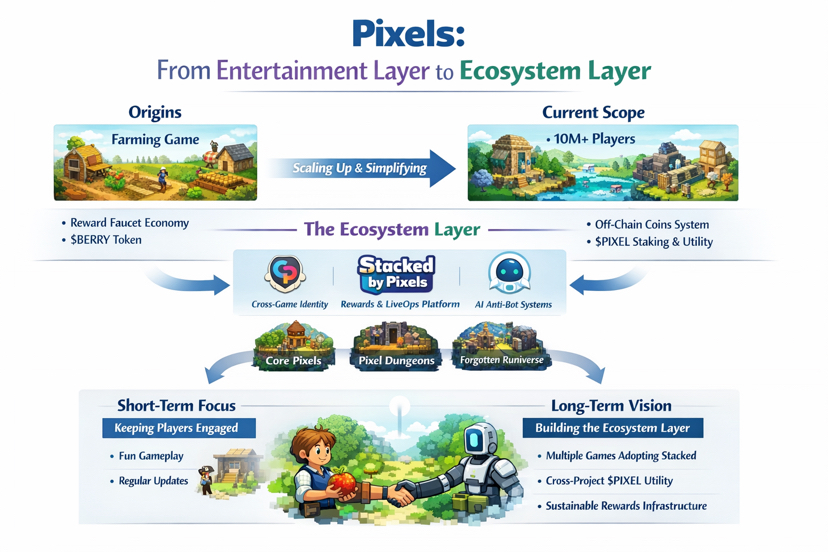
I find it helpful to ask why this angle is getting attention now instead of five years ago. Part of the answer is simple. Pixels has enough scale and enough live systems for people to take the broader thesis seriously. Ronin said Pixels surged past 1 million daily active users after migrating while the Pixels homepage now says the broader player base is over 10 million. Just as important the project has spent the last couple of years reworking its economy away from the older $BERRY setup. In its Chapter 2 FAQ the team said it wanted to phase out $BERRY protect $PIXEL reduce sell pressure and simplify the model by moving to an off-chain Coins system for routine play. That is a meaningful change in posture because it suggests the team no longer wants the game to be judged mainly as a reward faucet but as a place where rewards sit inside a more controlled economy.
The reason I think this matters is that Pixels is no longer asking $PIXEL to do just one job. In the old whitepaper $PIXEL was framed mainly as a premium in-game currency for things like pets skins faster build times and other optional boosts. More recent materials show a broader role. The staking help page says players can stake $PIXEL into different game projects and a May 2025 ecosystem update said more than 73 million $PIXEL had already been staked across Core Pixels Pixel Dungeons and Forgotten Runiverse. That same update described staking as a way for players to back games influence where visibility and resources go and feed data into future publishing and reward decisions. Then Ronin and Runiverse took it a step further by running an event where players could earn spend and claim $PIXEL inside Forgotten Runiverse itself. To me that is the real transition point because $PIXEL starts to look less like a premium currency for one world and more like a coordination asset across several worlds.
What surprises me is how openly Pixels now talks about turning its game lessons into infrastructure. In January the team said milestone rewards in the core game would be sunset and replaced with Stacked tasks and offers and that the ideal outcome was for most player earnings to come through Stacked. By March the AMA recap was describing Stacked as a platform other teams can use to optimize games rewards and incentive alignment with support intended for more than just Ronin titles. Later that month Ronin’s archive listed “Stacked by Pixels” as live and called it an AI-powered reward app for games while Pixels’ own launch post described it as both a player rewards app and a LiveOps engine for studios with Pixels Pixel Dungeons Sleepagotchi and Chubkins as the first wave. That is a very different ambition from simply making the farming MMO bigger. It is closer to turning rewarded play into a reusable system.
I think the logic here is stronger than it may look at first. Pixels has been unusually direct about what went wrong in earlier play-to-earn design such as fraud bad targeting weak attribution and rewards that encouraged extraction more than play. Its newer writing says the hard part was never putting assets onchain but managing incentive alignment and its game updates show the team reworking reputation and anti-bot measures using both onchain and in-game activity. If you believe rewarded play can work only when it is tightly measured and selectively deployed then Pixels is moving in a sensible direction. But the weak spot is just as clear. Most of this ecosystem is still early still closely tied to Pixels’ own orbit and still proving itself. The Stacked rollout is intentionally starting with first-party or near-first-party games which means the broader ecosystem claim remains partly aspirational until outside adoption becomes real and durable.
So my thesis is fairly simple. In the short term Pixels still lives or dies on whether the game stays engaging enough for people to care about any of this at all since that was true in the original economics docs and the team still says fun comes first. Over the longer term though I think the more important question is whether Pixels can become a genuine rewards and publishing layer for multiple games with PIXEL staking cross-game utility and Stacked all reinforcing one another. That is the version of the story market participants should probably watch not because it guarantees anything but because it changes what counts as evidence. I would care less about isolated bursts of activity and more about whether new games join whether reward systems look harder to exploit and whether $PIXEL becomes meaningfully useful outside one title. My read is that Pixels is at its most interesting right now not as a farming game trying to look bigger but as a game company trying to turn hard-earned operational knowledge into an ecosystem. If that works “ecosystem layer” will feel earned. If it does not Pixels may still be a notable game but the larger thesis will have stayed one layer too high.
