
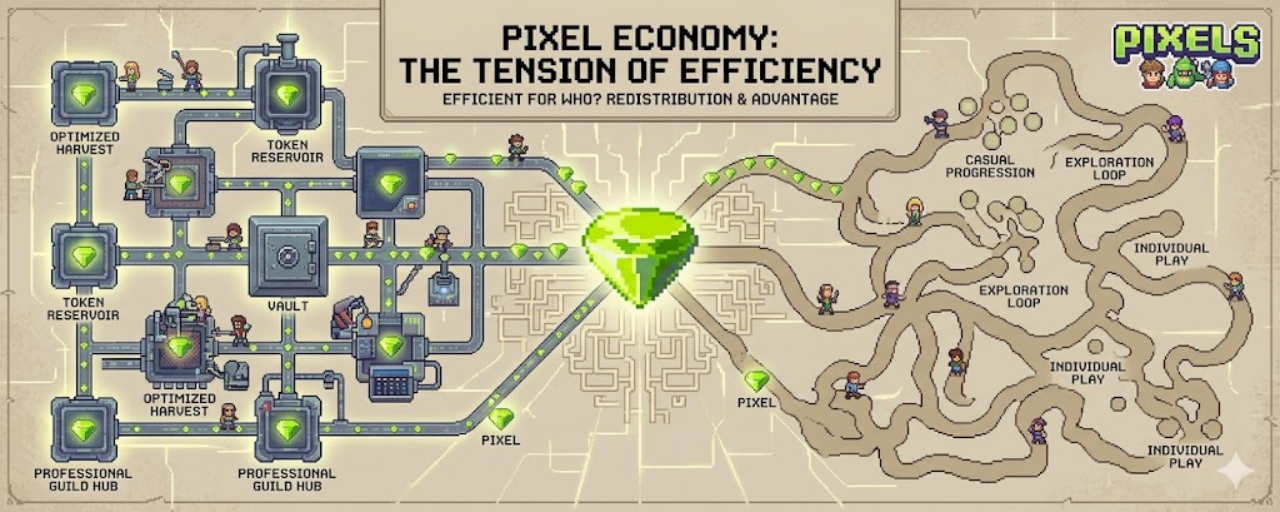
At first, efficiency sounded like an obvious win.
Smoother loops. Better systems. Less friction. More optimized paths for players to earn, progress, and stay engaged.
That all sounds good until you start asking a more uncomfortable question.
Efficient for who.
That question changes the entire reading.
Pixels has been evolving toward a world where more layers of gameplay, progression, and rewards connect more tightly. On the surface, that creates a better product. Less wasted motion. More clarity. More reasons for players to feel their time is being converted into something meaningful.
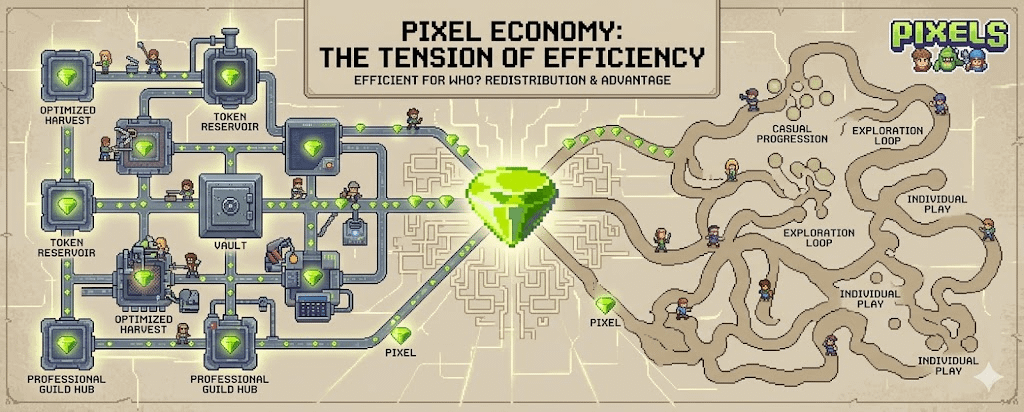
But efficient systems in token economies are never neutral.
They redistribute advantage.
The reason I keep circling back to this is simple. Efficiency does not just reduce friction for honest players. It also reduces friction for people who are best positioned to exploit structure. The more predictable a valuable loop becomes, the easier it is to optimize. The easier it is to optimize, the faster strong actors separate themselves from ordinary ones.
That separation is where things start to matter economically.
In a loose system, inefficiency acts like resistance. It slows extraction. It introduces randomness. It gives casual behavior room to coexist with optimized behavior without being completely crushed by it. But as a system becomes cleaner and more legible, it also becomes easier to map.
And mapped systems are easier to dominate.
That does not mean Pixels should stay messy. It means every gain in efficiency has a second-order effect that the surface narrative rarely talks about. Better coordination. Better planning. Better output. Those are not just quality-of-life improvements. In a token environment, they are changes to competitive positioning.
Some players benefit from cleaner design.
Others get outpaced by it.
That is why I think efficiency in PIXEL should never be read as purely positive. Not because efficiency is bad, but because efficient token systems tend to reward the people most capable of turning clarity into leverage.
And leverage compounds.
A player with more time, better coordination, better tools, or stronger economic discipline will extract more value from an optimized system than a casual player ever can. If enough of that advantage concentrates in one direction, then the economy starts feeling less like an open world and more like a structure that quietly favors those already closest to the optimal path.
That is the tension.
The game feels better.
But better design can also create sharper inequality inside participation.
I do not think Pixels is blind to this. In fact, I think this may be one of the reasons its evolution is worth watching more closely than people do. Because the project is no longer just dealing with user growth or token attention. It is dealing with the harder problem of how to make a system more efficient without making it economically narrower.
That is a much rarer challenge than most GameFi projects ever reach.
And it is probably where the real future of PIXEL gets decided.