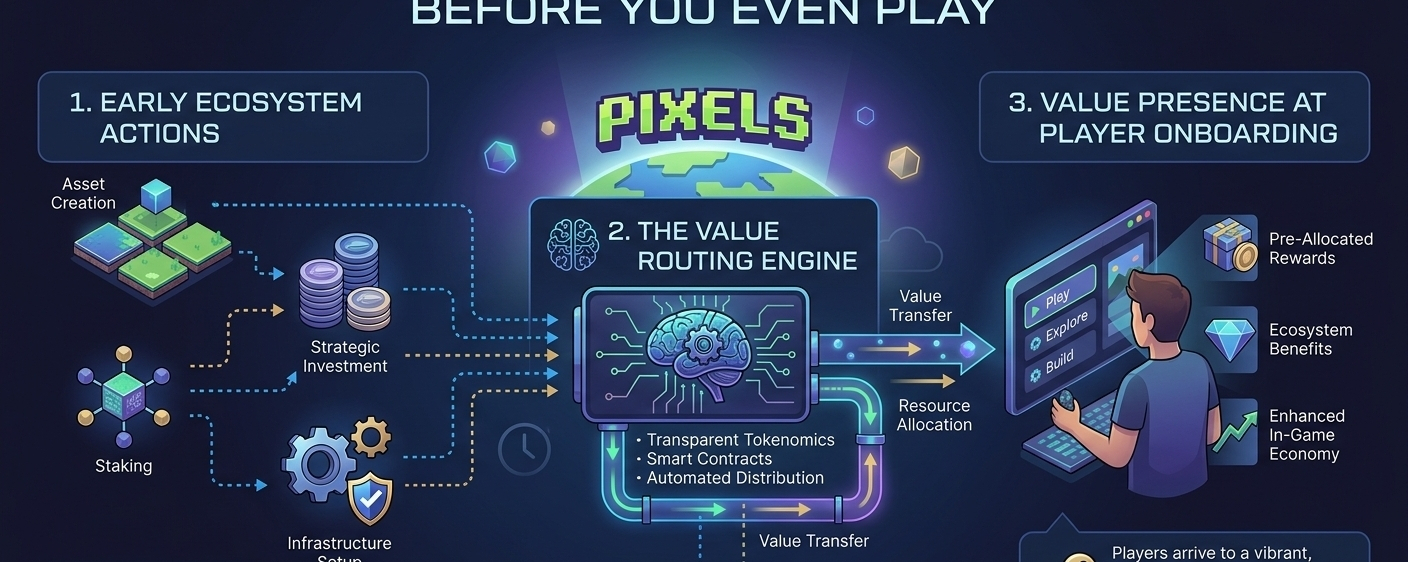
I spend most of my time looking at systems where user behavior, token flow, and infrastructure quietly shape each other, and Pixels is one of those cases where the surface experience hides a fairly tight economic design. When I look past the farming loop and the social layer, what I actually see is a controlled environment trying to solve a difficult problem: how to keep users engaged daily without letting the underlying token economy become unstable.
The first thing that becomes clear after some time is that Pixels is not optimizing for excitement—it’s optimizing for rhythm. The system nudges users into repeatable cycles that feel predictable enough to build habits. That predictability matters because it smooths out participation. When users behave in consistent intervals, the protocol can better manage emissions and sinks. But this comes with a trade-off. The more predictable a system becomes, the more it risks turning engagement into obligation. At that point, users are no longer exploring—they’re maintaining.
Running on Ronin plays directly into this. Low-cost, fast transactions allow the game to push a large number of small interactions without users feeling resistance. That’s not just a UX improvement; it fundamentally changes how the economy operates. When friction disappears, the limiting factor shifts from cost to design. The protocol has to actively prevent users from extracting too much value too quickly, because nothing in the infrastructure slows them down anymore. In Pixels, that control shows up in time gates, resource constraints, and progression pacing.
The farming system is the clearest example of this control. It looks simple, but it’s doing heavy lifting. Time becomes the main regulator of output, not effort. This equalizes production across users, which helps avoid concentration of rewards, but it also changes how users think. Instead of asking “what can I do better,” they start asking “when should I come back.” That shift sounds minor, but it’s important. It turns gameplay into scheduling, and scheduling is fragile. Once a user breaks the routine, re-entry feels less natural than initial onboarding.
I pay close attention to how tokens move through systems like this, and the PIXEL token behaves more like a pressure valve than a reward. Its role is to balance participation with sustainability. When players earn tokens, the system needs them to either spend or hold, not immediately exit. Whether that happens depends on how compelling the internal economy feels at any given moment. If progression feels meaningful, tokens circulate. If it doesn’t, they leak out.
What’s subtle here is that Pixels doesn’t rely purely on strong utility to drive that circulation. It also uses friction within progression. Advancing often requires spending, which creates a loop where users convert output back into capability. This can stabilize the system, but only as long as users believe that spending improves their position in a meaningful way. If that belief weakens, the same loop starts working in reverse—users extract instead of reinvesting, and the balance shifts quickly.
Another layer that’s easy to overlook is how state is managed. Not everything is pushed fully on-chain, and that’s a deliberate choice. Keeping critical assets verifiable while allowing flexible data to live off-chain reduces cost and keeps the system responsive. But it also introduces a boundary that most users don’t think about. As long as everything works, that boundary is invisible. When changes happen—especially ones that affect progression or assets—that’s when users start to notice what is and isn’t truly under their control.
Liquidity patterns around the token often reflect these internal dynamics more clearly than any external metric. When engagement is steady, token flows tend to recycle within the system. You see less aggressive selling because users still find value in staying engaged. When engagement softens, even slightly, that balance shifts. Sell pressure doesn’t spike dramatically—it just becomes more consistent. That consistency matters more than volatility because it signals a structural change in behavior rather than a temporary reaction.
The social layer is another area where the design reveals its priorities. Pixels presents itself as a shared world, but the incentives are still largely individual. Players optimize their own loops first, and interaction is optional rather than necessary. This keeps the system accessible, but it limits the formation of deeper economic relationships. Strong interdependence between players can create more resilient systems, but it also introduces complexity that can slow down adoption. Pixels leans toward simplicity, and you can see that in how loosely connected most player activities are.
Infrastructure stability also plays a quiet but important role. In a system built on frequent micro-interactions, consistency matters more than peak performance. Users may not track block times or validator behavior, but they immediately feel delays or inconsistencies. Even small disruptions can break the sense of flow that the game depends on. When the experience is built around routine, any interruption feels larger than it actually is.
What I find most telling is how the system behaves when nothing new is happening. During periods without updates or growth, the underlying structure is exposed. Users either continue their routines because the system still feels rewarding, or they gradually disengage. There’s no narrative to carry them through—only the mechanics. These quiet periods are where you can see whether the design holds up without external support.
There’s also a constant tension between intrinsic and reflexive value. Intrinsic value comes from the experience itself—the satisfaction of building, progressing, and interacting. Reflexive value comes from the expectation that others will continue to participate. Pixels operates somewhere in between. When the intrinsic side is strong, the economy stabilizes naturally. When it weakens, the system leans more on reflexivity, which is harder to maintain over time.
The longer I look at it, the more it feels like a system designed to operate within a narrow equilibrium. Too much activity, and emissions pressure builds. Too little, and liquidity thins out. Everything—from timers to costs to reward pacing—is tuned to keep the system inside that range. It’s not about maximizing growth at all times; it’s about avoiding extremes.
And that’s really what defines it for me. Pixels isn’t trying to solve for a perfect economy or a perfect game. It’s managing constraints—carefully, sometimes quietly—so that user behavior, token flow, and infrastructure remain in balance. Whether that balance holds doesn’t depend on any single feature. It depends on how all these small decisions interact when conditions change, especially when attention fades and only the structure is left doing the work.@Pixels #pixel $PIXEL