
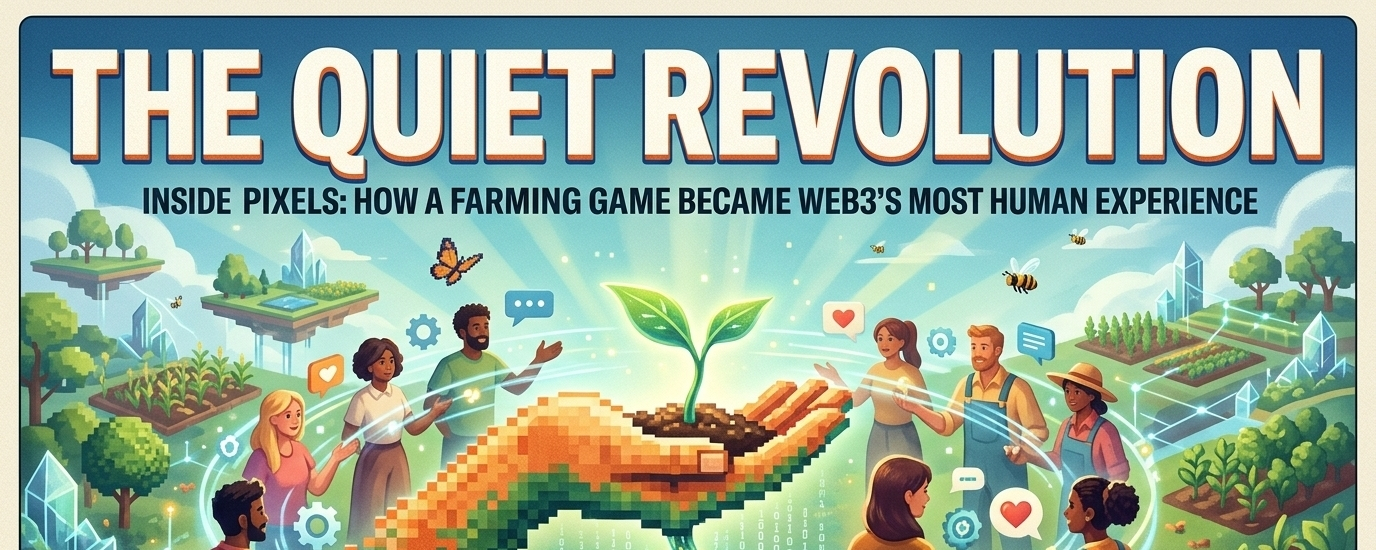
There’s something oddly poetic about the fact that one of the most talked-about Web3 games right now isn’t about war, speed, or dominationbut farming
Not futuristic combat. Not hyper-realistic shooters. Just soil, seeds, and a pixelated world where players slow down long enough to plant something and watch it grow
At the center of this unexpected movement is Pixels, a social, casual game built on the Ronin Network and powered by its native token, PIXEL
But describing it like that misses the point entirely
Because Pixels isn’t just a gameit’s an experiment in digital ownership, community behavior, and what happens when you remove the pressure and let players just exist.Why Pixels Feels Different From Most Web3 Games
Most Web3 games arrive with a promise: earn money while you play. And while that sounds appealing, it often leads to a strange outcomegames that feel more like jobs than entertainment
Pixels takes a different path
Instead of pushing players toward grinding or optimizing profits, it leans into something softer: curiosity
You log in, and instead of being bombarded with objectives, you find yourself wandering. Maybe you plant crops. Maybe you explore. Maybe you just chat with other players standing near a marketplace
It feels closer to games like Stardew Valley than anything traditionally associated with crypto
That shift matters
Because for the first time, a Web3 game is succeeding not because of its tokenomicsbut because people actually enjoy being there
The World: Simple on the Surface, Surprisingly Deep
At first glance, the world of Pixels looks deceptively basic. Pixel art. Small characters. Minimal animations
But spend an hour inside it, and the layers begin to reveal themselves
Land ownership isn’t just cosmeticit shapes your gameplay
Resources are interconnected, creating a subtle economic loop
Social spaces emerge organically, not through forced mechanics
What’s interesting is how the game avoids overwhelming players. It introduces systems slowly, almost casually. You learn by doing, not by reading long tutorials
And that design choice makes a huge difference
It lowers the barrier to entrynot just for gamers, but for people who’ve never touched Web3 before
Farming, But Make It Social
Farming in Pixels isn’t just about efficiency. It’s about rhythm
Plant, water, harvest
But unlike traditional farming simulators, you’re rarely alone
Players wander into your land. Conversations start. Trades happen. Sometimes, someone just stands there for a while, doing nothing in particular
That might sound insignificant, but it’s actually the core of the experienceBecause most online games are built around competitionPixels is built around presenceAnd that subtle shift changes everything.The Role of the PIXEL Token: More Than Just RewardsLet’s address the obvious questionyes, there’s a token
But here’s where things get interesting
In many Web3 games, tokens feel like the main attraction. Everything revolves around earning them
In Pixels, the token plays a quieter role
It exists, it mattersbut it doesn’t dominate the experience
You can use it for
Upgrading assets
Participating in the in-game economy
Unlocking certain features
But you’re not constantly thinking about it
That’s rare in the Web3 space
And it might be the reason Pixels has managed to attract both crypto-native users and complete newcomers without alienating either group
Built on Ronin Network Why That Matters
The choice of infrastructure isn’t just a technical detailits a strategic one
The Ronin Network, originally known for supporting Axie Infinity, is designed specifically for gaming. That means
Lower transaction fees
Faster interactions
A smoother user experience
In practice, this translates to something simple but crucial
You don’t feel like you’re using blockchain
And that’s exactly the point
Because the best technology is invisible
A Community That Feels... Real
Spend some time in Pixels, and you’ll notice something unusual
The community doesn’t feel transactional
There are players who help newcomers without expecting anything in return. Others organize informal events. Some just log in daily to check on their farms and chat
It feels closer to early MMORPG communities than modern competitive gaming environment
That sense of authenticity is hard to manufacture.It usually happens when a game gives players space instead of pressure
The Economy: Fragile, Evolving, and Fascinating
No Web3 game escapes the challenge of building a sustainable economy
And Pixels is no exception
What makes it compelling, though, is how transparent and dynamic the system feels
Prices fluctuate. Player behavior shifts. New strategies emerge
It’s less like a fixed system and more like a living organism
Sometimes that leads to imbalance. Sometimes it creates opportunity
But it always keeps things interesting
The Hidden Lesson: Slowing Down in a Fast Industry
The gaming industryand especially Web3 gamingis obsessed with speed
Faster gameplay. Faster rewards. Faster growth
Pixels quietly challenges that mindset
It invites players to slow down
To spend time on small tasks. To interact without urgency. To enjoy the process instead of chasing outcomes
That might sound simple, but in a digital world built on instant gratification, it’s almost radical
Where Pixels Could Go Next
The foundation is strong, but the future is still unwritten
There’s room for
Deeper crafting systems
Expanded land mechanics
More player-driven economies
Richer social features
The challenge will be maintaining what makes the game special while expanding its scope
Because scaling often comes at the cost of intimacy
And Pixels thrives on intimacy
Final Thoughts: A Game That Doesn’t Try Too Hard
There’s a quiet confidence in Pixels
It doesn’t scream for attention. It doesn’t overwhelm you with features. It doesn’t try to prove anything
And somehow, that’s exactly why it works
In a space crowded with ambitious promises and complex systems, Pixels succeeds by doing something surprisingly rare
It feels human
Not optimized. Not engineered for maximum engagement
Just… human
And if Web3 gaming has a future beyond speculation and hype, it probably looks a lot like thissimple worlds, real interactions, and experiences that people return to not because they have
