
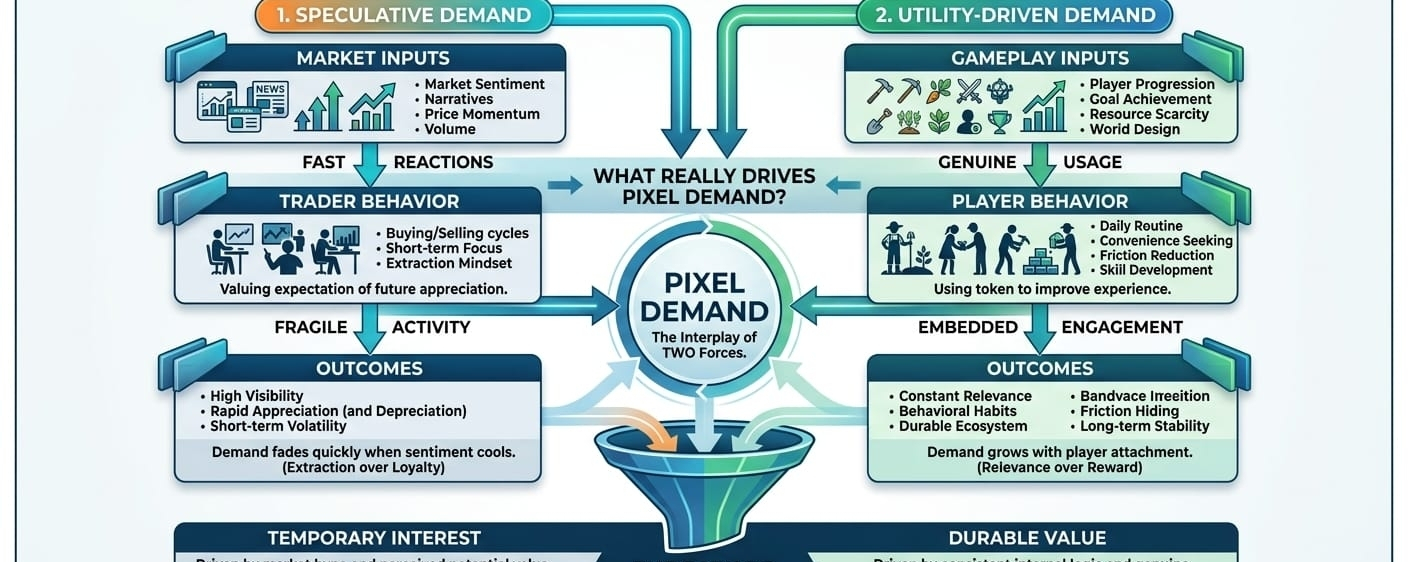
Most people still look at gaming tokens the same way they look at any other crypto asset. They watch the chart, follow the narrative, wait for momentum, and try to figure out whether attention is coming in or fading out. But to be honest, that way of thinking only tells part of the story.
A gaming token is not just something people buy and sell. At least, it should not be. The real value of a token like PIXEL is not only in whether the market is excited about it today. It is in whether players actually use it in ways that matter inside the game. That is a completely different kind of demand.
And that is why PIXEL is worth looking at more carefully.
With most crypto assets, speculation does a lot of the heavy lifting. Price moves create attention, attention creates volume, volume creates more conversation, and the cycle feeds itself. Gaming tokens are not immune to that. PIXEL also gets pulled into that same market behavior. When interest rises, people show up. When sentiment cools, many disappear. That part is normal.
But the deeper question is whether that attention turns into something more stable. Because speculation can create movement, but it does not automatically create meaning. It can bring people to the token, but it cannot guarantee they will care about the game, the economy, or the world behind it.
That is where the difference between short-lived demand and real demand starts to show.
Speculative demand is fast. It reacts to announcements, token narratives, momentum, and market mood. It is powerful, but it is also fragile. It does not ask whether the token is deeply useful. It only asks whether someone else might value it more later. That kind of demand can make a token look strong for a while, but it usually has very little loyalty behind it.
Utility-driven demand works differently. It grows when the token becomes part of how people actually play. Not because they are forced to touch it, but because it makes sense to use it. It helps them progress. It saves time. It improves convenience. It unlocks something desirable. It becomes part of the rhythm of the game.
That is the kind of demand that matters more in the long run.
And this is exactly why PIXEL should not be judged like an ordinary crypto asset alone.
If Pixels were just another tokenized product with a gaming wrapper around it, then speculation would probably remain the main story. But Pixels is trying to be more than that. It is building a world with routines, loops, social signals, and ongoing player behavior. In that kind of environment, utility is not a side detail. It is the foundation of whether token demand becomes sustainable or not.
A lot of Web3 games get this wrong. They build token demand around rewards first and player attachment second. That model can create fast activity, but the activity is often shallow. People come because there is something to farm. They stay only as long as the extraction feels worthwhile. The moment the reward weakens, the loyalty disappears because it was never really loyalty to begin with.
That is the real issue.
There is a big difference between a token people use because it helps them enjoy the game and a token people use because they are trying to pull value out before everyone else does. One creates an economy. The other creates pressure.
This is where PIXEL has to prove itself.
The token will always attract some speculative interest, and that is not necessarily a bad thing. Speculation brings visibility. It brings liquidity. It creates entry points. In some cases, it even helps people discover the game in the first place. But speculation should be the outer layer, not the core. If PIXEL demand depends too heavily on market excitement, then it becomes vulnerable to the same cycle that has hurt so many Web3 gaming projects before it.
Attention comes in fast. Expectations rise even faster. Then the token starts carrying more narrative weight than the game itself. Suddenly, every part of the economy gets judged through price. Players start acting like traders. The community becomes more sensitive to emissions than experience. And once that happens, it gets very hard to build something that feels like a real game world instead of a financial loop with art around it.
That is why utility matters so much, especially the kind of utility people often underestimate.
Convenience is utility.
Friction reduction is utility.
Better progression is utility.
Premium in-game advantages are utility.
Habitual usage is utility too.
These things may sound less exciting than a big token narrative, but they are often much stronger. Why? Because they shape behavior quietly and repeatedly. A player may speculate on PIXEL once, but if PIXEL consistently helps that player do meaningful things inside the game, then demand becomes more embedded. It stops being purely market-driven and starts becoming behavioral.
That is a huge difference.
Behavioral demand is harder to fake. It comes from repetition. A player logs in, wants to upgrade faster, wants access to better tools, wants smoother progress, wants to avoid friction, wants to keep building. If PIXEL sits naturally inside those actions, then the token gains relevance. Not abstract relevance. Lived relevance.
And that is what gaming tokens need more of.
The strongest token economies are usually not built on hype alone. They are built when usage becomes normal. When players stop thinking of the token as an external asset and start treating it as part of the game’s internal logic. That shift is subtle, but it changes everything.
Because once a token becomes part of habit, demand becomes more durable.
Habit is underrated in crypto gaming conversations. People talk a lot about tokenomics, emissions, sinks, and incentives, and those things do matter. But in practice, a player’s daily behavior matters just as much. Does the token fit naturally into the player’s loop? Does it improve how they play? Does it feel useful often enough to stay relevant? Or does it only matter when rewards are being distributed?
Those are the questions that separate temporary interest from actual economic depth.
To be completely honest, some projects confuse forced interaction with utility. They insert the token everywhere and assume that means demand has been created. But forced usage is not the same thing as real usefulness. If people only touch the token because the system makes them, that demand is artificial. It may keep the economy moving for a while, but it does not build conviction. Players can feel the difference between a token that helps them and a token that taxes them.
That is why the quality of utility matters more than the quantity of token touchpoints.
For PIXEL, the real opportunity is not just to be active inside Pixels, but to become genuinely relevant to the player experience. The token should feel like something that improves the way the world functions for the people who spend time there. It should support progression, deepen engagement, and create small but meaningful reasons to hold and use it beyond pure speculation.
That is where embedded value comes from.
Speculation makes a token visible. Embedded utility makes it stick.
And in gaming, sticking power is everything.
A token can trend for a week and still mean very little. But if it becomes part of how players move through the game over months, that is when it starts to matter in a deeper way. That is when the token stops being just a market object and starts becoming economic infrastructure.
I think that is the right lens for PIXEL.
Not just asking whether demand exists, but asking what kind of demand it is.
Is it demand built on hype, narrative, and short-term attention? Or is it demand built on relevance, convenience, progression, and repeated player behavior?
One fades quickly when sentiment turns. The other has a chance to survive ordinary conditions.
And that is probably the cleanest way to understand the token utility versus speculation debate around PIXEL. Speculation can help create awareness. It can pull people in. It can even amplify the story. But it cannot carry the economy forever. At some point, the token has to become useful in a way that players actually feel.
Because in the end, sustainable demand in a gaming token does not come from people merely believing it might go up.
It comes from people finding it genuinely worth using.
That is the difference between extraction and loyalty.
That is the difference between reward and relevance.
That is the difference between a token people trade and a token people actually live with inside a game world.
And for PIXEL, that difference may end up being the whole story.
