


This is a sharp take on the "Web3 Wall" that invisible barrier where the immersion of a game crashes into the reality of a ledger. You’ve highlighted the exact tension that defines the current era of decentralized gaming: we have mastered the aesthetic of "digital slow living," but we are still wrestling with the mechanical "micro-anxieties" of the blockchain handshake.
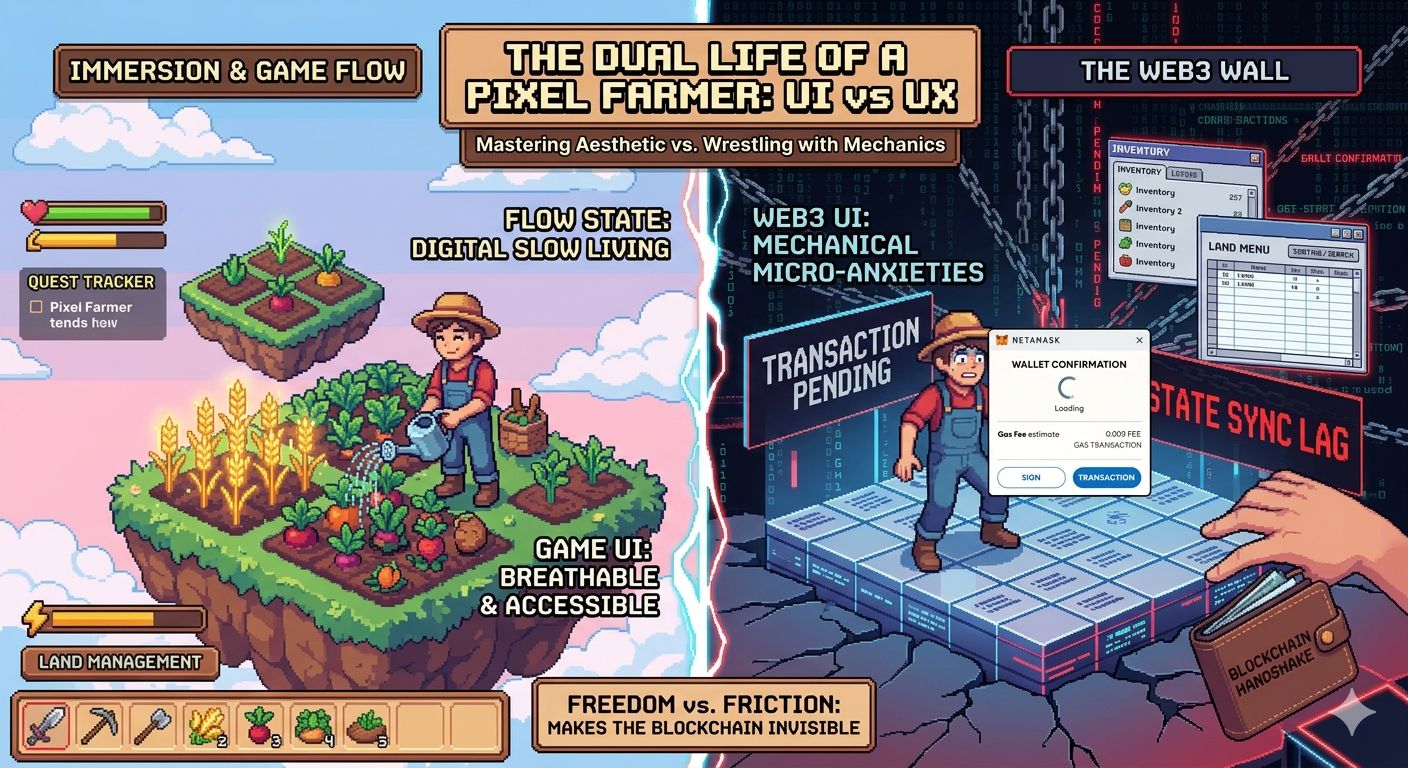
The most significant "freedom" Pixels offers is its zero-barrier entry. By ditching the standalone launcher, the game bypasses the first hurdle of Web3: the "trust fall" of downloading unknown software. This treats the player like a gamer first and a wallet-holder second.
Furthermore, the choice of 16-bit art isn't just a vibe; it’s a clarity tool. In a space where "high-fidelity" often leads to "unplayable lag," the Pixels UI stays breathable. The legible hotbar and quest tracker follow industry standards, though the simplicity of the art sometimes masks the complexity of the systems, leading to that "Keep the Wiki open"$ necessity.
However, as you noted, the "𝐟𝐥𝐨𝐰 𝐬𝐭𝐚𝐭𝐞" is the holy grail of gaming, and in Pixels, that flow is frequently interrupted by the Wallet Confirmation. This jarring transition from farmer to financier waiting for block confirmations creates a "state sync" lag that reminds you you’re interacting with a database, not just a world.
This friction increases as you scale. While the dashboard excels at the start, it begins to strain as resource loads grow. Without advanced sorting or search functionality, inventory management becomes a manual labor task that isn't part of the "fun" labor of the game. Similarly, land management menus currently lean toward the "spreadsheet" end of the spectrum, favoring power-user utility over intuitive design.
Pixels has successfully built a "𝐆𝐚𝐦𝐞 𝐔𝐈 " that people actually want to use. Now, the industry's collective task is to fix the "Web3 UI" to make the blockchain as invisible as the server code in a traditional MMO. We are tolerating the friction because the freedom of the core loop is worth it.